
Makeup
What’s at the Center of the Milky Way?
Jul
Every city has a downtown. Ours has traffic, coffee shops, and at least one person walking too slowly in front of you. The Milky Way’s downtown is a little different: it has a supermassive black hole, a crowded swarm of stars, immense clouds of gas and dust, powerful magnetic fields, stellar explosions, and enough cosmic drama to make a soap opera look underwritten.
So, what is at the center of the Milky Way? The short answer is Sagittarius A*, pronounced “Sagittarius A-star,” a supermassive black hole with a mass roughly four million times that of the Sun. But that answer is only the opening scene. The galactic center is not one lonely black hole sitting in an empty parking lot. It is one of the busiest, strangest, and most difficult-to-observe regions in the universe.
Located roughly 26,000 light-years from Earth in the direction of the constellation Sagittarius, the center of our galaxy is hidden behind thick curtains of interstellar dust. Luckily, astronomers are a stubborn bunch. They use radio waves, infrared light, X-rays, and other wavelengths to peer through the cosmic fog and investigate what is happening in the Milky Way’s most crowded neighborhood.
The Short Answer: Sagittarius A* Is at the Galactic Center
At the heart of the Milky Way sits Sagittarius A*, often shortened to Sgr A*. It is the supermassive black hole at the center of our galaxy. A black hole is not a giant vacuum cleaner roaming through space and slurping up everything in sight. It is a region where gravity is so strong that, beyond a boundary called the event horizon, not even light can escape.
Sagittarius A* is enormous by black hole standards, yet surprisingly quiet compared with the ravenous black holes found in some distant galaxies. Many active galactic centers shine brightly because their black holes are consuming large amounts of gas and dust. Sagittarius A*, by contrast, is more like a giant bear that occasionally wakes up, yawns in X-rays, and goes back to sleep.
That does not make it boring. The material around Sgr A* produces flashes of radiation, and astronomers have observed flares that change on short timescales. These bursts offer clues about hot gas, magnetic fields, and matter moving close to one of the most extreme gravitational environments we can study.
How Do Scientists Know There Is a Black Hole There?
Astronomers cannot simply point a telescope at Sagittarius A* and snap a normal photograph of a black hole. Black holes do not emit visible light, which is inconvenient but very on-brand for something called a black hole. Instead, scientists look at the behavior of nearby stars and gas.
Stars Orbiting an Invisible Giant
For decades, teams of astronomers have tracked stars racing around the galactic center. One famous star, called S0-2 or S2, completes an orbit around Sagittarius A* in about 16 years. That is astonishingly fast for a star orbiting the center of a galaxy. The star’s motion reveals that an invisible object with millions of times the Sun’s mass is packed into an extremely small region.
There are not many reasonable explanations for that much mass squeezed into such a tiny volume. A cluster of ordinary stars would not remain stable. A giant collection of dark objects would eventually collide, merge, or spread out. A supermassive black hole is the explanation that fits the evidence best.
Observations of S0-2 and other nearby stars have also helped test Einstein’s theory of general relativity. As these stars sweep past the black hole, their motion reflects the effects of intense gravity on space and time. In other words, the Milky Way has kindly provided physicists with a natural laboratory where the equipment is free, although the commute is terrible.
The Event Horizon Telescope Image
In 2022, the Event Horizon Telescope collaboration released the first image of Sagittarius A*. The image showed a glowing ring of hot material surrounding a dark central region: the black hole’s shadow. The result was a major scientific achievement because Sagittarius A* is relatively small in the sky and changes quickly compared with the much larger black hole imaged in galaxy M87.
The Event Horizon Telescope did not use one gigantic dish the size of a planet, because building that would require an alarming amount of scaffolding. Instead, it linked radio observatories around Earth to create a virtual telescope with planet-scale resolution. The image gave astronomers direct visual evidence that the compact object at the Milky Way’s center behaves like a black hole predicted by general relativity.
The Galactic Center Is More Than a Black Hole
It is tempting to imagine Sagittarius A* as the only important thing at the center of the Milky Way. In reality, it is surrounded by a wildly complex cosmic environment. Think less “single object in space” and more “crowded city center during a festival, except everyone is made of plasma.”
A Dense Nuclear Star Cluster
Near Sagittarius A* is a nuclear star cluster packed with stars. Some are old and evolved, while others are young, massive, and surprisingly close to the black hole. Astronomers are still trying to understand how certain young stars formed in such a harsh environment, where strong gravity, radiation, and stellar winds make the neighborhood less welcoming than a blender full of gravel.
These stars are crucial because their orbits act like visible markers around an invisible gravitational object. By tracking them over time, astronomers can measure the black hole’s mass, map its gravitational influence, and search for subtle deviations that might reveal new physics.
Gas, Dust, and the Galactic Mini-Spiral
The inner region of the Milky Way contains hot gas, cold dust, ionized clouds, and streams of material that loop around the black hole. Radio and infrared observations reveal a structure sometimes called the galactic mini-spiral. It is not a neat, polished spiral like the picture on a cereal box. It is a tangled system of gas streams shaped by gravity, radiation, shocks, and magnetic fields.
Some gas circles Sagittarius A* in a dusty ring-like structure. Other material appears to be falling inward, while some is pushed away by energetic outflows. This constant tug-of-war helps explain why Sgr A* remains relatively dim. Much of the available gas may not actually cross the event horizon. Instead, it can heat up, swirl around, and get blown outward before the black hole gets a proper meal.
Star Nurseries Near the Galactic Center
The central region is also home to major star-forming clouds, including Sagittarius B2, one of the most active stellar nurseries in the Milky Way. This enormous molecular cloud lies a few hundred light-years from Sagittarius A* and contains dense gas, warm dust, young stars, and the ingredients needed for future generations of stellar troublemakers.
Studying these clouds helps astronomers understand how stars form under extreme conditions. The galactic center has stronger radiation, greater turbulence, and more intense magnetic fields than the quieter regions around the Sun. It is an environment where ordinary star-formation rules may need extra footnotes.
Dead Stars and Exotic Objects
The Milky Way’s center also contains stellar remnants: neutron stars, black holes, supernova remnants, and compact objects that would make excellent villains in a science-fiction movie. Astronomers have detected a magnetar, a type of neutron star with an incredibly powerful magnetic field, relatively close to Sagittarius A*.
There is also evidence that many smaller black holes may exist near the galactic center. This makes sense because massive stars live fast, burn bright, and often end dramatically. Over billions of years, the central region may have accumulated a population of compact remnants orbiting the supermassive black hole.
Why Is Sagittarius A* So Quiet?
For a black hole with the mass of four million Suns, Sagittarius A* is oddly restrained. It is not currently blazing like a quasar, and it is not devouring stars every Tuesday. Scientists believe this is largely because it does not have a steady supply of gas falling into it at high rates.
When gas approaches a black hole, friction and magnetic forces can heat it to extreme temperatures. Hot gas produces radiation, especially in X-rays and radio waves. But around Sagittarius A*, much of that gas may be expelled in winds or trapped in unstable flows rather than plunging directly across the event horizon.
Still, “quiet” is not the same as inactive. Sagittarius A* produces flares, and studies of reflected X-rays from nearby gas clouds suggest that it may have been brighter in the relatively recent past. In cosmic terms, “recent” can mean a few centuries, which is an excellent reminder that astronomers and calendars do not always get along.
Does the Black Hole Control the Entire Milky Way?
Not exactly. Sagittarius A* dominates gravity in its immediate neighborhood, but it does not act like a galactic puppet master pulling every star by a string. The Milky Way contains hundreds of billions of stars, enormous gas clouds, dark matter, and a central bulge. Together, all that mass shapes the galaxy’s overall structure and rotation.
The Sun orbits the center of the Milky Way, but not because Sagittarius A* alone is dragging it around. Our solar system moves under the combined gravitational influence of the galaxy’s mass. The black hole matters enormously near the center, yet on the scale of the entire Milky Way, it is only one part of a much larger gravitational system.
That distinction matters because it prevents a common misconception: if Sagittarius A* suddenly vanished, the stars near it would be dramatically affected, but the outer galaxy would not instantly fly apart like someone cut the power to a cosmic ceiling fan.
Could Sagittarius A* Ever Threaten Earth?
No. Sagittarius A* is far too distant to pose a danger to Earth. It is about 26,000 light-years away, and the Sun is safely orbiting far from the galactic center. Even if Sgr A* became more active, any direct effects would be concentrated much closer to the black hole.
Black holes are dangerous only when you get extremely close to them. Earth is not close. In fact, we are so far away that the light we see from the galactic center today began its journey before humans had invented agriculture. That is not just socially distant. That is “please do not expect a quick reply” distant.
What Scientists Still Want to Know
Despite decades of observations, the center of the Milky Way remains full of mysteries. Astronomers are still investigating how Sagittarius A* formed, how quickly it spins, why it consumes so little material, and whether it has experienced powerful outbursts in the past.
Researchers also want to understand the strange population of young stars near the black hole, the role of magnetic fields in directing gas flows, and the number of hidden black holes and neutron stars in the region. New observations from the James Webb Space Telescope, radio arrays, X-ray missions, and future extremely large telescopes should reveal more details.
The center of the Milky Way is not a finished story. It is a live investigation happening 26,000 light-years away, with every new observation adding a clue and occasionally making the universe seem even weirder than before.
Experiencing the Milky Way’s Center From Earth
Most people will never see Sagittarius A* directly with their eyes, and that is perfectly normal. The black hole is hidden behind dense dust clouds, and even powerful telescopes need special wavelengths of light to study it. Still, you can experience the direction of the Milky Way’s center in a surprisingly personal way from Earth.
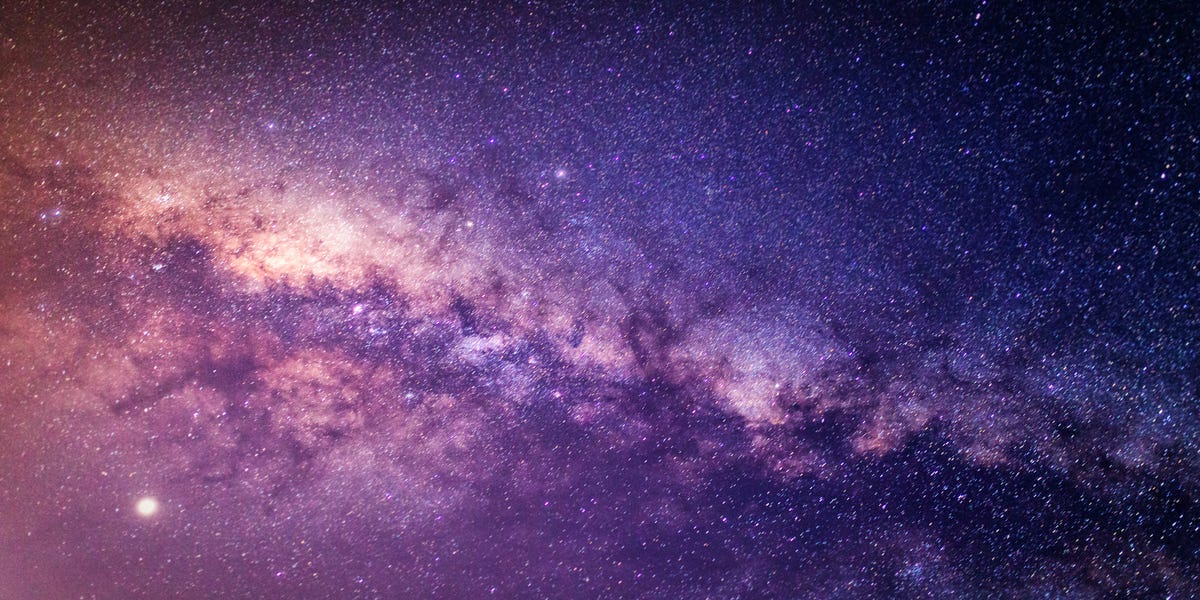
On a dark summer night in the Northern Hemisphere, look toward the southern sky and find the constellation Sagittarius. The galactic center lies in that general direction. You will not see a giant black hole hovering above the horizon with a neon sign that says “Welcome to Downtown Galaxy.” What you may see is the Milky Way itself: a pale, cloudlike band crossing the sky, thick with stars and interrupted by dark lanes of dust.
That view can be humbling. The bright, crowded part of the Milky Way near Sagittarius is not merely a pretty background for camping photos. You are looking toward the central hub of the galaxy, where immense gravitational forces shape the orbits of stars and where hidden structures glow in radio waves, infrared light, and X-rays.
Binoculars can make the experience even better. They will not reveal Sagittarius A* itself, but they can show dense star fields, clusters, and nebulae in the Sagittarius region. The Lagoon Nebula, Trifid Nebula, and other deep-sky objects are all located in the broad direction of the galactic center. Each one is a reminder that our line of sight passes through a crowded stretch of the Milky Way.
A planetarium visit can also transform the idea of the galactic center from an abstract diagram into a spatial experience. When you see the Milky Way projected across a dome, it becomes easier to understand that Earth is not outside the galaxy looking in. We live inside the disk, embedded in one of its spiral arms, watching the galaxy from a seat with excellent atmosphere but terrible visibility through dust.
There is another kind of experience available through astronomy images. Compare a visible-light photograph of the galactic center with an infrared or radio image. In visible light, much of the central region looks blocked and dark. In infrared and radio wavelengths, the dust becomes more transparent, revealing stars, warm clouds, filaments, and structures near Sagittarius A*. It feels a little like switching from an old flashlight to a medical scanner and discovering that the wall in front of you is not the end of the room.
Following discoveries about the galactic center can be just as memorable as looking at the sky. The first image of Sagittarius A* made a distant black hole feel strangely tangible. It was not a cartoon, not an artist’s guess, and not a Hollywood portal. It was data gathered by telescopes around Earth, transformed into an image of a real object at the center of our own galaxy.
The most meaningful experience may be simply pausing under a dark sky and realizing what the Milky Way represents. Every star you see is part of a vast structure that has been evolving for billions of years. Somewhere in the direction of Sagittarius, a supermassive black hole anchors a crowded and energetic galactic core. Meanwhile, you are standing on a small planet, around an ordinary star, in a quiet outer neighborhood of the same enormous cosmic city.
That is a pretty good view for a species that once thought the universe might revolve around Earth.
Conclusion
The center of the Milky Way is home to Sagittarius A*, a supermassive black hole with a mass around four million times that of the Sun. But the real answer is richer than one headline-grabbing object. Around the black hole is a dense nuclear star cluster, streams of gas, dusty molecular clouds, young stars, magnetic fields, stellar remnants, and clues to the history of our galaxy.
Sagittarius A* may be quiet compared with the blazing black holes in active galaxies, but it remains one of astronomy’s most valuable laboratories. By watching stars orbit an invisible giant, mapping gas flows, detecting X-ray flares, and studying the black hole’s shadow, scientists are learning how gravity behaves under extreme conditions and how galaxies evolve over time.
The Milky Way’s center is not just a faraway mystery. It is the hidden heart of our cosmic home.
Editorial note: This publication-ready article was informed by astronomy research and educational materials from NASA, NASA JPL, NASA Webb, Chandra X-ray Observatory, the National Science Foundation, NRAO, Keck Observatory, UCLA, the University of Chicago, Caltech/IPAC, STScI, Carnegie Science, the National Academies, Sky & Telescope, and the Nobel Prize. No outbound source links are included in the article body.

