
Beauty Tools & Accessories
This FB Page Shares Fascinating Historical Photos, And Here Are 50 You Might Not Have Seen Before
Jun
History textbooks are excellent at providing dates, treaties, wars, and the occasional portrait of a statesman who looks deeply offended by indoor lighting. Historical photographs do something different. They show people dancing in the street, trying new technology, showing off outrageous clothes, working ordinary jobs, and occasionally riding a high-wheel bicycle down the steps of the United States Capitol.
The Facebook page “Undiscovered History” collects fascinating historical photos that place viewers unusually close to the past. Instead of presenting history as a parade of famous speeches, the page highlights nurses, shopkeepers, students, immigrants, soldiers, families, celebrities, pets, factories, and fashion choices that were apparently made without consulting anyone who could say, “Maybe 81 scooter lights are enough.”
The 50 rare historical photos below cover more than a century of human experience. Some document major events, while others preserve moments that probably felt completely ordinary when the shutter clicked. Together, they remind us that the past was not lived in black and white. It was noisy, colorful, awkward, funny, frightening, and filled with people who worried about work, hugged their children, loved their dogs, and took self-portraits long before social media gave the activity a name.
Why Old Photographs Make History Feel Real
Photography changed the historical record by preserving details that written accounts often overlook. A grocery shelf can reveal how people shopped. A family dinner can show housing conditions, clothing, tableware, and relationships. A street portrait can document local businesses, architecture, hairstyles, and neighborhood pride in a single frame.
By the late 19th century, roll-film cameras were making photography increasingly accessible to amateurs. Snapshots gradually moved the camera away from studios and formal ceremonies and into beaches, kitchens, sidewalks, classrooms, and family vacations. That shift created an enormous visual record of everyday life.
Modern archives now preserve millions of photographs, negatives, slides, albums, and digital files. Yet social media pages can introduce these materials to audiences who might never search a museum database. The result is valuable, but it comes with one important warning: viral captions are not automatically reliable. Dates can be misremembered, locations can be guessed, and entertaining stories can spread faster than careful research.
50 Fascinating Historical Photos Worth a Closer Look
Everyday Lives and Unforgettable Personal Moments
- An obstetrical nurse at the beginning and end of her career: Two portraits taken 42 years apart transform an ordinary employment record into a moving visual biography.
- A proud Harlem grocer in 1937: Standing outside his carefully arranged store, the owner represents entrepreneurship, neighborhood service, and the dignity of independent work.
- A little girl posing with three owls in 1925: The mysterious companions turn a childhood portrait into something resembling an unusually polite fairy tale.
- A couple dancing in New York City in 1979: Their spontaneous street performance captures joy without a stage, choreography, or apparent concern for passing traffic.
- Friends enjoying the beach during the 1940s: The swimsuits have changed, but the cheerful group pose would fit comfortably into a modern vacation album.
- A mother and daughter making faces around 1900: Their playful expressions challenge the stereotype that everyone in early photography spent life looking solemn and mildly haunted.
- A father helping a child ride a bicycle in Central Park: Photographed in 1973, the scene captures a familiar mixture of trust, concentration, and parental panic.
- Two women relaxing on a Harlem fire escape in 1978: The narrow platform becomes a neighborhood balcony, conversation room, and front-row seat to city life.
- A young East Harlem girl photographed between 1947 and 1951: Her confident stance gives a neighborhood documentary image the presence of a formal portrait.
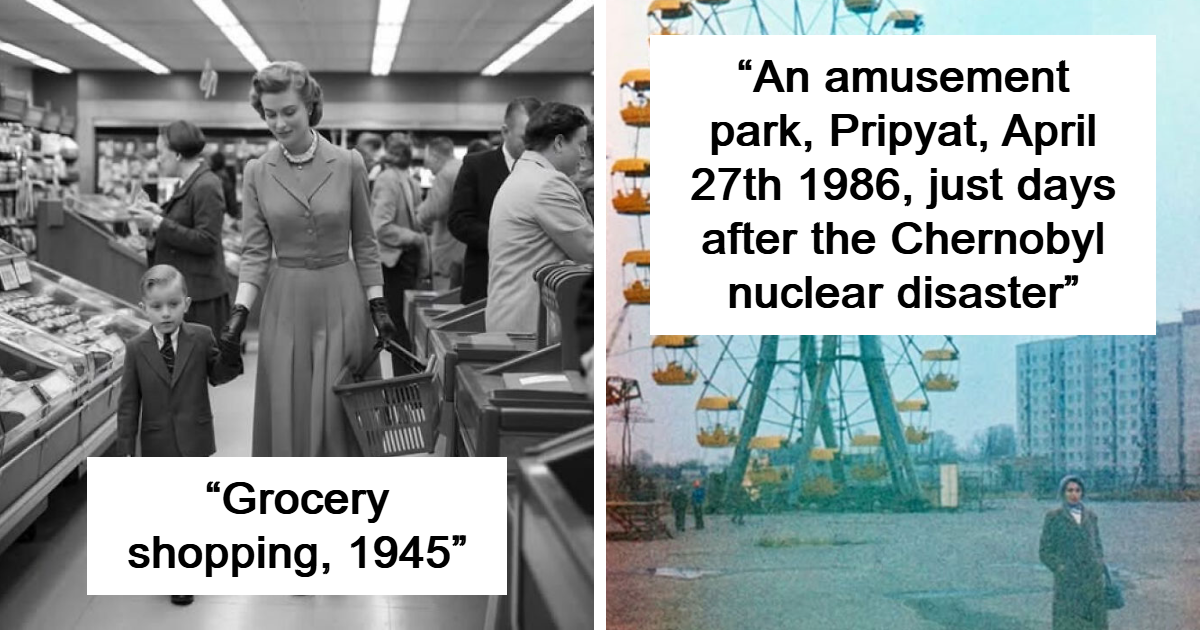
- A family grocery shopping in 1945: Clothing, packaging, store displays, and shopping habits make this seemingly simple image a compact social-history lesson.
Science, Technology, Design, and Delightfully Strange Machines
- Katherine Johnson at work: The NASA mathematician calculated trajectory data for Alan Shepard’s 1961 Freedom 7 mission and helped make American spaceflight possible.
- A boy seeing television through a store window in 1948: His intense attention recalls an era when television was astonishing technology rather than background noise.
- A 1963 split-window Chevrolet Corvette: The distinctive rear window, airport setting, and polished styling create a concentrated dose of mid-century automotive glamour.
- A surfer carrying a massive wooden board in 1914: Early surfing required enthusiasm, balance, and the upper-body strength of someone relocating a dining-room table.
- A Great Dane riding in a Hollywood sports car in 1961: The dog occupies the passenger seat with the calm authority of a celebrity arriving late.
- The General Motors Technical Center reception area in 1965: Futuristic furniture and architecture show how mid-century designers imagined the office of tomorrow.
- Shigeru Miyamoto holding a Game Boy in 1992: The influential game designer appears with technology that helped make portable gaming a global phenomenon.
- Cars on Fiat’s rooftop test track in Turin: The Lingotto factory sent completed vehicles upward through production floors before testing them on the roof.
- A 1951 mirror self-portrait: It looks surprisingly modern, although photographic self-portraits had already existed for more than a century.
- A teenager’s mirror-covered Vespa in 1983: With 34 mirrors and 81 lights, the scooter proves that customization can continue long after moderation has left the building.
War, Migration, Survival, and Political Change
- A soldier returning to his daughter after World War II: Her run toward his open arms compresses separation, uncertainty, and relief into one powerful instant.
- An East German guard offering a flower through the Berlin Wall in 1989: The small gesture contrasts sharply with the concrete symbol dividing the city.
- An immigrant family looking toward New York from Ellis Island: Their luggage and distant skyline suggest hope, exhaustion, uncertainty, and the beginning of an unfamiliar life.
- A Marine holding a dog in Vietnam in 1971: The animal provides a moment of tenderness within the emotional strain of wartime service.
- An Italian soldier feeding a child in Mogadishu in 1993: The image isolates a personal act of care within the larger violence and instability of conflict.
- A family living in a tent near Alexandria, Louisiana: Their temporary shelter records the harsh housing insecurity experienced by many struggling rural families.
- Chernobyl cleanup workers near the damaged reactor: The photograph documents the hazardous work performed after the catastrophic nuclear accident of April 1986.
- A sailor’s extraordinary leave request from 1967: The handwritten explanation reveals how family events and military bureaucracy sometimes met on the same sheet of paper.
- A young woman near Pripyat’s amusement park after the Chernobyl disaster: Such images require careful verification, but their eerie settings symbolize a city abruptly abandoned.
- Roald Dahl walking with Ernest Hemingway in wartime London: The 1944 encounter joins two famous writers whose reputations would later become far larger than the sidewalk.
Fashion, Entertainment, and People Who Understood the Assignment
- Three sharply dressed Harlem children in 1970: Their coordinated suits and confident walk could make a modern fashion campaign reconsider its entire budget.
- A woman matching pink platforms and bell-bottoms to her pink Volvo: The 1973 ensemble demonstrates commitment to a color palette at an advanced professional level.
- Three female Bauhaus students in Dessau in 1927: Their playful appearance reveals the informal human side of an enormously influential design school.
- Harrison Ford and Karen Allen making Raiders of the Lost Ark: The behind-the-scenes photograph captures two stars during production of the 1981 adventure classic.
- Jane Seymour photographed in 1978: The relaxed portrait reflects the softer styling associated with late-1970s fashion and celebrity photography.
- A United Airlines flight attendant in 1970: The uniform, rotary telephone, and interior design create a time capsule of commercial aviation.
- A Los Angeles officer posing with flappers: The group portrait brings law enforcement and rebellious 1920s fashion together in one cheerfully awkward arrangement.
- A silver Christmas tree in a 1950s home: Metallic branches and bright ornaments show that holiday decorating has always welcomed a little theatrical excess.
- Hermosa Beach in the summer of 1978: A weathered car, casual clothing, and California sunlight produce a scene that feels like an album cover.
- Disneyland employees eating together in 1961: Costumed performers waiting in a cafeteria line reveal the wonderfully practical backstage reality of manufactured fantasy.
Architecture, Landscapes, and Places Transformed by Time
- Multnomah Falls in Oregon in 1918: Early automobiles and formally dressed visitors show how tourism changed while the waterfall remained unmistakable.
- Chichén Itzá in 1892 and today: The comparison demonstrates how excavation, restoration, tourism, and vegetation can dramatically reshape the appearance of an archaeological site.
- The Shambles in York, then and now: The narrow medieval street is frequently compared with Diagon Alley, although claims of direct inspiration remain disputed.
- The Vienna Court Opera in 1902: Pedestrians, parasols, carriages, and monumental architecture create a street scene from the final decades of imperial Vienna.
- Architects dressed as their own buildings in 1931: William Van Alen appears as the Chrysler Building in what may be architecture’s most ambitious costume party.
- A high-wheel bicycle descending the Capitol steps in 1884: The rider combines athletic ability, questionable judgment, and an impressive absence of visible protective equipment.
- Gustave Eiffel exploring his completed tower in 1889: The exposed stairs and dizzying height emphasize the engineering boldness of the Paris landmark.
- A fountain frozen solid in Detroit in 1917: Two observers stand beside an enormous tower of ice created by a winter that had clearly become personal.
- A timber railroad structure in early-1900s Oregon: The temporary construction illustrates the speed and ingenuity of logging operations in difficult terrain.
- A child photographed beside a window in 1913: Light, clothing, and posture turn an unidentified boy into a haunting representative of an otherwise undocumented life.
How to Enjoy Rare Historical Photos Without Being Fooled
Historical-photo pages are excellent starting points, but a caption should be treated as a clue rather than a final verdict. Begin by checking whether the image appears in a museum, university, newspaper, government archive, or photographer’s collection. Reliable catalog records often identify the creator, date, location, original caption, photographic process, and ownership history.
Next, look closely at the image itself. Clothing, cars, signs, architecture, film characteristics, and printed markings can confirm or contradict a proposed date. Reverse-image searches may reveal that a photograph originally came from a different country or decade. Cropping also matters: a viral version may remove a sign, photographer’s credit, or surrounding detail that changes the interpretation.
Context is equally important. A compelling photograph does not always represent a typical experience. A glamorous airline advertisement may have been staged. A humorous street scene may record a special event rather than ordinary behavior. Documentary images may also reflect the photographer’s assignment, choices, and institutional purpose.
None of this makes old photographs less enjoyable. In fact, investigation adds another layer of fascination. The goal is not to drain the fun from history. It is to keep an amusing caption from quietly turning into a fictional fact repeated by 40,000 enthusiastic commenters and one extremely confident uncle.
Conclusion: The Past Was More Human Than We Remember
These fascinating historical photos work because they replace abstraction with recognizable emotion. We understand the pride of the grocer, the excitement of the boy watching television, the relief of the returning soldier, and the confidence of someone who matched an entire outfit to a Volvo.
Great historical images do not merely show how the world looked. They reveal how people occupied it: working, inventing, surviving, celebrating, posing, experimenting, and occasionally turning a factory roof into a racetrack. The technology changes, but the human behavior remains wonderfully familiar.
What Exploring Historical Photos Feels Like: A Personal Viewing Experience
Exploring a large collection of rare historical photos is different from reading a traditional timeline. A timeline encourages you to move forward in an orderly fashion. A photo collection sends you bouncing from a Harlem storefront to a German design school, then to a rooftop automobile track, a Louisiana tent, and a 1970s living room decorated with a silver Christmas tree. It is less like attending a lecture and more like opening 50 mysterious doors in a hallway.
The first experience is usually recognition. Even when the clothes, technology, and surroundings are unfamiliar, the body language makes sense. The nurse smiling at the end of a long career looks like someone proud of work that mattered. The father steadying a bicycle looks like every parent trying to appear calm while preparing to sprint. Friends at the beach lean toward one another exactly as friends do now. The distance between past and present suddenly becomes much smaller.
Then comes curiosity. A single detail starts asking questions. What products were sold in that grocery store? How heavy was the wooden surfboard? Why did early televisions attract crowds outside appliance shops? Did the teenager with 81 scooter lights have access to a second battery, or was he powered entirely by optimism? Good historical photography encourages research because it makes the past specific enough to investigate.
Another striking experience is realizing how selective popular history can be. Major events deserve attention, but people did not spend every day signing treaties or standing beside famous leaders. They cooked dinner, waited for transportation, went swimming, decorated homes, worked reception desks, and took pictures of their pets. These ordinary activities are not distractions from history. They are the substance of it.
The emotional shifts can also be abrupt. One photograph may be charming, while the next documents war, poverty, migration, or disaster. That contrast discourages the easy belief that the past was universally simpler or better. Nostalgia can make vintage cars, clothing, and storefronts look attractive, but photographs also preserve segregation, unsafe labor, inadequate housing, political division, and the human cost of conflict.
Finally, historical-photo collections change the way you view your own pictures. Today’s casual image of a kitchen, neighborhood shop, family gathering, or workplace may eventually become valuable because of details nobody currently considers important. The brand on a package, the design of a phone, the price on a sign, or the shape of a building could help future viewers understand how people lived.
That may be the most rewarding lesson of the experience: history is constantly being photographed before anyone realizes it is history. Most meaningful images begin as ordinary moments. Time performs the final edit.
SEO Tags

