
Beauty Tools & Accessories
Talk Your Book: Fixing Fixed Income
Jul
Fixed income has one of finance’s most misleading names. The “income” may be scheduled, but almost everything surrounding itprices, yields, credit spreads, liquidity, taxes, and investor emotionsmoves constantly. A bond portfolio can therefore look calm on a monthly statement while hiding enough complexity to make a spreadsheet quietly beg for retirement.
That contradiction was at the center of the 2022 Animal Spirits episode “Talk Your Book: Fixing Fixed Income.” Hosts Michael Batnick and Ben Carlson spoke with Russell Feldman, CEO of fixed-income technology company IMTC, about the differences between trading stocks and bonds, portfolio analytics, allocation, optimization, and risk management. The larger message remains relevant: improving bond investing requires more than choosing securities with attractive coupons. It requires better information and a more disciplined decision-making process.
The need for that discipline is substantial. SIFMA reported that the U.S. corporate bond market had approximately $11.7 trillion outstanding as of the first quarter of 2026, with average daily trading volume of $69.1 billion during the first half of the year. That is a very large market operating through millions of individual securities, each with its own maturity, coupon, issuer, seniority, call provisions, trading history, and credit characteristics.
What Does “Fixing Fixed Income” Really Mean?
Fixing fixed income does not mean repairing a broken asset class. Bonds still perform valuable jobs: generating income, preserving capital, funding future liabilities, and diversifying equity exposure. The problem is that the systems used to analyze and manage bonds have often lagged behind the sophistication of the securities themselves.
Stocks are generally easy to identify and compare. A public company may have one primary common stock, a continuously updated price, and heavy trading on centralized exchanges. A single corporation, however, may issue dozens or hundreds of bonds. Those bonds can mature in different years, offer different coupons, rank differently in the capital structure, and include different call or redemption features.
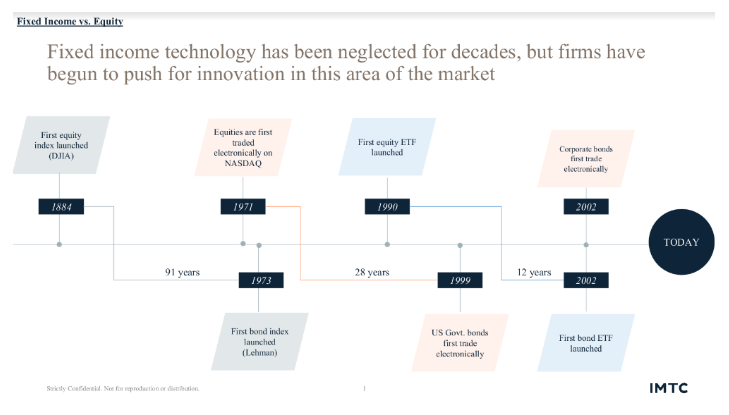
Many bonds also trade over the counter rather than through one central exchange. Although electronic trading has expanded, the market is still a patchwork. SIFMA’s fixed-income market structure research estimated that electronic trading represented less than 60% of Treasury volume, about half of investment-grade corporate volume, and roughly one-third of high-yield corporate volume. In other words, the bond market has embraced technology, but it has not suddenly transformed into a giant stock exchange wearing a tie.
Allocation Is Not the Same as Optimization
One of the most useful distinctions raised by “Talk Your Book: Fixing Fixed Income” is the difference between allocation and optimization.
Allocation asks, “Which account should receive this bond?” Optimization asks a much larger question: “Considering all available securities, portfolio objectives, tax restrictions, cash needs, credit limits, maturity targets, and compliance rules, which combination of trades creates the best overall result?”
Suppose a manager purchases $5 million of municipal bonds for 100 client accounts. A basic allocation system may divide the bonds according to account size. A true optimization process examines whether every bond actually fits each account. One client may live in a different state, another may need cash in three years, and a third may already have excessive exposure to the same issuer. Equal distribution may look fair while producing unequal outcomes.
Modern fixed-income optimization platforms are designed to evaluate thousands of possible combinations simultaneously, identify accounts requiring attention, locate suitable securities, model pre- and post-trade effects, and embed investment or compliance rules into the process. The technology does not eliminate human judgment. It handles repetitive calculations so portfolio managers can apply judgment where it matters.
The Risks Hidden Behind a Predictable Coupon
A bond’s scheduled interest payment can create a comforting impression of certainty. Unfortunately, a predictable coupon does not produce a risk-free investment.
Interest-Rate and Duration Risk
Bond prices generally move in the opposite direction of interest rates. When market rates rise, an older bond paying a lower coupon becomes less attractive, so its market price usually falls. When rates decline, the older bond’s coupon may become more valuable, causing its price to rise. FINRA identifies this relationship as one of the fundamental rules of bond investing.
Duration estimates how sensitive a bond or bond portfolio may be to rate changes. A duration of six years suggests that the investment’s price could move approximately 6% in the opposite direction of a one-percentage-point change in rates, although the actual result can differ because duration is an estimate rather than a crystal ball with a finance degree. Longer-duration bonds are generally more sensitive to rate movements than shorter-duration bonds.
Duration should not be viewed in isolation. Two portfolios with similar average durations can have different exposures along the yield curve. One may concentrate heavily in intermediate maturities, while another combines very short and very long bonds. Their average numbers could look alike even though their behavior under changing rate conditions may differ significantly.
Credit Risk
Credit risk is the possibility that an issuer will fail to make scheduled interest or principal payments. Credit ratings can help investors evaluate this risk, but the SEC warns that ratings address credit risk only. They do not measure interest-rate risk, market risk, liquidity risk, or every other unpleasant surprise that may arrive without knocking. Ratings should supplement independent analysis rather than replace it.
A higher yield often represents compensation for accepting greater risk. A corporate bond yielding considerably more than a comparable Treasury security may face weaker credit quality, lower liquidity, unfavorable structural features, or several of those issues at once. The additional yield is not a complimentary dessert. Investors are being paid to absorb something.
Liquidity Risk
Liquidity risk is the possibility that an investor cannot sell a bond quickly at a reasonable price. This risk is especially relevant for securities that trade infrequently. The SEC notes that investors may struggle to find a market for certain bonds or may receive a price that does not reflect the security’s perceived value.
Liquidity can deteriorate during volatile periods, precisely when investors are most eager to sell. Federal Reserve research tracks corporate bond liquidity through trading volume, turnover, large-trade activity, dealer inventories, and bid-ask spreads. These measurements demonstrate that liquidity is not a permanent feature attached to a security. It is a market condition that can improve or disappear.
Inflation, Reinvestment, and Call Risk
Inflation reduces the purchasing power of fixed payments. A bond may return every promised dollar while those dollars gradually lose their ability to purchase groceries, health care, or anything else that refuses to remain politely priced.
Reinvestment risk appears when maturing principal or coupon income must be invested at lower rates. Call risk occurs when an issuer redeems a bond before maturity, often because market rates have fallen and the issuer can refinance more cheaply. The investor gets the principal back but may lose the attractive income stream at the least convenient moment.
A Practical Framework for Building Better Bond Portfolios
1. Define the Bond Portfolio’s Job
Begin with purpose rather than yield. Is the portfolio expected to preserve capital, fund known expenses, produce retirement income, diversify stocks, or pursue total return? A portfolio designed for a home purchase in two years should not resemble one intended to support a 30-year retirement.
High-quality bonds have historically provided stronger diversification against stock volatility than lower-quality credit, which can behave more like equities during market stress. Vanguard and Morningstar both emphasize that the type of fixed income matters: a bond allocation built primarily from risky credit may generate income but provide less defensive ballast than an allocation centered on high-quality government and core bonds.
2. Match Duration to the Time Horizon
If money will be needed on a known date, the portfolio’s maturity structure should reflect that liability. Shorter maturities usually provide lower rate sensitivity and more frequent opportunities to reinvest. Longer maturities can lock in income for an extended period but expose the investor to greater price volatility.
The objective is not to guess the Federal Reserve’s next move with theatrical confidence. It is to create a duration profile that remains reasonable across several possible rate environments.
3. Diversify Credit Exposure
Diversification should extend beyond the number of bonds held. Ten bonds issued by companies in the same industry may provide less protection than a smaller collection spread across different sectors and issuers.
Investors should evaluate issuer concentration, sector concentration, seniority, security structure, and correlations with other portfolio holdings. A bond portfolio can contain many line items while still placing one giant economic bet.
4. Consider a Bond Ladder
A bond ladder holds securities with staggered maturity dates. As each bond matures, the principal can be spent or reinvested at current rates. The structure can help distribute reinvestment opportunities over time rather than forcing the investor to commit the entire portfolio at one interest-rate level.
For example, an investor allocating $250,000 might place $50,000 into bonds maturing in each of the next five years. At the end of year one, the first $50,000 maturity could be reinvested into a new five-year bond, extending the ladder. Fidelity and Charles Schwab both describe laddering as a strategy for generating scheduled cash flow while helping manage interest-rate and reinvestment risk.
A ladder is not automatically diversified. Each rung should still be examined for credit quality, call features, liquidity, and issuer concentration. Five questionable bonds arranged by maturity are not a sophisticated ladder. They are five questionable bonds standing on each other’s shoulders.
5. Choose the Right Investment Vehicle
Individual bonds allow investors to target specific maturities and receive principal at maturity, assuming the issuer does not default. However, constructing a diversified portfolio can require substantial capital, ongoing research, and careful trade execution.
Bond mutual funds and exchange-traded funds provide broader diversification and professional management, but they generally do not promise the return of a specific amount of principal on a specific date. Fund values fluctuate, holdings change, and investors may sell at a gain or loss.
Target-maturity bond ETFs attempt to combine features of both approaches by holding diversified portfolios of bonds that mature near a designated year. Vanguard’s 2026 expansion into target-maturity corporate bond ETFs illustrates how the industry is developing more precise tools for building scalable maturity-based portfolios.
6. Account for Taxes
Taxable yield is not the same as spendable yield. Municipal bonds may offer federally tax-exempt income, and some may also provide state tax advantages for residents of the issuing state. Investors should compare municipal and taxable securities using tax-equivalent yield rather than coupon rates alone.
Municipal bond analysis also requires attention to issuer finances, call provisions, insurance, revenue sources, and continuing disclosures. The Municipal Securities Rulemaking Board’s EMMA platform provides free access to official statements, trade data, continuing disclosures, and other municipal market information.
Why Technology Matters in Fixed-Income Portfolio Management
The traditional spreadsheet is useful, familiar, and surprisingly determined to remain employed. It is also limited. Manual processes become increasingly fragile as the number of accounts, securities, restrictions, and data sources grows.
Imagine a manager overseeing 2,000 separately managed accounts. Each account may contain a different amount of cash, a unique tax situation, prohibited issuers, customized maturity targets, credit limits, and income requirements. Reviewing those accounts individually can delay trades, create inconsistent allocations, and increase the risk of missed restrictions.
An integrated fixed-income system can identify accounts needing action, evaluate available inventory, propose trades, test compliance, model cash flows, allocate securities, and analyze the portfolio after execution. It can also preserve an audit trail explaining why a trade was considered or rejected.
This is the practical meaning of fixing fixed income: connecting portfolio construction, analytics, trading, compliance, and reporting instead of treating them as separate islands communicating through email attachments.
Technology should remain a decision-support system rather than an unquestioned authority. An optimizer can process enormous amounts of information, but its recommendations are only as sound as its data, objectives, assumptions, and constraints. A machine can optimize the wrong goal with breathtaking efficiency.
Common Fixed-Income Mistakes to Avoid
Chasing the Highest Yield
The highest-yielding security on a screen is rarely offering extra income because the issuer is feeling generous. Compare yield with credit quality, maturity, liquidity, call features, and potential recovery in a default.
Confusing “Held to Maturity” With “No Risk”
Holding a bond to maturity may reduce concern about interim price movements, but it does not eliminate default risk, inflation risk, opportunity cost, or the possibility that the investor will need to sell early.
Ignoring Position Size
A well-researched bond can still damage a portfolio if the position is too large. Risk management depends on both the probability of a problem and the amount exposed to that problem.
Using One Average to Describe Everything
Average yield, duration, maturity, and credit rating are useful summaries, but each can hide important details. Portfolio managers should examine the distribution beneath the average, including concentrations at specific maturities, ratings, sectors, and issuers.
Assuming Passive Management Means No Decisions
Every bond index has rules governing eligibility, weighting, rebalancing, and turnover. Because debt-weighted indexes may assign larger positions to the biggest borrowers, investors should understand what an index owns rather than assuming the word “passive” means economically neutral.
Active managers may shift among sectors, maturities, and securities when relative values change, although active management introduces manager-selection risk and additional costs. BlackRock and PIMCO both argue that selectivity, credit research, liquidity analysis, and active duration management can be especially valuable in complex fixed-income markets.
Experience-Based Lessons From Fixing Fixed Income
Several practical lessons repeatedly emerge when investors, advisers, and portfolio teams work through real bond-market decisions. These experiences are less exciting than forecasting the exact level of the 10-year Treasury yield, but they tend to be considerably more useful.
The First Experience: A Comfortable Coupon Can Hide an Uncomfortable Portfolio
An investor may review a collection of bonds paying 4% or 5% and conclude that the portfolio is safely producing income. A deeper review may reveal that nearly every holding matures in the same period, belongs to the same sector, or carries substantial call risk. The coupons look diversified because they arrive from different securities, but the underlying risks are traveling together.
The lesson is to examine the portfolio as a system. Income, maturity exposure, credit quality, liquidity, and tax treatment should be evaluated collectively. Security-by-security research is necessary, but it is not sufficient.
The Second Experience: Cash Can Become a Long-Term Position by Accident
Investors often hold cash while waiting for the “perfect” time to buy longer-term bonds. Attractive short-term rates make waiting feel productive. Then market yields decline, reinvestment opportunities weaken, and the temporary cash position becomes a permanent strategy without anyone formally deciding that it should.
A staged approach can be more practical. Dividing purchases across several maturities or investing incrementally can reduce the pressure to identify one ideal entry point. The portfolio gains exposure while preserving opportunities to reinvest later.
The Third Experience: The Best Bond Is Not Always the Best Bond for Every Account
A portfolio manager may identify a security with attractive credit characteristics and pricing. Nevertheless, the bond may be inappropriate for an account that already owns the issuer, needs an earlier maturity, faces a state-specific tax issue, or prohibits that industry.
This is where optimization improves on simple allocation. The question is not merely whether a bond is attractive. The question is where it improves the total portfolio after every relevant constraint has been considered.
The Fourth Experience: Liquidity Matters Before It Becomes Urgent
During calm markets, investors may treat a narrow bid-ask spread as a permanent characteristic. In stressed conditions, trading activity can decline, dealers may become less willing to hold inventory, and the cost of selling can rise.
A liquidity plan should therefore be created when liquidity is plentiful. Portfolios with near-term spending needs can maintain cash, Treasury bills, or other highly liquid assets rather than relying on the emergency sale of thinly traded bonds. The time to locate the fire exit is before the room smells like smoke.
The Fifth Experience: Automation Works Best When the Rules Are Thoughtful
Technology can process accounts faster, flag violations, and identify trades that humans might overlook. It cannot decide what an investor truly values unless those priorities are translated into clear objectives and constraints.
A poorly defined optimization rule might maximize yield while unintentionally increasing credit concentration. A better process sets limits for issuer exposure, duration, ratings, liquidity, taxes, and cash-flow requirements before asking the system to recommend securities.
The enduring experience is that successful fixed-income management combines three elements: reliable data, disciplined rules, and human judgment. Remove any one of them and the process becomes weaker. Data without judgment creates noise. Judgment without data creates blind spots. Rules without flexibility create portfolios that may be technically compliant but economically peculiar.
Conclusion
“Talk Your Book: Fixing Fixed Income” highlights a truth that extends well beyond one podcast episode or one technology platform. Bond investing is not simply the act of buying a coupon and waiting for maturity. It is an ongoing exercise in matching assets to liabilities, balancing income against risk, evaluating liquidity, controlling concentration, and adapting to changing market conditions.
For individual investors, fixing fixed income may mean clarifying the portfolio’s purpose, building a diversified bond ladder, understanding duration, or comparing individual bonds with funds. For professional managers, it may mean replacing isolated spreadsheets with integrated analytics, optimization, compliance, and trading systems.
The bond market may never become simple. That is fine. The goal is not to eliminate complexity but to manage it deliberately. When information is organized, risks are measured, and securities are selected according to a clearly defined objective, fixed income can return to doing what investors hired it to do: provide income, stability, and fewer reasons to stare nervously at a brokerage account before breakfast.
Note: This article is provided for educational purposes and does not constitute personalized investment, tax, or legal advice.

