
Skincare
Raspberry Pi Cosmic Ray Detector
Jun
Most Raspberry Pi projects begin with something modest: blink an LED, monitor a plant, annoy a cat with a servo. Then someone looks up at the universe and says, “What if this tiny computer helped detect particles from deep space?” That is how the Raspberry Pi cosmic ray detector becomes one of the most delightfully ambitious projects in citizen science. It takes a low-cost computer, combines it with particle-detection hardware, and turns your desk, classroom, garage, or lab bench into a small window into high-energy astrophysics.
To be clear, the Raspberry Pi itself does not magically “see” cosmic rays. It is not a wizard in a plastic case, though it often behaves like one. A proper detector uses hardware such as a plastic scintillator, silicon photomultiplier, photomultiplier tube, Geiger-Müller tube, or a light-shielded CMOS camera to sense the effects of energetic particles. The Raspberry Pi then handles the less glamorous but extremely important jobs: collecting data, timestamping events, logging sensor readings, storing files, running Python scripts, showing dashboards, and sometimes sending results to a network.
In other words, the detector catches the whisper of a particle; the Raspberry Pi keeps the diary.
What Are Cosmic Rays?
Cosmic rays are high-energy particles traveling through space at nearly the speed of light. Many are atomic nuclei, especially protons, while others include heavier nuclei and smaller subatomic particles. Their origins can include the Sun, supernova remnants, black holes, and other extreme environments that make ordinary thunderstorms look like someone shuffling socks on carpet.
When primary cosmic rays hit Earth’s upper atmosphere, they collide with atoms and create cascades of secondary particles. Among the most useful for ground-level experiments are muons. Muons are heavier cousins of electrons, and they are surprisingly good at passing through matter. A muon can travel through the atmosphere, through rooftops, through a lab table, and sometimes through you before you finish reading this sentence. Rude? Perhaps. Scientifically useful? Absolutely.
Why Use a Raspberry Pi for Cosmic Ray Detection?
The Raspberry Pi is popular because it is affordable, compact, energy-efficient, and friendly to Python. That combination makes it perfect for a DIY cosmic ray detector or classroom muon experiment. It can run continuously, log data to a microSD card, connect to Wi-Fi, read GPS modules, display live charts, and communicate with sensors over GPIO, USB, serial, I2C, or SPI.
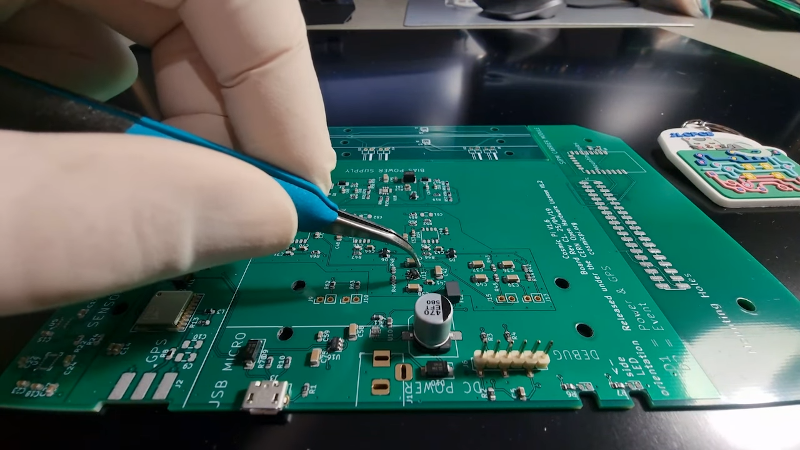
Projects such as Cosmic Pi and CosmicWatch show why the Pi fits so well. Cosmic Pi aimed to build a distributed network of low-cost cosmic ray detectors using Raspberry Pi hardware, GPS, environmental sensors, and open designs. CosmicWatch, meanwhile, popularized the idea of a compact desktop muon detector built around a plastic scintillator and silicon photomultiplier, with open software and data tools. These projects helped bring particle physics out of giant laboratories and into classrooms, makerspaces, and hobby benches.
How a Raspberry Pi Cosmic Ray Detector Works
1. The Particle Passes Through a Detection Medium
The most common educational designs use a plastic scintillator. When a charged particle such as a muon passes through the scintillator, the material emits a tiny flash of light. This flash is not dramatic. Do not expect a Marvel portal to open over your workbench. The light pulse is brief and faint, which is why sensitive electronics are needed.
2. A Light Sensor Converts the Flash Into an Electrical Signal
A silicon photomultiplier, often shortened to SiPM, or a traditional photomultiplier tube can detect the faint light and convert it into an electrical pulse. SiPMs are especially attractive for modern small detectors because they are compact, relatively rugged, and work at lower voltages than older photomultiplier tubes.
3. Electronics Shape and Measure the Pulse
The raw signal from the sensor is usually too small and messy to send directly into a Raspberry Pi. A detector board amplifies the signal, filters noise, compares it against a threshold, and generates a clean digital event. Some designs also measure pulse height with an analog-to-digital converter, helping estimate the strength of each detection.
4. Coincidence Logic Reduces False Events
Many muon detectors use two scintillator panels stacked vertically. If both panels register a pulse within a short time window, the system records a coincidence event. This makes it more likely that a real particle passed through both detectors rather than the system simply catching electrical noise or local background radiation. Think of it as asking the universe for two witnesses before accepting the story.
5. The Raspberry Pi Logs the Data
Once a valid event occurs, the Raspberry Pi records the timestamp, count rate, sensor data, and sometimes GPS location. The Pi can also run Python scripts for analysis, create CSV files, update a local dashboard, or upload data to a larger network. In school settings, this turns the detector into a hands-on lesson in physics, electronics, coding, statistics, and patience.
Main Types of Raspberry Pi Cosmic Ray Detector Builds
Scintillator and SiPM Muon Detector
This is the most serious and educationally useful design. It is the style used by many compact muon detector projects. The build usually includes a plastic scintillator, reflective wrapping, black light-blocking material, a SiPM, a detector PCB, and Raspberry Pi data logging. It is more complicated than a plug-and-play sensor, but it produces more meaningful particle data.
Geiger Counter With Raspberry Pi
A Geiger-Müller tube connected to a Raspberry Pi can detect ionizing radiation, including some background radiation events. However, it is not ideal for clean cosmic ray muon studies because it cannot easily distinguish muons from other radiation sources. It is great for learning about radiation counts and logging, but less precise for cosmic ray science.
Raspberry Pi Camera Cosmic Ray Detector
Some experiments use a Raspberry Pi camera or other CMOS sensor in darkness. When high-energy particles strike the sensor, they may create bright pixels or streaks. This approach is affordable and fascinating, but it requires careful light sealing, image processing, and skepticism. Hot pixels, sensor noise, and software filtering can masquerade as particle events. Still, as a low-cost science experiment, it is wonderfully accessible.
Distributed Cosmic Ray Network Node
A single detector is fun. A network of detectors is science with a social life. If many Raspberry Pi cosmic ray detectors are spread across different locations and share timestamped data, researchers and students can look for patterns, showers, altitude effects, weather correlations, and rare events. GPS timing and location data become especially important in this setup.
Parts You Might Need
A practical Raspberry Pi cosmic ray detector may use a Raspberry Pi Zero, Raspberry Pi 3, Raspberry Pi 4, or Raspberry Pi 5, depending on the software load. A low-power Pi is often enough for logging detector pulses, while image processing from a camera benefits from stronger hardware. For a scintillator design, the core components include a plastic scintillator tile, SiPM, front-end electronics board, stable power supply, light-tight enclosure, and data logging software.
Optional parts can make the project much better. A GPS module gives accurate event timing and location. Environmental sensors for pressure, temperature, and humidity help explain count-rate variations. A small OLED or LCD screen makes the detector feel alive, especially when it blinks every time a particle is recorded. A battery pack allows portable measurements, such as comparing counts indoors, outdoors, upstairs, downstairs, or at higher elevation.
What Can You Measure?
The simplest measurement is count rate: how many events occur per minute or per hour. After that, the experiments get more interesting. You can compare muon counts at different altitudes, test whether shielding changes the rate, rotate stacked detectors to study angle dependence, or compare readings during pressure changes. Atmospheric pressure matters because muons are produced in the atmosphere; changing air density can slightly affect the number reaching ground level.
Students can also learn the difference between random variation and meaningful trends. Cosmic ray data can look noisy because particle arrivals are statistical. A quiet five-minute stretch does not mean the universe took a coffee break. It means you need longer runs, better controls, and a healthy respect for Poisson statistics.
Software: Where the Raspberry Pi Shines
The software side is one of the most rewarding parts of the project. A Python script can monitor GPIO pulses, read serial data from a detector board, write events to CSV, and generate simple graphs. More advanced setups can use SQLite, InfluxDB, Grafana, Jupyter Notebook, or a web dashboard. For classroom use, a clean graph of counts over time is often more exciting than a pile of raw numbers, especially when students realize those numbers came from particles born high above their heads.
A useful data record might include event ID, timestamp, detector channel, coincidence flag, pulse height, temperature, pressure, humidity, GPS coordinates, and device status. That may sound like overkill until the day your count rate drops and you discover the enclosure was leaking light, the power supply sagged, or someone used the detector as a coaster. Data saves dignity.
Common Build Challenges
Light Leaks
Scintillator detectors are extremely sensitive to tiny flashes of light. If visible light leaks into the enclosure, your detector may count room lighting instead of cosmic particles. Black tape, dark enclosures, careful cable exits, and proper wrapping are not cosmetic details; they are the difference between science and a very expensive night-light.
Electrical Noise
Power supplies, long wires, breadboards, and poor grounding can create false pulses. Use short signal paths, shielded cables where possible, stable power, and tested detector boards. Particle physics is already weird enough; do not let a noisy USB charger impersonate the cosmos.
Calibration
Threshold settings matter. Too low, and the detector records noise. Too high, and it misses real events. Many projects require careful adjustment using test runs, known background behavior, and comparison between channels. Coincidence detection helps, but calibration is still essential.
Expectations
A Raspberry Pi cosmic ray detector will not identify the exact supernova that launched a particle. It will not tell you that a muon came from “left of Orion, slightly annoyed.” What it can do is show real particle events, reveal statistical patterns, and make invisible radiation measurable with affordable hardware.
Best Raspberry Pi Cosmic Ray Detector Project Ideas
For beginners, a Raspberry Pi camera experiment is the easiest entry point. Cover the lens completely, take long dark exposures, process frames for bright streaks, and compare results over many hours. This teaches image analysis and experimental caution.
For serious learners, a scintillator and SiPM detector is the better path. Start with a proven open-source design instead of inventing the entire analog front end from scratch. Once the detector works, add GPS, environmental sensors, and automated plots.
For classrooms, build two detectors and run coincidence experiments. Let students predict how the count rate changes when the detectors are stacked, separated, tilted, or shielded. The moment students realize they are not just reading about particles but measuring them is the moment physics stops sounding like homework and starts acting like a secret doorway.
Real-World Uses of Muon Detection
Muon detection is not just a maker hobby. Scientists use cosmic muons for imaging large structures because muons can penetrate dense material. Muon tomography has been explored for studying volcanoes, pyramids, cargo containers, and damaged nuclear reactors. Large research detectors also use related principles to study high-energy particles, neutrinos, and cosmic ray showers.
A Raspberry Pi detector is obviously not a billion-dollar observatory or a national security scanner. But it demonstrates the same core idea: energetic particles pass through matter, detectors register their interactions, and data analysis turns those interactions into knowledge.
Experiences From Building and Using a Raspberry Pi Cosmic Ray Detector
The first experience most builders have with a Raspberry Pi cosmic ray detector is not cosmic wonder. It is usually confusion. The detector is assembled, the software runs, the graph appears, and then the count rate looks too high, too low, too flat, or too chaotic. This is normal. Particle detection is a humbling hobby. It teaches you that the universe is subtle, electronics are moody, and black electrical tape deserves more respect than it gets.
One of the best practical lessons is learning to control light. A scintillator detector may seem sealed, but one tiny gap near a cable hole can flood the sensor with enough stray photons to ruin the data. Builders often discover this by turning off the room lights and watching the count rate change. That moment is annoying, educational, and slightly funny. You thought you built a cosmic ray detector; congratulations, you built a lamp detector. Fixing the enclosure becomes part of the scientific process.
Another memorable experience is the first believable coincidence event. With two detector panels stacked together, a real muon passing through both layers creates a small but satisfying digital footprint. It is not flashy. There is no thunderclap. The screen may simply add one count. Yet that tiny increment feels enormous because it represents a particle that began as part of a high-energy atmospheric shower and ended as a row in your CSV file. That is a wild career change for a muon.
Long data runs teach patience. A ten-minute test is useful for checking whether the system is alive, but overnight and multi-day measurements are where patterns become visible. Builders often start noticing that pressure changes, detector orientation, or location can influence readings. Moving the detector from a basement to an upper floor may produce discussion. Taking it to a hill, school roof, or higher-elevation site can turn the project into a field experiment. The Raspberry Pi makes this easy because it can run from a power bank, store data locally, and restart scripts automatically.
The project also builds respect for documentation. Good notes about threshold settings, sensor temperature, enclosure changes, and software versions can prevent many headaches. Without notes, you may stare at two graphs from different days and wonder why one looks cleaner than the other. Was the threshold changed? Was the room warmer? Was the detector tilted? Did someone unplug the GPS? Did the cat sit on the cable? The data will not confess. Your lab notebook might.
For students and hobbyists, the most valuable experience is realizing that science is not just polished textbook diagrams. It is trial runs, false starts, noisy signals, suspicious spikes, careful fixes, and gradually improving confidence. A Raspberry Pi cosmic ray detector turns abstract physics into something physical. You can hold the enclosure, inspect the code, watch the counts rise, and understand that the universe is constantly sending messengers through the room. The detector does not make the cosmos less mysterious. It makes the mystery measurable, which is even better.
Conclusion
A Raspberry Pi cosmic ray detector is one of the best examples of modern citizen science: affordable computing, open-source software, clever sensors, and a topic big enough to make your coffee feel cosmologically insignificant. Whether you build a simple Raspberry Pi camera experiment or a more advanced scintillator-based muon detector, the project teaches electronics, Python, statistics, astrophysics, and experimental discipline in one satisfying package.
The key is to choose the right detector style for your goals. A camera-based setup is accessible and fun but requires careful interpretation. A Geiger counter is simple for radiation logging but limited for muon studies. A scintillator and SiPM detector is the strongest choice for serious cosmic ray measurements, especially when paired with coincidence logic, GPS timing, and environmental sensors.
Most importantly, this project reminds us that science does not always need a giant lab coat budget. Sometimes it starts with a Raspberry Pi, a light-tight box, a few carefully chosen components, and the bold belief that your desk deserves a particle physics department.
SEO Tags

