
Makeup
Every Glorious Image From the James Webb Space Telescope (So Far)
Jul
The James Webb Space Telescope does not take ordinary snapshots. It collects ancient infrared light, separates it by wavelength, and turns invisible information into portraits of newborn stars, dying suns, stormy planets, colliding galaxies, and objects that existed near the dawn of cosmic history.
Since Webb’s first full-color science images arrived in July 2022, its public gallery has expanded into a visual history of the universe. Some releases look like paintings. Others resemble jewelry, smoke, seashells, fingerprints, or the album cover of a band that plays only 40-minute synthesizer solos. All of them are scientific measurements first and spectacular images second.
No single article can reproduce every engineering exposure, research frame, and processed composite in Webb’s enormous archive. This guide instead tours the landmark public images and major visual releases available through July 19, 2026the pictures that best show what the telescope has revealed and why astronomers keep asking it to look again.
Why James Webb Space Telescope Images Look So Different
Webb studies primarily infrared light, which human eyes cannot see. Its Near-Infrared Camera, or NIRCam, excels at detecting stars, young stellar objects, distant galaxies, and light passing through relatively thin dust. Its Mid-Infrared Instrument, or MIRI, is especially sensitive to cooler dust, molecules, and deeply embedded structures.
The familiar blues, oranges, reds, and golds in James Webb Space Telescope images are therefore not a literal view from a spaceship window. Each instrument records grayscale data through different filters. Image specialists assign visible colors to those wavelengths, commonly mapping shorter infrared wavelengths toward blue and longer ones toward red. The result preserves real differences in the data while making them understandable to human vision.
Webb’s bright stars also display a recognizable eight-point pattern. Six prominent spikes come from diffraction around the edges of its hexagonal mirror segments, while two fainter horizontal spikes are associated with the structures supporting the secondary mirror. Those sparkles are not proof that space has hired a jewelry designer. They are signatures of the observatory’s optics.
Operating near the Sun-Earth L2 region, roughly one million miles from Earth, Webb remains cold enough to detect faint infrared signals that would otherwise be overwhelmed by heat. Its location, large segmented mirror, sunshield, and specialized instruments allow it to study everything from neighboring planets to galaxies whose light has traveled for more than 13 billion years.
The First Webb Images That Changed Astronomy Overnight
Webb’s First Deep Field: SMACS 0723
The opening act was Webb’s First Deep Field, centered on the galaxy cluster SMACS 0723. Thousands of galaxies crowd the scene, while the gravity of the foreground cluster bends and magnifies light from even more distant galaxies behind it. Some appear as stretched arcs, as though the universe briefly became soft taffy.
The field covers a patch of sky comparable to a grain of sand held at arm’s length. Yet within that tiny area, Webb recorded galaxies at many stages of cosmic history. The image demonstrated not only sensitivity but efficiency: Webb could reveal extraordinarily faint infrared objects without requiring the extremely long exposure campaigns associated with earlier deep fields.
The Cosmic Cliffs in the Carina Nebula
Webb’s view of NGC 3324, a star-forming region in the Carina Nebula, may be the mission’s most instantly recognizable image. A glowing wall of gas and dust rises beneath a blue field of stars, creating the illusion of mountains under a moonlit sky.
The “cliffs” are the edge of a vast cavity carved by intense radiation and winds from massive young stars outside the frame. Webb revealed hundreds of stars previously concealed by dust, along with jets, cavities, pillars, and streams of hot material. Located about 7,600 light-years away, this stellar nursery gave the public its first unforgettable lesson in Webb’s specialty: looking through the universe’s curtains.
The Southern Ring Nebula
The Southern Ring Nebula, also cataloged as NGC 3132, captures a late chapter in a star’s life. A dying star has expelled shells of gas and dust that now form a luminous, irregular bubble roughly 2,500 light-years from Earth.
Webb’s near- and mid-infrared views exposed different structures within those shells and clarified the presence of two central stars. The image looks delicate, but it records a dramatic process: a star shedding much of itself into space, supplying material that may eventually participate in the formation of other stars, planets, and perhaps organisms that complain about cloudy weather.
Stephan’s Quintet
Stephan’s Quintet is a visual grouping of five galaxies, four of which are physically interacting. Webb’s enormous mosaic revealed shock waves, star-forming regions, tidal tails, and hot material generated as the galaxies disturb one another.
The image also penetrated the dusty surroundings of the active galactic nucleus in NGC 7319. The compact group functions as a relatively nearby laboratory for studying interactions that were more common when the universe was younger. In visual terms, it is also what happens when several galaxies ignore the concept of personal space.
Famous Cosmic Landmarks Reimagined by Webb
The Pillars of Creation
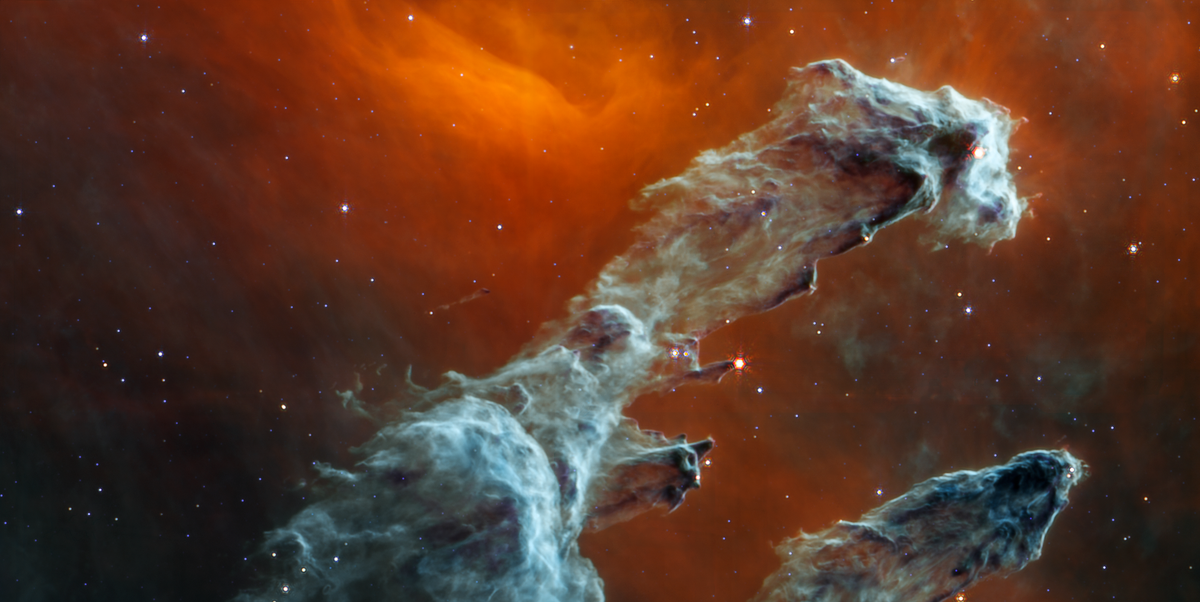
Hubble made the Pillars of Creation cultural icons. Webb made them feel newly discovered. Its NIRCam portrait reveals a dense background of stars, glowing young objects, and red jets emerging from forming suns. Its MIRI view shifts attention toward cooler dust, causing many stars to fade while the pillars become ghostly blue-gray monuments against a red background.
Located about 6,500 light-years away in the Eagle Nebula, the pillars are clouds where gravity, radiation, and stellar winds compete. Dense knots collapse into protostars while nearby massive stars erode the surrounding material. The combined NIRCam and MIRI composite brings both populations into one frame: the stars being born and the dusty structures supplying their raw material.
The Tarantula Nebula
Webb’s Tarantula Nebula mosaic spans approximately 340 light-years and exposes tens of thousands of previously hidden young stars. Located in the Large Magellanic Cloud, the region is valuable because its chemical environment resembles conditions in the universe several billion years ago, when star formation was especially vigorous.
NIRCam shows a glittering cavity and dusty filaments, while MIRI emphasizes cooler gas and embedded protostars. The difference between the two views is a reminder that an astronomical object does not have one definitive appearance. Change the wavelength, and the universe changes costume.
The Phantom Galaxy and Other Grand Spirals
M74, nicknamed the Phantom Galaxy, appears almost face-on, allowing Webb to trace delicate dust filaments along its symmetrical spiral arms. Its bright center and web-like structure make it resemble a cosmic seashellor a hypnotist’s final attempt to persuade humanity to fund more astronomy.
Webb has also transformed views of galaxies such as IC 5332, the Whirlpool Galaxy, NGC 628, NGC 1365, Messier 77, and NGC 5134. In many of these images, older stars dominate near-infrared views while mid-infrared observations illuminate dust lanes and regions where new stars are forming. By comparing Webb with Hubble, astronomers connect stellar populations to the dusty material moving through galactic disks.
The Cartwheel Galaxy
The Cartwheel Galaxy’s ring-like shape is the aftermath of a high-speed collision with another galaxy. Webb revealed hot dust, individual stars, and active regions within its inner and outer rings. The expanding outer ring has been forming stars for hundreds of millions of years, turning a violent encounter into an enormous, slowly evolving stellar workshop.
Webb’s Portraits of Stellar Birth and Death
Rho Ophiuchi
Released for Webb’s first science anniversary, the Rho Ophiuchi image presents star formation with almost painterly intensity. Red jets burst from young stars, illuminated gas forms a glowing cave, and dark disks hint at future planetary systems.
Rho Ophiuchi is only about 390 light-years away, making it the closest major star-forming region to Earth. Its proximity lets Webb examine Sun-like and lower-mass stars during their earliest stages with extraordinary detail.
Herbig-Haro 46/47 and Herbig-Haro 211
Herbig-Haro objects are glowing shocks produced when young stars eject narrow jets into surrounding gas. Webb’s image of Herbig-Haro 46/47 shows two actively forming stars buried inside an orange-white disk, with enormous lobes extending outward. A reddish object shaped like a question mark appears far in the background, likely produced by interacting or merging galaxies rather than by the universe requesting clarification.
Herbig-Haro 211 offers an even younger system. Its remarkably detailed jets contain knots and bow shocks that allow researchers to reconstruct how material has been expelled in repeated bursts.
The Ring Nebula, Helix Nebula, and Southern Ring
Webb’s planetary-nebula portraits reveal the complicated structures produced by dying Sun-like stars. The Ring Nebula contains thousands of dense knots and intricate molecular material. The Helix Nebula presents overlapping shells, comet-like features, and material shaped by radiation from the central stellar remnant.
These are not planets despite the historical name “planetary nebula.” Early astronomers thought their round shapes resembled planetary disks. The objects are actually brief, beautiful phases in stellar evolutioncelestial retirement parties with extremely elaborate decorations.
Wolf-Rayet 124
Webb captured the massive star Wolf-Rayet 124 surrounded by clumpy clouds of ejected material. Wolf-Rayet stars have shed their outer layers and are approaching the ends of their lives. The surrounding dust is scientifically important because astronomers are still working to understand how so much dust survives and accumulates in the universe.
Cassiopeia A and the Crab Nebula
Cassiopeia A is a young supernova remnant whose Webb portraits expose expanding shells, knots of stellar debris, dusty structures, and a curious feature nicknamed the “Green Monster.” A later near-infrared view revealed a compact object informally called Baby Cas Aa light echo produced when the original explosion heated distant dust.
The Crab Nebula offers another view of explosive stellar death. Webb traced cage-like gas filaments, synchrotron radiation, and dust surrounding the nebula’s rapidly spinning neutron star. Comparing Webb with observations from Hubble and X-ray telescopes helps researchers separate the remnant’s many energetic components.
The Horsehead Nebula
Webb’s close-up of the Horsehead Nebula studies the illuminated upper edge of a dense cloud rather than reproducing the entire familiar horse-shaped silhouette. The sharply resolved layers show where ultraviolet radiation is eroding the cloud and influencing its chemistry. It is less a portrait of a horse and more a geological survey of the horse’s foreheadbut the details are magnificent.
Webb Brings the Solar System Into Infrared Focus
Jupiter
Webb’s images of Jupiter display bright auroras, high-altitude hazes, faint rings, small moons, and atmospheric structures surrounding the Great Red Spot. Infrared wavelengths make some high clouds appear bright while methane-rich regions absorb light and appear darker.
Later observations showed that Jupiter’s auroral emissions can vary rapidly and possess intensities far beyond Earth’s northern and southern lights. Webb is not merely photographing the planet; it is monitoring how energy moves through its upper atmosphere.
Neptune
Webb delivered the clearest view of Neptune’s rings in decades, recovering faint structures that had not been seen so clearly since Voyager 2 flew past the planet in 1989. Because methane absorbs much of the near-infrared light, Neptune looks pale and comparatively dark rather than vivid blue. Bright methane-ice clouds stand out dramatically.
Subsequent Webb observations also provided the first clear infrared detection of Neptune’s auroral activity, demonstrating that even familiar planets can still produce first-of-their-kind discoveries.
Uranus and Saturn
Webb’s Uranus portraits resolve the planet’s rings, moons, seasonal polar cap, storms, and exceptionally faint inner material, including the elusive Zeta ring. The planet’s sideways orientation creates unusual seasons that Webb can track over time.
Saturn looks almost eerie in Webb’s infrared view. Methane absorption darkens much of the globe while the rings remain bright. Small moons appear nearby, and atmospheric differences emerge across the planet. Combined Webb and Hubble observations extend the color palette across infrared, visible, and ultraviolet wavelengths, allowing scientists to examine different atmospheric depths.
Galaxies From the Early Universe
Some of Webb’s most scientifically important images are not the most conventionally beautiful. Deep surveys such as JADES, CEERS, GLASS, and the Cosmic Evolution Early Release Science program contain thousands of faint galaxies whose shapes, colors, and spectra help astronomers reconstruct the universe’s youth.
Webb has identified exceptionally distant galaxy candidates and confirmed galaxies seen only a few hundred million years after the Big Bang. Images of objects such as JADES-GS-z14-0 show little more than compact reddish smudges to casual viewers. Scientifically, however, those pixels carry information about early star formation, chemical enrichment, and the speed at which galaxies assembled.
Other deep fields contain “little red dots,” a puzzling population of compact red sources that may include rapidly growing black holes hidden by dense gas. Gravitationally lensed fields produce arcs, duplicated galaxies, Einstein rings, and occasionally magnified individual stars. Webb’s deepest images are therefore both photographs and maps of gravity.
The Newest Webb Image Highlights Through July 2026
Penguin and Egg
Webb marked its second science anniversary with Arp 142, a pair of interacting galaxies nicknamed the Penguin and the Egg. The Penguin’s spiral structure has been stretched by gravity, triggering waves of star formation, while the compact Egg remains comparatively intact. Together they demonstrate that galaxy interactions can be both destructive and creatively productive.
The Sombrero Galaxy and NGC 602
Webb’s mid-infrared Sombrero Galaxy image transformed the familiar bright central bulge into a smoother inner disk surrounded by a sharply defined dust lane. A view of NGC 602 in the Small Magellanic Cloud, meanwhile, exposed a festive wreath of gas, dust, young stars, and distant background galaxies.
Pismis 24, W51, and Other Stellar Nurseries
Webb’s portrait of the Pismis 24 cluster inside the Lobster Nebula revealed thousands of young stars and a towering wall of gas shaped by radiation. Observations of W51 exposed deeply embedded massive stars whose formation could not be studied as clearly with visible-light telescopes. These images expand Webb’s growing atlas of stellar childhoodfrom quiet Sun-like nurseries to chaotic regions producing some of the galaxy’s heaviest stars.
FS Tau
Released in July 2026, Webb’s FS Tau image shows a young multiple-star system roughly 450 light-years away. Bright protostars illuminate blue scattered-light ridges, while red molecular hydrogen and orange carbon-rich material trace outflows through the surrounding dust.
Webb’s view contrasts sharply with Hubble’s visible-light image, in which thick dust conceals much of the activity. FS Tau is a near-perfect demonstration of why astronomers need both observatories: Hubble records what the dust allows visible light to show, while Webb uncovers the structures hiding within it.
Centaurus A
For its fourth science anniversary, Webb targeted Centaurus A, a turbulent galaxy formed through a major merger. Near- and mid-infrared observations cut through its famous dark dust lane, resolving dense star fields and complex structures around its active center.
The anniversary release illustrates how Webb’s mission is evolving. Its early images proved the observatory worked; later images increasingly combine beauty with long-term programs designed to answer focused questions about galactic evolution, star formation, black holes, and interstellar dust.
Beta Pictoris d
One of Webb’s newest image-based discoveries is Beta Pictoris d, a giant exoplanet in a young planetary system 63 light-years away. It was confirmed not merely as a bright dot but through the chemical fingerprint recorded in spatially resolved spectroscopic data.
Researchers estimate that the planet is at least twice Jupiter’s mass and follows a wide orbit comparable to the region occupied by Neptune in our solar system. Webb observations detected atmospheric signatures including water vapor and methane, showing that modern astronomical “images” may combine position, brightness, chemistry, temperature, and motion in the same dataset.
What It Feels Like to Explore Webb’s Images
The First Reaction Is Usually Scale Failure
Looking through the James Webb Space Telescope image gallery is an exercise in repeatedly discovering that the human brain did not evolve with adequate cosmic measuring equipment. A bright speck may be a foreground star. A smaller red speck may be an entire galaxy. A glowing ridge that resembles a few miles of mountain terrain may stretch for light-years.
The best viewing experience begins by resisting the urge to scroll immediately. Open a high-resolution image, hide the surrounding interface, and spend a full minute examining only the frame. Look for diffraction spikes, dark dust lanes, tiny background galaxies, jets, arcs, knots, and areas where the color suddenly changes. Webb images reward patience in the way maps do: the longer you study them, the more territory appears.
Read the Caption, Then Look Again
A second viewing after reading the official caption is almost always more dramatic than the first. The attractive orange streak becomes shocked molecular hydrogen. A smooth dark patch becomes dense dust hiding protostars. A curved reddish line becomes a distant galaxy distorted by gravitational lensing.
This shift from “pretty picture” to “physical event” is the central pleasure of Webb imagery. The photographs do not become less beautiful when explained. They become stranger. Knowing that a delicate shell was expelled by a dying star, or that a faint reddish dot began sending its light toward us more than 13 billion years ago, adds intellectual depth without subtracting any visual magic.
Compare Instruments and Telescopes
Side-by-side comparisons create another rewarding experience. Start with a visible-light Hubble image, switch to Webb’s NIRCam version, and then examine the MIRI data. Stars may appear or disappear. Dust changes from an obstruction into the main subject. Structures that seemed solid become transparent, while previously empty regions fill with detail.
The exercise also corrects a common misconception: Webb did not simply replace Hubble with a sharper camera. The two observatories examine overlapping but different wavelength ranges. Hubble remains exceptionally valuable for ultraviolet and visible-light astronomy, while Webb extends far deeper into the infrared. Their combined observations tell a more complete story than either could provide alone.
Try a Personal Webb Viewing Ritual
For an immersive session, choose three contrasting images: one nearby planet, one stellar nursery, and one deep field. Jupiter supplies familiar geography transformed by infrared light. Rho Ophiuchi or the Cosmic Cliffs shows stars being born. SMACS 0723 or a JADES field sends the mind toward the earliest observable galaxies.
View each image at full resolution on the largest screen available. Zoom slowly rather than jumping directly to maximum magnification. Then read the scale and distance information. A feature that looked like a decorative curl may span several light-years; an apparently crowded galaxy field may represent objects separated by billions of years of cosmic history.
The Images Make the Universe Feel Both Larger and Closer
Webb creates a productive contradiction. Its pictures emphasize distances so enormous that everyday language begins to wobble, yet they also make remote objects feel immediate. We can inspect dusty ridges around forming stars, weather patterns on planets, and structures inside galaxies whose light began traveling before Earth existed.
That experience is why Webb’s public images matter beyond professional astronomy. They provide an emotional entrance into difficult science. Spectroscopy, infrared filters, stellar evolution, and gravitational lensing become easier to approach when attached to something visually unforgettable.
The gallery also encourages humility. Each frame contains more objects than anyone can discuss in one caption, and many background sources have not yet been studied in detail. Webb does not present a finished universe. It presents a universe full of unopened messages.
Conclusion: Webb’s Greatest Image May Still Be Ahead
The finest James Webb Space Telescope images combine three qualities: visual beauty, scientific depth, and the ability to make familiar objects appear new. The Cosmic Cliffs turned stellar birth into a landscape. The Pillars of Creation became transparent laboratories. Neptune’s rings returned in extraordinary clarity. Deep fields filled tiny patches of darkness with ancient galaxies.
By July 2026, Webb had progressed from proving its capabilities to delivering sustained, increasingly sophisticated observations of planetary atmospheres, protostars, supernova remnants, black holes, nearby galaxies, and the early universe. Its latest releasesincluding FS Tau, Centaurus A, and the Beta Pictoris systemshow that the observatory’s visual legacy is still expanding.
“So far” is therefore the most important phrase in the title. Webb’s archive is not a completed coffee-table book. It is a living scientific record, and the next glorious image may already be traveling through the telescope’s instruments.
SEO Information

