
Makeup
The Air Force Is Sending Its Light Attack Plane Competition to War
May
For years, the U.S. Air Force has wrestled with a strange but very expensive question: should America use some of the most advanced fighter jets on Earth to chase insurgents with pickup trucks, radios, and machine guns? That is a little like using a Formula 1 car to deliver pizza. Technically possible? Sure. Financially sensible? Not unless the toppings are classified.
That is the logic behind the Air Force light attack plane competition, often known as OA-X or the Light Attack Experiment. The idea was simple, practical, and surprisingly old-fashioned: find a rugged, affordable aircraft that could fly close air support, armed overwatch, reconnaissance, and partner-nation missions in relatively permissive combat environments. In plain English, the Air Force wanted a cheaper way to put eyes, radios, and precision weapons over the battlefield without burning through the service life of high-end fighters built for wars against advanced militaries.
The headline “The Air Force Is Sending Its Light Attack Plane Competition to War” captures the drama of the moment. Instead of simply testing aircraft over a quiet range in New Mexico, the Air Force explored the idea of putting competing aircraft into real combat conditions. That concept raised eyebrows across the defense world because competitions usually happen in test ranges, not war zones. But the reason made sense: combat reveals truths that PowerPoint slides politely avoid.
What Was the Air Force Light Attack Plane Competition?
The Light Attack Experiment was designed to evaluate commercially available or near-ready aircraft for low-intensity conflict. The Air Force was not trying to build a gold-plated stealth aircraft from scratch. It wanted something closer to an airborne multitool: affordable, maintainable, armed, sensor-equipped, and able to work with U.S. and allied ground forces.
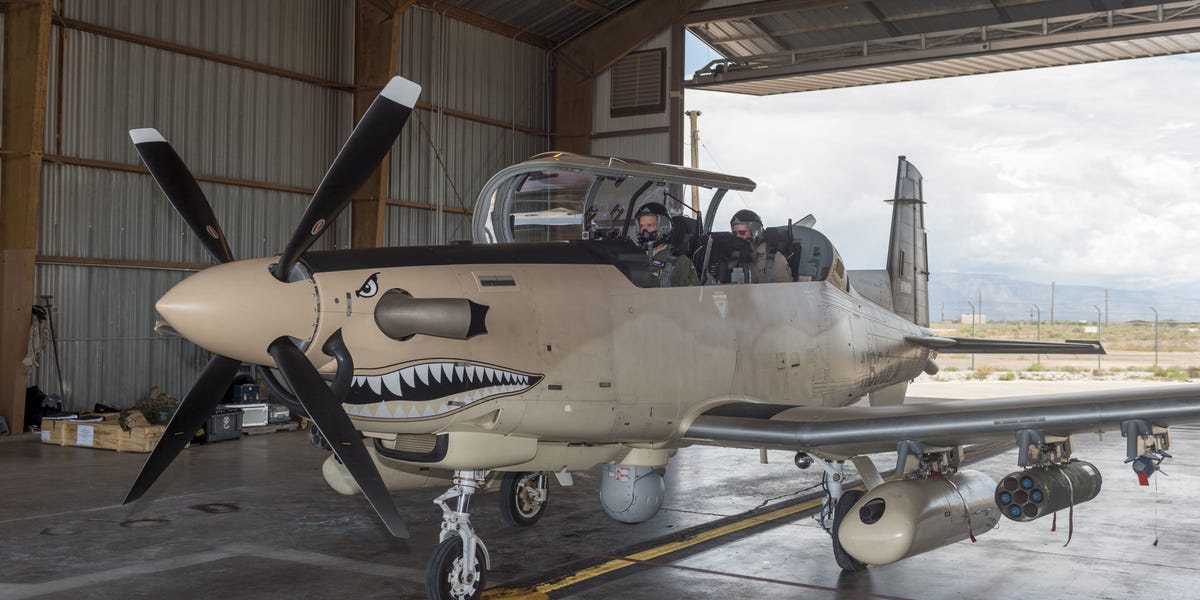
The first phase took place at Holloman Air Force Base in New Mexico in 2017. Four aircraft were involved: the Sierra Nevada/Embraer A-29 Super Tucano, the Textron Aviation AT-6 Wolverine, the Textron Scorpion jet, and the AT-802L Longsword from L3 Technologies and Air Tractor. Each brought a different answer to the same question: what should a modern light attack aircraft look like?
The A-29 Super Tucano and AT-6 Wolverine quickly became the stars of the show. Both are turboprop aircraft, which means they look modest next to screaming jets but offer real advantages for missions that require patience rather than Mach speed. They can loiter, observe, communicate, and strike while using less fuel and requiring a smaller logistical footprint.
Why Send a Competition to War?
Testing aircraft in a combat environment can expose realities that a controlled demonstration cannot. How does the aircraft perform in desert heat? How quickly can maintainers turn it around? Can it communicate with American command-and-control networks? Can it share data with coalition partners? Does it carry the right weapons for the job? Can pilots stay effective during long overwatch missions?
Those are not small questions. In modern warfare, an aircraft is not just a flying weapons rack. It is a sensor node, a radio relay, a tactical messenger, and sometimes the difference between a ground unit feeling alone or feeling protected. A light attack plane that cannot plug into the broader battlefield network is just a very expensive lawn ornament with wings.
The proposed combat trial was sometimes linked to the idea of sending aircraft into a real-world theater where U.S. forces were already fighting violent extremist groups. The war against ISIS and operations in Afghanistan were obvious reference points because they involved enemies with limited air-defense capability. That is exactly the type of environment where a light attack aircraft could make sense.
The A-29 Super Tucano: Small Plane, Serious Resume
The A-29 Super Tucano entered the experiment with a strong reputation. Built by Embraer and offered in the United States with Sierra Nevada Corporation, the A-29 had already served with multiple air forces around the world. It was designed for counterinsurgency, border patrol, reconnaissance, and close air support. It can carry precision-guided munitions, rockets, guns, and sensors while operating from relatively austere airfields.
One major advantage of the A-29 was that it was not merely theoretical. The Afghan Air Force had already received A-29s through a U.S.-backed light air support program, and Afghan pilots used the aircraft for combat operations. That gave the Super Tucano something every military buyer loves: a real-world track record. Defense procurement people can argue over brochures forever, but combat hours have a way of ending debates.
The aircraft’s appeal lies in its balance. It is not a replacement for the F-35, F-15E, F-16, or A-10. It is not supposed to kick down the door of a modern integrated air-defense system. Instead, it is built for the messy middle: insurgent fights, remote patrols, convoy overwatch, partner training, and rapid response when ground troops need help from above.
The AT-6 Wolverine: Familiar Bones, New Teeth
The AT-6 Wolverine came from another practical direction. It is based on the T-6 Texan II training aircraft, which is already familiar to U.S. military aviation. That commonality matters. If a service already understands an aircraft family, training, maintenance, parts, and logistics can become simpler. In military procurement, “simpler” is not a boring word. It is a magic spell that sometimes saves millions of dollars.
The AT-6 was designed to carry sensors, precision weapons, communications systems, and mission computers while retaining much of the training aircraft’s proven foundation. Textron promoted it as a flexible aircraft with strong interoperability potential and relatively low operating costs.
For the Air Force, the AT-6 offered a different kind of value. It was not just about dropping weapons. It was also about developing tactics, testing exportable networks, and helping partner air forces operate with U.S. forces. That became especially important as the Light Attack Experiment evolved from a possible large aircraft buy into a smaller effort focused on experimentation, training, and partner capacity.
Why the Air Force Wanted a Cheaper Close Air Support Option
The main keyword in this story is not “airplane.” It is “cost.” Modern U.S. fighters are astonishing machines. They are fast, survivable, sensor-rich, and deadly. They are also expensive to buy, maintain, and fly. Using high-end jets for every low-threat mission can drain budgets and wear out aircraft that may be needed for far more dangerous conflicts.
Light attack aircraft promised a different model. In a permissive environment, a turboprop can remain overhead for a long time, use precision weapons when needed, communicate with troops, and operate with a smaller footprint. That is attractive in counterinsurgency warfare, where the challenge is often not breaking through enemy air defenses but finding the enemy, confirming the target, and staying available long enough to help.
Think of it this way: a stealth fighter is a world-class sprinter wearing night-vision goggles and carrying a graduate degree in electronic warfare. A light attack turboprop is the reliable pickup truck of the sky. It may not impress at an air show full of afterburners, but it can show up, stay around, and do the job without requiring a royal treasury.
What Missions Could a Light Attack Plane Perform?
Close Air Support
Close air support is one of the most demanding missions in aviation. It requires pilots to help friendly ground forces while avoiding civilian casualties and friendly fire. A light attack aircraft can support troops with precision-guided bombs, rockets, and gunfire when the enemy lacks serious air defenses.
Armed Overwatch
Armed overwatch means watching over ground forces and being ready to strike if needed. This mission rewards endurance, communication, and situational awareness. A fast jet can arrive quickly, but a turboprop can often stay longer. In many low-intensity conflicts, staying power is gold.
Intelligence, Surveillance, and Reconnaissance
Modern light attack planes carry sensors that can find, track, and identify targets. That makes them useful even when they never release a weapon. Sometimes the most valuable thing an aircraft does is confirm what is happening on the ground.
Partner-Nation Training
Many allied air forces cannot afford fleets of advanced fighters. A light attack aircraft can be a more realistic option for countries dealing with insurgency, border security, smuggling, terrorism, and internal defense missions. For the United States, helping partners build those capabilities can reduce the need for direct American involvement.
The Combat Trial That Became More Complicated
The idea of sending aircraft from a competition into combat sounded bold, but the path did not unfold in a straight line. After the initial 2017 experiment, the Air Force moved into a second phase in 2018 with the A-29 Super Tucano and AT-6 Wolverine. That phase focused on aircraft capability, logistics, weapons, sensors, and interoperability with partner nations.
Then tragedy struck. In June 2018, an A-29 Super Tucano crashed during the Light Attack Experiment Phase II at the Red Rio Bombing Range in New Mexico. U.S. Navy Lt. Christopher Short was killed, and an Air Force weapon systems officer ejected with minor injuries. The accident investigation later identified aircraft over-control and inadequate recovery inputs after a weapons release maneuver as central factors in the mishap.
After the crash, the Air Force suspended and then ended the remaining flight demonstration portion of the experiment. That moment changed the tone of the program. What had once looked like a fast-moving push toward a combat evaluation became a more cautious effort to collect data, assess requirements, and decide whether light attack aircraft still fit the service’s future.
The Bigger Strategic Argument
The light attack debate was never only about the A-29 versus the AT-6. It was about what kind of wars the United States expected to fight and how the Air Force should prepare for them. One camp argued that the Air Force needed cheap, rugged aircraft for counterterrorism and irregular warfare. Another camp worried that buying light attack aircraft would distract from preparing for high-end conflict against major powers such as China or Russia.
Both sides had a point. The United States spent decades flying missions over Iraq, Afghanistan, Syria, and other regions where enemies had little or no air force. In those environments, an affordable light attack aircraft could make practical sense. But the Air Force also faced growing pressure to invest in stealth aircraft, long-range bombers, tankers, drones, electronic warfare, and advanced command-and-control systems for more dangerous future battles.
The result was a compromise. Instead of buying hundreds of light attack planes, the Air Force eventually moved toward purchasing only a small number of A-29 and AT-6 aircraft. The stated purpose was not to create a giant new combat fleet, but to support partner capacity, training, experimentation, and tactical network development.
What the Air Force Ultimately Decided
In 2019, the Air Force released final requests for proposals for a limited number of AT-6 and A-29 aircraft. The AT-6 was intended for Air Combat Command at Nellis Air Force Base in Nevada, where it would support continued testing, tactics development, and exportable tactical networks. The A-29 was intended for Air Force Special Operations Command at Hurlburt Field in Florida, where it would support instructor pilot development for the Combat Aviation Advisor mission.
That decision was smaller than the sweeping vision some light attack advocates had imagined. At one time, discussions included the possibility of buying hundreds of aircraft. Instead, the Air Force chose a limited procurement path. In other words, the light attack aircraft did not become the next massive fleet. It became a specialized tool for training, experimentation, and allied support.
Still, the program mattered. It forced the Air Force to confront an uncomfortable question: does every mission require a premium aircraft? The answer, clearly, is no. But whether a separate light attack fleet is the best solution remains a tougher question.
Why This Story Still Matters Today
The Air Force light attack plane competition remains relevant because the underlying problem has not disappeared. The United States still needs affordable ways to support allies, fight irregular threats, monitor remote regions, and avoid using expensive aircraft for every mission. At the same time, the Pentagon is increasingly focused on high-end deterrence, advanced drones, long-range strike, and networked warfare.
Light attack aircraft sit at the crossroads of those priorities. They are useful but limited. Affordable but vulnerable. Practical but politically awkward. They are excellent for some missions and completely wrong for others. No pilot wants to take a turboprop into a sky filled with advanced surface-to-air missiles. But no budget officer wants to watch an expensive fighter burn hours circling over a low-threat area when a smaller aircraft could do the job.
The future may not belong to manned light attack planes alone. Armed overwatch aircraft, drones, loitering munitions, low-cost sensors, and artificial intelligence-enabled command networks may all compete for similar missions. But the OA-X experiment helped sharpen the debate. It showed that airpower is not just about speed, stealth, or price. It is about matching the tool to the task.
Experience Section: Lessons From Watching the Light Attack Debate Up Close
One of the most interesting things about the Air Force light attack plane competition is how human the debate became. On paper, it looked like a technical comparison: payload, fuel burn, runway length, sensor quality, weapons integration, maintainability, and cost per flight hour. But underneath all that was a deeper cultural argument about what the Air Force values.
High-performance jets dominate the imagination. They are fast, loud, expensive, and visually spectacular. They make great posters. A light attack turboprop, by comparison, does not look like the future. It looks like something a practical uncle would buy after reading Consumer Reports. Yet that is exactly why the concept attracted supporters. It was not glamorous. It was useful.
Anyone who has followed military aviation for a while knows that useful aircraft do not always get the love they deserve. Tankers, cargo planes, trainers, surveillance aircraft, and close air support platforms rarely receive the same attention as stealth fighters. But wars are not won by glamour alone. They are won by logistics, persistence, training, communications, and the ability to put the right effect in the right place at the right time.
The light attack competition also revealed the challenge of buying equipment for real wars while preparing for possible future wars. During counterinsurgency campaigns, ground troops often needed aircraft that could stay overhead and respond quickly. Light attack advocates argued that aircraft like the A-29 Super Tucano and AT-6 Wolverine were tailor-made for that reality. Critics warned that the Air Force could not afford to spend too much money and attention on permissive-environment aircraft when great-power competition was returning.
Both arguments feel reasonable because both are rooted in real experience. A patrol under fire does not care whether tomorrow’s strategy document emphasizes peer conflict. It needs help now. But a national air force cannot design itself only around yesterday’s battlefield. That tension is what made OA-X so fascinating. It was a procurement story, yes, but also a story about memory, priorities, and risk.
There is also a lesson in humility. The planned move toward combat testing sounded bold, almost cinematic. Then the program encountered the hard edges of aviation reality: safety, accidents, budgets, changing leadership priorities, and strategic uncertainty. The fatal A-29 crash in 2018 was a sobering reminder that even “low-cost” aviation is never low-risk. Every aircraft, whether a stealth fighter or a turboprop, carries human beings, training demands, and operational consequences.
The most useful takeaway may be this: the light attack idea was never silly. It was also never a magic answer. A-29s and AT-6s can do important work in the right environment. They can help train partners, support irregular warfare missions, and reduce pressure on high-end aircraft. But they cannot replace advanced fighters, survive dense air defenses, or solve the entire cost problem of modern airpower.
In the end, the Air Force light attack plane competition showed that smart military planning is not about choosing the fanciest tool. It is about choosing the tool that fits the job, the budget, the threat, and the strategy. Sometimes that tool is a stealth fighter. Sometimes it is a drone. And sometimes, just maybe, it is a tough little turboprop with a targeting pod, a pair of radios, and absolutely no interest in looking cool for Instagram.
Conclusion
The story of “The Air Force Is Sending Its Light Attack Plane Competition to War” is really the story of an Air Force searching for balance. The OA-X Light Attack Experiment asked whether affordable aircraft like the A-29 Super Tucano and AT-6 Wolverine could handle missions that did not require the full power of America’s most advanced fighter jets. The answer was not a simple yes or no.
The experiment proved that light attack aircraft had real value for permissive combat environments, partner training, armed overwatch, and lower-cost airpower. It also showed the limits of the concept. Safety risks, shifting budgets, strategic priorities, and the return of great-power competition all shaped the final outcome. Instead of buying hundreds of aircraft, the Air Force chose a smaller path focused on testing, training, and partner-nation support.
That may sound less dramatic than sending a competition straight to war, but it may be more honest. Light attack planes are not miracle machines. They are specialized tools. Used wisely, they can save money, preserve high-end fighters, and help allies build credible airpower. Used carelessly, they could become another niche fleet fighting for relevance. The genius is knowing the difference.

