
Hair Care
Five Nations with Green, White, and Orange Flags
Jun
Some flags whisper. Some flags shout. And then there are green, white, and orange flags: bright enough to spot across a parade route, meaningful enough to carry centuries of history, and similar enough to make geography quiz night slightly dangerous. These three colors appear on several national flags, but they do not always mean the same thing. In one country, orange may suggest courage or sacrifice. In another, it may point to desert landscapes, national growth, or copper-rich soil. Green can symbolize hope, fertility, agriculture, forests, or a cultural tradition. White, reliable as ever, usually steps in as the peacekeeper.
This guide explores five nations with green, white, and orange flags: Ireland, India, Côte d’Ivoire, Niger, and Cyprus. A small but important note before we unfold the bunting: India officially uses “saffron,” not ordinary orange, and Cyprus uses a copper-colored island shape that is often grouped visually with orange. So, this article uses “green, white, and orange flags” in the common search-friendly sense while also respecting the official descriptions. In other words, the flag nerds may keep their monocles polished.
Why Green, White, and Orange Flags Stand Out
National flags are visual shortcuts. They condense a country’s identity, history, political hopes, geography, and sometimes its most complicated arguments into a few colors and shapes. Green, white, and orange flags are especially memorable because the combination is warm, fresh, and high-contrast. Green feels alive. White gives the design breathing room. Orange adds energy, heat, and motion.
These flags also show how the same color palette can tell very different stories. Ireland’s tricolor is often read as a hope for unity between different traditions. India’s Tiranga connects saffron, white, green, and the Ashoka Chakra to courage, truth, growth, and moral movement. Côte d’Ivoire uses a vertical orange-white-green tricolor connected to national development, peace, and hope. Niger’s flag points toward desert, purity, fertile regions, and the sun. Cyprus uses a white field, a copper-colored island map, and green olive branches to emphasize peace and reconciliation.
Quick Comparison of the Five Green, White, and Orange Flags
| Nation | Flag Design | Color Order or Layout | Key Symbolism |
|---|---|---|---|
| Ireland | Vertical tricolor | Green, white, orange | Unity, peace, and different Irish traditions |
| India | Horizontal tricolor with wheel | Saffron, white, green with blue Ashoka Chakra | Courage, peace, growth, law, and progress |
| Côte d’Ivoire | Vertical tricolor | Orange, white, green | National growth, peace, unity, and hope |
| Niger | Horizontal tricolor with disk | Orange, white, green with orange sun disk | Sahara, purity, fertile land, sun, and sacrifice |
| Cyprus | White field with map and olive branches | Copper-orange island, white background, green branches | Peace, copper heritage, and reconciliation |
1. Ireland: The Famous Green, White, and Orange Tricolor
The Irish flag is probably the first design many people picture when they hear “green, white, and orange flag.” It is a vertical tricolor with green at the hoist, white in the center, and orange on the fly side. Its design is simple, but its meaning carries serious emotional weight. The green is commonly associated with Irish nationalist and Gaelic traditions. The orange is commonly linked with the Orange tradition and supporters of William of Orange. The white between them is often interpreted as a hope for peace or a lasting truce.
That center stripe is doing a lot of diplomatic heavy lifting. It is not just empty space between two bold colors; it represents the aspiration that different traditions can share the same island without turning every dinner table conversation into a constitutional crisis.
What Makes Ireland’s Flag Easy to Recognize?
Ireland’s flag has a width-to-length ratio of 1:2, making it longer than the flag of Côte d’Ivoire. This matters because the two flags are often confused. Ireland’s green stripe is nearest the flagpole, while Côte d’Ivoire’s orange stripe is nearest the flagpole. If you are trying to tell them apart quickly, remember: Ireland starts green. Côte d’Ivoire starts orange. Simple, unless the flag is hanging backward in a pub window, in which case good luck and may the geography gods be kind.
The Irish tricolor grew in importance during the 19th and early 20th centuries and became closely associated with Irish national identity. Today, it is flown on national holidays, at official events, in sports stadiums, and anywhere Irish pride needs a dramatic backdrop.
2. India: Saffron, White, Green, and the Ashoka Chakra
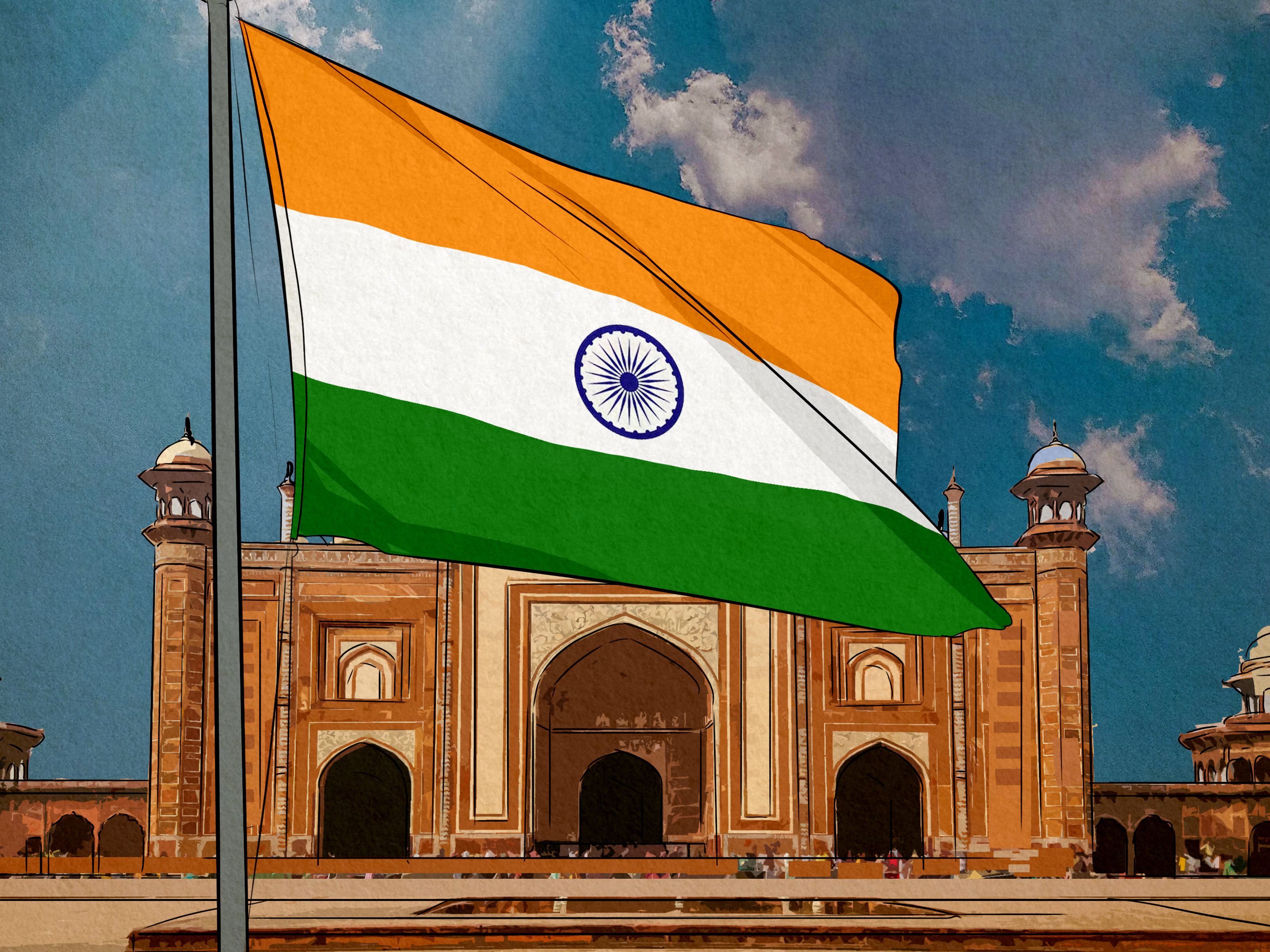
India’s national flag, often called the Tiranga, is a horizontal tricolor of saffron at the top, white in the middle, and green at the bottom. At the center of the white band is the navy blue Ashoka Chakra, a 24-spoked wheel. Although people often describe the top band as orange, the official color is India saffron, which is why accuracy-minded writers should avoid calling it plain orange without explanation.
The saffron band is commonly associated with courage, strength, and sacrifice. White is linked with peace and truth. Green often represents fertility, growth, and auspiciousness. The Ashoka Chakra adds a powerful layer of meaning. It is not decoration tossed in because someone thought the middle stripe looked lonely. The wheel symbolizes law, movement, progress, and ethical action.
Why India’s Flag Is More Than a Tricolor
India’s flag was adopted in its present form shortly before independence in 1947. Its design emerged from a long freedom struggle, and the final version replaced the spinning wheel used in earlier nationalist designs with the Ashoka Chakra. That change connected the flag to a broader idea of justice, governance, and forward motion.
The result is one of the most recognizable flags in the world. The design balances warmth, calm, and vitality: saffron brings intensity, white provides clarity, green grounds the flag in life and growth, and the blue Chakra creates a strong central focus. It is a flag with rhythm. Even standing still, it seems to move.
3. Côte d’Ivoire: Orange, White, and Green in a Vertical Tricolor
Côte d’Ivoire, also known in English as Ivory Coast, flies a vertical tricolor of orange, white, and green. It is one of the flags most often confused with Ireland’s because both use the same three colors in vertical bands. The key difference is the order: Côte d’Ivoire begins with orange at the hoist, followed by white and green. Ireland begins with green.
The Ivorian flag was adopted in 1959, shortly before the country became fully independent from France in 1960. Its vertical tricolor layout reflects the influence of the French Tricolor, but the colors speak to Ivorian identity. Orange is often interpreted as national growth, the land, or the northern savannas. White is linked with peace, purity, and unity. Green is associated with hope, forests, and a better future.
Ireland vs. Côte d’Ivoire: The Friendly Flag Mix-Up
If flags had a “frequently mistaken for” section on their résumés, Ireland and Côte d’Ivoire would list each other in bold. Both are vertical tricolors. Both use green, white, and orange. Both avoid extra symbols. But their proportions and color order differ. Ireland is longer, with green at the hoist. Côte d’Ivoire has a 2:3 proportion and places orange at the hoist.
The similarities are useful for teaching vexillology, the study of flags, because they show how a small design change can alter national meaning. Flip the order, shift the proportions, move the historical context, and suddenly the same color palette belongs to a completely different country.
4. Niger: Orange, White, Green, and the Sun
Niger’s flag is a horizontal tricolor with orange on top, white in the middle, and green at the bottom. In the center of the white band sits a small orange disk, commonly interpreted as the sun. The flag was adopted in 1959, before Niger’s independence from France in 1960.
The orange band is often connected with the Sahara or the dry northern regions of the country. White is linked with purity and innocence. Green points to hope and fertile southern and western areas, as well as productive land. The orange disk adds a distinctive symbol that sets Niger apart from India, whose flag also uses a horizontal orange/saffron-white-green structure but places a blue wheel in the center instead of an orange disk.
Niger and India: Similar Layout, Different Centerpiece
Niger’s flag and India’s flag are another classic comparison. Both are horizontal tricolors. Both feature warm color at the top, white in the center, and green at the bottom. But the central symbols make them immediately different. India has the navy blue Ashoka Chakra with 24 spokes. Niger has a simple orange disk representing the sun.
The effect is striking. India’s wheel suggests law, movement, and philosophical depth. Niger’s disk feels elemental: sun, land, heat, endurance. It is minimal but memorable, like a tiny sunrise placed exactly where your eye expects something important to happen.
5. Cyprus: White, Green, and Copper-Orange Symbolism
Cyprus is the most visually different flag on this list. Instead of stripes, the national flag uses a white field with a copper-colored silhouette of the island above two crossed green olive branches. The copper shade is often perceived as orange or copper-orange, which is why Cyprus appears in many discussions of flags with green, white, and orange elements.
The white background represents peace. The green olive branches symbolize hope for peace and reconciliation, especially between Greek Cypriot and Turkish Cypriot communities. The copper-colored map refers to Cyprus’s historical connection with copper; the island was famous in antiquity for copper resources, and the metal is closely tied to its identity.
Why Cyprus Breaks the Stripe Pattern
Most flags in this color family use tricolors. Cyprus does something more unusual: it puts the country’s own map on the flag. That is rare among national flags. The design is intentionally neutral, avoiding symbols that would strongly favor one major community over another. No cross. No crescent. No blue or red emphasis. Instead, the flag uses the island itself, olive branches, and a white field as a visual plea for unity.
In design terms, Cyprus proves that green, white, and orange do not need to appear as bands. They can work as background, emblem, and symbol. It is a quieter flag than the tricolors, but its message is direct: here is the island, here is peace, please stop making things complicated.
Common Themes Behind Green, White, and Orange Flags
Peace Is the White Thread
Across these five flags, white frequently represents peace, unity, truth, purity, or reconciliation. That is not surprising. White is widely used in flags as a balancing color. It creates contrast, separates stronger colors, and often carries the symbolic job of cooling down conflict. In Ireland, it stands between green and orange. In India, it holds the Ashoka Chakra. In Niger, it frames the sun disk. In Cyprus, it becomes the whole background for a message of peace.
Green Usually Points to Life, Land, or Hope
Green is one of the most flexible colors in flag design. In these flags, it can suggest fertile land, forests, agriculture, growth, or cultural identity. For Côte d’Ivoire, green is often tied to hope and the forests of the south. For Niger, it connects with fertile regions and hope. For India, it suggests growth and auspiciousness. For Cyprus, the green olive branches represent peace. For Ireland, green is commonly connected to Gaelic and nationalist traditions.
Orange Brings Energy and Identity
Orange is less common on national flags than red, blue, green, or white, which makes it stand out. In Ireland, orange is connected with the Orange tradition. In Côte d’Ivoire, it is often associated with national development or northern landscapes. In Niger, orange suggests the Sahara and the sun. In India, saffron carries meanings of courage and sacrifice. In Cyprus, copper-orange points to the island’s mineral heritage.
How to Tell These Five Flags Apart
Here is the easy memory trick. Ireland is vertical and starts green. Côte d’Ivoire is vertical and starts orange. India is horizontal and has a blue wheel. Niger is horizontal and has an orange sun disk. Cyprus is white with a copper island map and green olive branches. That is the whole cheat sheet. Congratulations: you are now slightly more prepared for trivia night than the person who keeps calling every tricolor “Italy but different.”
Also remember that not every green-and-white flag belongs in this group. Nigeria, for example, has a green-white-green flag, but no orange. Italy has green, white, and red, not orange. Hungary has red, white, and green. These look related at a glance, but the color set is different. In flags, one stripe can change everything.
Experiences and Reflections: Seeing Green, White, and Orange Flags in Real Life
There is something different about seeing a flag in motion compared with seeing it in a textbook. On a page, the Irish tricolor is neat and balanced. In the wind, it becomes emotional. The green, white, and orange do not simply sit beside one another; they ripple together. That movement makes the symbolism easier to feel. The white stripe does not look like a passive separator. It looks like a living space between two histories, a reminder that peace is not a decorative idea but an ongoing practice.
India’s flag creates a different experience. The saffron, white, and green bands feel ceremonial, especially when the Ashoka Chakra is clearly visible. The wheel pulls your attention to the center, almost like the flag is asking you to pause and think about responsibility. At public events, the Tiranga has a powerful visual presence because the design combines color, geometry, and national memory. It is not just a flag you look at; it feels like a flag that looks back and says, “Stand up straight, history is in the room.”
Côte d’Ivoire’s flag often surprises people who first notice its similarity to Ireland’s. That moment of confusion can actually be a useful learning experience. It shows how easy it is to assume that colors have universal meanings when they do not. The same three colors can carry completely different stories depending on geography, colonial history, independence movements, political ideals, and national landscapes. Once you learn that Côte d’Ivoire’s orange-white-green arrangement reflects its own identity, the flag stops looking like a reversed Irish flag and starts standing firmly on its own.
Niger’s flag feels especially connected to environment. The orange band and orange disk bring to mind sun and heat, while the green suggests hope and fertile zones. It is a compact design, but it tells a landscape story. Many flags are political first and geographic second; Niger’s flag feels both at once. The central disk is small, yet it changes the whole personality of the flag. Without it, the design could be mistaken for another tricolor. With it, the flag gains a focal point that is easy to remember.
Cyprus offers perhaps the most reflective experience because its flag does not rely on stripes. The white field gives it a quiet quality, while the island map makes the country itself the central symbol. The olive branches below the map are simple, but they carry a message that feels deeply human: peace is the goal, and the land is shared. In a world where many flags emphasize victory, power, or revolution, Cyprus uses its flag to emphasize reconciliation. That is not flashy, but it is powerful.
For travelers, students, teachers, and curious readers, these flags are excellent reminders that national symbols are not random color palettes. They are visual essays. They compress arguments, hopes, wounds, landscapes, and aspirations into a rectangle that can be raised on a pole. Once you begin noticing green, white, and orange flags, you start noticing the choices behind them: stripe direction, color order, center symbols, proportions, and historical timing. Suddenly a flag is no longer “that one with orange.” It becomes a doorway into a country’s story.
The best way to remember these five nations is to connect each flag with one strong image. Ireland: peace between traditions. India: the wheel of law and progress. Côte d’Ivoire: orange at the hoist and hope for national development. Niger: the sun over desert and fertile land. Cyprus: a copper island above olive branches. Those images are stickier than memorizing color order alone, and they make the topic much more enjoyable. Geography is easier when it comes with pictures, stories, and the occasional flag mix-up.
Conclusion
The five nations with green, white, and orange flags each use the palette in a distinct way. Ireland and Côte d’Ivoire are the classic vertical tricolors, often mistaken for one another but separated by color order, proportions, and meaning. India and Niger share a horizontal structure, yet India’s Ashoka Chakra and Niger’s orange sun disk create very different identities. Cyprus breaks away from stripes entirely, using a copper-orange map, green olive branches, and a white background to express peace and reconciliation.
These flags prove that color alone never tells the whole story. Green may mean land, tradition, growth, or hope. White may symbolize peace, truth, purity, or unity. Orange may point to courage, desert, national growth, religious history, or copper. Together, the colors create some of the world’s most memorable national symbols. And yes, they may still confuse you during a fast-paced flag quizbut now, at least, you can be confused with confidence.
SEO Tags
Note: This article is written in standard American English and is based on real flag descriptions, national symbolism, and historical background from reputable reference and government sources. No source links are embedded so the HTML remains publication-ready.

