
Beauty Tools & Accessories
Top 10 Funniest Cartoon Shows Ever
Jun
Cartoon comedy is one of television’s sneakiest superpowers. A live-action sitcom can make someone trip over a chair; an animated show can make a man fight a giant chicken across three zip codes, send a sponge to driving school for the 400th time, or turn a family dinner into a musical number about burger puns. That is the magic of the funniest cartoon shows ever: they bend reality until the joke squeaks.
This ranking looks at more than nostalgia. The best animated comedy shows earn their place through memorable characters, rewatchable jokes, cultural impact, sharp writing, and the ability to make different generations laugh for completely different reasons. Some are family-friendly. Some are proudly not family-friendly unless your family communicates entirely through sarcasm. Together, they prove that cartoons are not just “kids’ stuff.” They are comedy laboratories with unlimited props, zero gravity, and no need to clean up after an explosion.
What Makes a Cartoon Show Truly Funny?
The funniest cartoon series usually share a few traits. First, they have instantly recognizable characters. Homer Simpson’s “D’oh!” works because we know exactly who Homer is: a lovable disaster with a snack-based moral compass. SpongeBob’s laugh works because it sounds like happiness trapped inside a clarinet. Cartman’s insults land because his confidence is wildly out of proportion to his decency.
Second, great animated comedies use the freedom of animation wisely. They do not simply draw jokes; they build worlds where jokes can multiply. In Futurama, science fiction becomes a delivery system for math jokes, robot jokes, alien jokes, and heartbreaking dog jokes. In Looney Tunes, gravity waits politely until a character notices the cliff. In Rick and Morty, one episode can be a family therapy session, a cosmic horror story, and a burp-powered improv routine.
Finally, the funniest cartoons age well because their humor has layers. Kids may laugh at slapstick. Adults may notice satire, wordplay, social commentary, and jokes that flew over their heads years ago like a well-aimed anvil. That combination is why these shows keep finding new fans long after their first episodes aired.
Top 10 Funniest Cartoon Shows Ever
1. The Simpsons
The Simpsons is the grand yellow monument of animated comedy. Created by Matt Groening, the show grew from short sketches into the longest-running primetime scripted series in American television history. But records alone do not make it funny. What makes The Simpsons legendary is how perfectly it turned everyday family life into a satire machine.
Homer, Marge, Bart, Lisa, and Maggie live in Springfield, a town flexible enough to contain a nuclear plant, a corrupt mayor, a billionaire villain, several angry mobs, and somehow still feel like home. The best episodes balance silly jokes with surprisingly sharp observations about school, work, marriage, religion, politics, consumer culture, and the eternal human need for donuts.
The show’s golden-era writing remains a masterclass in joke density. A throwaway sign, background gag, or single line from a side character can become more memorable than the main plot. Characters like Mr. Burns, Chief Wiggum, Krusty the Clown, Moe, and Ralph Wiggum are not just supporting players; they are comedy vending machines that accept payment in chaos.
Why it still matters: The Simpsons helped prove that animated sitcoms could be smart, satirical, emotionally grounded, and wildly popular. Without Springfield, modern adult animation would look very differentand probably have fewer chalkboard gags.
2. Looney Tunes
Before animated sitcoms dominated television, Looney Tunes perfected cartoon comedy in short bursts of genius. Bugs Bunny, Daffy Duck, Porky Pig, Elmer Fudd, Wile E. Coyote, Road Runner, Tweety, Sylvester, and Yosemite Sam built an empire on timing, attitude, and violence so elegant it somehow feels like ballet with dynamite.
The humor of Looney Tunes is beautifully simple on the surface. A coyote wants to catch a bird. A hunter wants to catch a rabbit. A duck wants respect. Yet the execution is endlessly inventive. Bugs does not merely win; he wins with style. Daffy does not merely fail; he fails with theatrical outrage. Wile E. Coyote does not merely fall; he discovers new scientific categories of falling.
These cartoons are funny because they understand rhythm. The pause before the explosion is often funnier than the explosion. The raised eyebrow before Bugs says, “What’s up, Doc?” tells the audience that the game is already over and the rabbit has read the script.
Why it still matters: Looney Tunes created a comedy vocabulary that nearly every animated show has borrowed from. Fast cuts, exaggerated reactions, impossible physics, and fourth-wall jokes all owe a debt to these shorts.
3. SpongeBob SquarePants
SpongeBob SquarePants sounds like a show that should not work: a cheerful sea sponge flips burgers under the ocean while living in a pineapple next to a squid who hates everything. Somehow, it became one of the most beloved cartoon comedy shows ever made. Created by Stephen Hillenburg, the series mixes nautical nonsense with surprisingly precise comic timing.
SpongeBob himself is pure optimism with shoes. Patrick is a starfish-shaped monument to bad ideas. Squidward is the exhausted adult in the room, which is especially tragic because the room is usually full of jellyfish, bubbles, and SpongeBob’s enthusiasm. Mr. Krabs brings money obsession, Sandy brings Texas squirrel science, and Plankton brings villainy at fun-size scale.
The show’s best humor works for children and adults at once. Kids laugh because Patrick says something absurd. Adults laugh because Squidward’s soul appears to leave his body every time SpongeBob knocks on the door. Episodes like “Band Geeks,” “Chocolate with Nuts,” and “Pizza Delivery” are still quoted because the jokes are simple, strange, and perfectly delivered.
Why it still matters: SpongeBob SquarePants became a cross-generational meme factory without losing its bright, weird heart. It is silly in the way a kazoo is silly: impossible to take seriously, yet strangely powerful.
4. South Park
South Park is the cartoon equivalent of a snowball packed around a firecracker. Created by Trey Parker and Matt Stone, the series follows four boys in a Colorado town where every cultural panic, celebrity scandal, political argument, and moral contradiction can become an episode before the rest of television has finished blinking.
The show’s crude animation style is part of the joke. It looks simple, but that simplicity allows the writing to move fast. South Park became famous for satirizing current events with almost reckless speed, often turning public debates into stories involving aliens, talking towels, giant guinea pigs, or Cartman being Cartman, which is basically its own disaster category.
Its comedy is not gentle. The show frequently aims for shock, but its best episodes are sharper than simple provocation. They expose hypocrisy, groupthink, media panic, and the weird ways adults make children’s lives more ridiculous while claiming to protect them.
Why it still matters: South Park proved that animation could be one of the fastest forms of social satire on television. It is rude, risky, and sometimes outrageous, but when it lands, it lands like a piano dropped from a helicopter.
5. Futurama
Futurama is what happens when a workplace comedy steals a spaceship and refuses to apologize. Created by Matt Groening and developed with David X. Cohen, the series follows Fry, a pizza delivery guy frozen in 1999 and awakened 1,000 years later. In the future, he joins Planet Express, a delivery company staffed by a cyclops captain, a hard-drinking robot, a lobster-like doctor, and a professor whose inventions should probably be illegal in several galaxies.
The show’s comedy is brainy without being smug. It packs episodes with science fiction references, math jokes, language gags, absurd bureaucracy, and emotional surprises. Bender is one of animation’s greatest comic creations: selfish, loud, metallic, and somehow lovable despite behaving like a toaster possessed by a casino.
Futurama is especially funny because it uses the future to mock the present. Advertisements are worse, politics are worse, delivery jobs are still exhausting, and humanity remains deeply committed to making dumb choices in exciting new locations.
Why it still matters: Few cartoons combine nerdy intelligence, emotional storytelling, and joke-packed absurdity as well as Futurama. It is comfort food for anyone who likes their comedy with robots and existential dread.
6. Rick and Morty
Rick and Morty took the mad scientist adventure formula, added family dysfunction, multiverse panic, and a suspicious amount of burping, then launched itself into pop culture orbit. The show follows Rick Sanchez, a genius scientist with terrible coping skills, and Morty Smith, his anxious grandson who keeps getting dragged into adventures that would require years of therapy and possibly a space lawyer.
The series is funny because it turns enormous science fiction ideas into personal disasters. A portal gun can open the universe, but it cannot fix a broken family dinner. Clones, alternate timelines, alien civilizations, and reality-ending inventions all become setups for jokes about insecurity, ego, and the absurdity of existence.
The best episodes are not just weird; they are structurally clever. “Total Rickall,” “Pickle Rick,” and “The Ricklantis Mixup” show how the series can move from absurd one-liners to elaborate storytelling without losing comic momentum.
Why it still matters: Rick and Morty made high-concept sci-fi comedy feel mainstream. It is chaotic, cynical, and often gross, but beneath the slime is a surprisingly sharp understanding of family damage and self-sabotage.
7. Bob’s Burgers
Bob’s Burgers is proof that a cartoon does not need constant explosions to be hilarious. Created by Loren Bouchard, the show follows the Belcher family as they run a struggling burger restaurant. Bob is tired but determined, Linda is a one-woman parade, Tina is awkward poetry in human form, Gene is a soundboard with legs, and Louise is what would happen if mischief got a bunny-eared hat.
The comedy comes from affection. Unlike many animated families built on insult warfare, the Belchers actually like each other. They are weird, broke, dramatic, and frequently one health inspection away from doom, but their loyalty gives the jokes warmth.
The show also has one of the best running-gag engines in television: burger-of-the-day puns. A chalkboard can deliver jokes like a tiny stand-up comedian. Add musical numbers, school chaos, holiday episodes, and Tina’s legendary relationship with horses and butts, and you have a show that is cozy without being bland.
Why it still matters: Bob’s Burgers brought heart back to adult animation. It is funny because it understands families are ridiculous, but love makes the ridiculous worth serving with fries.
8. Family Guy
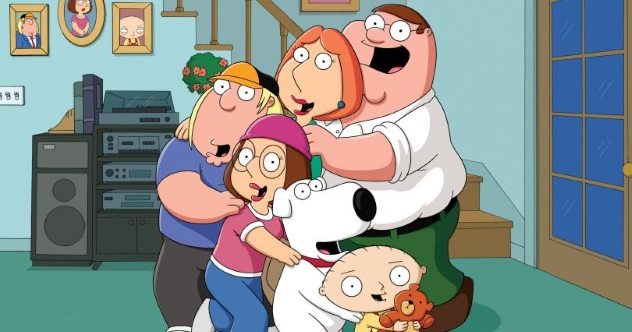
Family Guy is the cartoon that turned the cutaway gag into an Olympic sport. Created by Seth MacFarlane, the series follows the Griffin family of Quahog, Rhode Island: Peter, Lois, Meg, Chris, Stewie, and Brian. On paper, it is a family sitcom. In practice, it is a pop-culture blender with a raccoon inside.
The show’s humor is fast, random, and reference-heavy. A scene can begin with a family argument and end in a flashback involving a celebrity, a historical figure, or a chicken fight that lasts longer than some job interviews. Stewie and Brian became the show’s most flexible comedy duo, shifting between world domination, road trips, musical banter, and strangely sincere friendship.
Not every joke is subtle. In fact, subtlety often leaves the room, locks the door, and files a complaint. But Family Guy has produced some of television’s most memorable animated comedy moments by embracing speed, absurdity, and a complete lack of fear about going too far.
Why it still matters: Family Guy reshaped adult animated comedy by proving that randomness could become a recognizable style. It is loud, messy, and often outrageous, but it knows exactly what kind of circus it is running.
9. Animaniacs
Animaniacs is what happens when classic cartoon energy meets educational songs, Hollywood satire, and jokes written fast enough to require seatbelts. The Warner siblingsYakko, Wakko, and Dotescape the water tower and create beautiful mayhem across studio lots, historical settings, and musical numbers that somehow taught geography better than many classrooms.
The show’s genius lies in its range. It could deliver slapstick for kids, industry jokes for adults, parody songs, old-school vaudeville timing, and Pinky and the Brain segments about two lab mice trying to take over the world. Pinky’s nonsense and Brain’s doomed ambition remain one of animation’s funniest partnerships. Every plan fails, yet Brain returns with the confidence of a tiny dictator who has never met evidence.
Animaniacs also understood that cartoons could be smart without becoming homework. Its wordplay, music, and references reward repeat viewing. Many viewers who watched as kids later returned as adults and discovered half the jokes had been hiding on the top shelf the whole time.
Why it still matters: Animaniacs kept the spirit of classic Warner Bros. comedy alive while creating something fresh, fast, and wonderfully unhinged.
10. Beavis and Butt-Head
Beavis and Butt-Head may look simple: two teenage slackers sit on a couch, laugh at music videos, and make terrible decisions. But that simplicity is exactly why it works. Created by Mike Judge, the show captured a specific kind of dumb teenage energy so accurately that it became strangely brilliant.
Beavis and Butt-Head are not witty in the traditional sense. Their laugh is the joke. Their confusion is the joke. Their ability to misunderstand nearly every situation is also the joke. Yet the show’s stupidity is carefully engineered. The characters reveal the absurdity of media, advertising, school, authority figures, and youth culture simply by reacting to everything with the emotional range of a broken vending machine.
The music video commentary gave the show a unique rhythm. It felt like watching TV with the worst possible friends, which somehow made it hilarious. Later revivals proved that the characters could still function in a modern world because dumbness, like denim, never fully goes out of style.
Why it still matters: Beavis and Butt-Head influenced slacker comedy, adult animation, and deadpan satire. It is lowbrow, yesbut lowbrow comedy can still be sharply observed when the eyebrows are drawn that way on purpose.
Honorable Mentions That Nearly Made the List
Choosing only ten funny cartoon shows is unfair, like asking a parent to pick a favorite child while the other children are holding anvils. Several classics deserve applause. Archer delivers rapid-fire spy parody and some of the sharpest dialogue in adult animation. King of the Hill, also from Mike Judge, is quieter but brilliantly funny in its dry portrait of Texas suburbia. Adventure Time blends surreal humor with emotional depth. BoJack Horseman is painfully funny, though its comedy often arrives wearing a sadness trench coat. Tom and Jerry remains a masterpiece of silent slapstick, even if its “show” format differs from later TV series.
There are also cult favorites like The Venture Bros., Daria, Aqua Teen Hunger Force, Regular Show, and Teen Titans Go!, each with its own comic language. The world of animated comedy is huge, noisy, and occasionally covered in cheese dust, which is exactly how it should be.
Why Animated Comedy Keeps Winning
Animated comedy lasts because it is not limited by budgets, aging actors, or real-world physics. A cartoon character can remain ten years old for thirty years. A town can be destroyed and rebuilt by the next episode. A robot can become a folk hero, a sponge can become a Broadway-level optimist, and a rabbit can defeat an armed hunter with grammar, confidence, and a carrot.
The best funny cartoon shows also invite repeat viewing. A great animated joke can live in the background, in a sign, in a facial expression, or in a line delivered so casually that it becomes funnier the fifth time. That makes cartoons ideal for streaming culture, meme culture, and late-night comfort watching when the brain says, “Please, no serious prestige drama tonight. I have paid taxes.”
Most importantly, cartoons can tell the truth while pretending not to. The Simpsons satirizes American life. South Park attacks public hypocrisy. Bob’s Burgers celebrates weird families trying their best. Rick and Morty mocks intelligence without kindness. SpongeBob reminds us that joy itself can be rebellious, especially when your neighbor plays clarinet badly.
Personal Viewing Experiences: Growing Up With Cartoon Chaos
One of the best things about funny cartoon shows is how differently they hit depending on your age. As a kid, you might watch SpongeBob SquarePants and laugh because Patrick says something perfectly foolish, like his brain has gone on vacation and left no forwarding address. Years later, you rewatch the same episode and realize Squidward is not the villain. He is just tired. Very tired. Spiritually tired. “Worked retail during a holiday sale” tired.
That is the strange beauty of animated comedy: it grows with you even when the characters do not. Bart Simpson has been in fourth grade forever, but viewers keep graduating into new layers of the joke. When you are young, Homer is the goofy dad who strangles words, eats donuts, and makes bad choices. When you are older, Homer becomes a warning label with legs: funny, lovable, and deeply unqualified to manage a nuclear console.
Watching Looney Tunes also feels different over time. At first, it is just hilarious to see Wile E. Coyote fall off a cliff. Later, you admire the craftsmanship: the pause, the sign, the tiny puff of dust, the musical sting. Comedy timing that precise is harder than it looks. Anyone can drop a cartoon coyote. Not everyone can make the fall feel like destiny wearing roller skates.
Adult animated shows create another kind of experience. Futurama may make you laugh at Bender’s shamelessness, then suddenly ambush you with an emotional ending that leaves you staring at the screen like your snack betrayed you. Bob’s Burgers can turn a small family problem into a full musical crisis and still make the Belchers feel real. South Park and Family Guy are often best watched with the understanding that the volume knob is not only for sound; sometimes you need to turn down your expectations of politeness.
What makes these shows memorable is not just the jokes, but the shared experience around them. People quote them at school, at work, in group chats, and during awkward silences when no one knows what to say. A single line from a cartoon can become social currency. Someone says, “Good news, everyone,” and instantly the Futurama fans reveal themselves. Someone says, “Pinky, are you pondering what I’m pondering?” and suddenly the room becomes a tiny nostalgia convention.
There is also comfort in returning to animated comedy. Real life changes quickly. Jobs change. Technology changes. Streaming menus become longer than ancient scrolls. But Springfield is still Springfield. Bikini Bottom is still weird. The Planet Express crew is still underqualified. Bugs Bunny is still calm in a crisis, mostly because he caused it. These worlds offer reliable laughter, and reliable laughter is not a small thing.
The funniest cartoon shows ever are more than background noise. They are time capsules, joke machines, comfort blankets, satire engines, and occasionally very elaborate excuses for characters to scream. Whether you prefer clever wordplay, chaotic slapstick, dark satire, family warmth, or pure nonsense, animated comedy has a couch saved for you. It may be occupied by two slackers, a talking dog, a robot, and a sea sponge, but there is probably room if you bring snacks.
Conclusion
The top 10 funniest cartoon shows ever prove that animation is one of comedy’s most flexible forms. The Simpsons gave animated sitcoms cultural authority. Looney Tunes built the blueprint for visual comedy. SpongeBob SquarePants turned absurd innocence into a global language. South Park made satire faster and sharper. Futurama gave science fiction a hilarious human heart. Rick and Morty sent existential panic through a portal gun. Bob’s Burgers made family weirdness feel warm. Family Guy made randomness a signature style. Animaniacs revived classic cartoon lunacy with brainy speed. Beavis and Butt-Head proved that stupidity, when carefully written, can be weirdly brilliant.
Ranking comedy will always start friendly arguments, and honestly, that is part of the fun. The best cartoon is often the one you quote without thinking, rewatch when you need a mood rescue, or share with someone just to say, “This is my kind of ridiculous.” In that sense, the funniest cartoon shows ever are not only shows. They are laugh tracks for our own livesonly with better timing and more explosions.
SEO Tags
Note: This article was written in original American English and synthesized from real show history, official entertainment information, awards context, and reputable U.S. television coverage, with no copied passages or unnecessary source-code artifacts.

