
Beauty Tools & Accessories
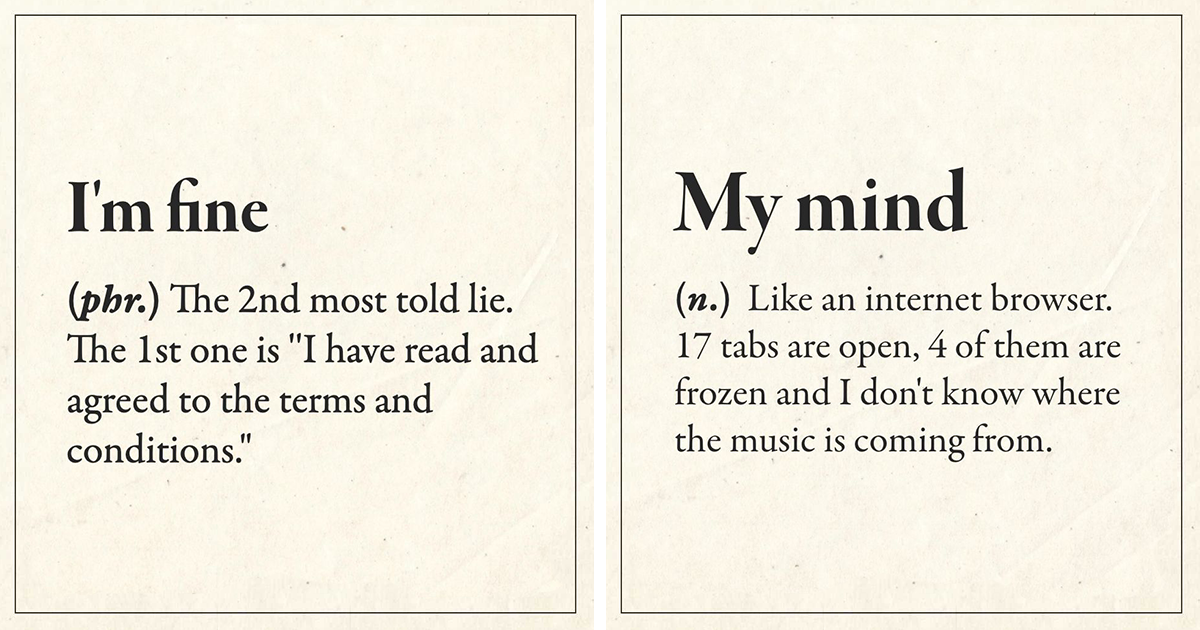
50 Of The Funniest And Most Honest “Definitions” Of Everyday Words Explained In This Crowd-Sourced Online Dictionary
Aug
Traditional dictionaries tell us what words are supposed to mean. The internet, meanwhile, tells us what those words feel like after three meetings, two loads of laundry, a dead phone battery, and an unexpected email marked “urgent.” That difference explains why crowd-sourced online dictionaries can be so entertaining: they replace formal precision with exaggeration, social observation, sarcasm, and the occasional emotional ambush.
Urban Dictionary, founded in 1999, became one of the best-known examples of a user-written slang dictionary. Unlike conventional reference books, it allows multiple contributors to define the same term, often producing competing interpretations, jokes, personal complaints, and miniature cultural time capsules.
The funniest entries rarely explain a word in the academic sense. Instead, they expose the experience hiding behind it. “Monday” stops being merely the day after Sunday and becomes a weekly reminder that freedom was temporary. “Password” is no longer a security credential; it is a puzzle you created six months ago specifically to defeat your future self.
The 50 definitions below are original editorial rewrites inspired by the style of crowd-sourced dictionaries. They are not copied entries. Think of them as unofficial definitions written by people who have survived work emails, family group chats, grocery shopping, online meetings, and the mysterious disappearance of matching socks.
Why Crowd-Sourced Definitions Feel So Accurate
Professional lexicographers generally wait for evidence that a word or meaning has been used widely and consistently before adding it to a dictionary. Online tools have made that usage easier to observe, but established dictionaries still document language rather than accepting every clever phrase invented before lunch.
Crowd-sourced dictionaries operate differently. They can capture new slang, niche references, regional expressions, and internet jokes almost immediately. That speed makes them messy, subjective, and sometimes unreliable, but it also makes them unusually good at recording how people play with language in real time. Linguists have even examined Urban Dictionary as a source of informal language data, while warning that its content can include misinformation, prejudice, and deliberately offensive humor.
Slang has always helped people signal identity and group membership. The internet simply gives a new expression a much larger runway. A phrase can begin in a small online community, spread through memes and group chats, and eventually appear in mainstream dictionaries after demonstrating staying power.
These joke definitions also use one of humor’s most reliable mechanisms: violated expectations. Readers expect a neutral explanation, then receive a painfully specific description of modern life. That unexpected turn creates the punch line. When thousands of people recognize the same experience, the laughter also creates a small sense of connection: apparently, everyone else is ignoring laundry in a chair-shaped formation too.
50 Funny and Honest Definitions of Everyday Words
Work, School, and Other Organized Forms of Tiredness
- Monday: A weekly software update installed without permission that removes motivation, increases loading time, and makes coffee a required operating system.
- Alarm clock: A small electronic device assigned to interrupt the best part of your dream at the exact moment the plot becomes interesting.
- Snooze button: A nine-minute loan taken from your future self at an interest rate of panic, missing socks, and forgotten breakfast.
- Coffee: A hot beverage that transforms “Do not speak to me” into “I can probably answer one carefully worded question.”
- Commute: The unpaid journey during which a person practices patience while calculating how many years of life are being exchanged for brake lights.
- Meeting: A scheduled gathering where six people discuss work that could have been completed by one person before the meeting began.
- Email: A digital message that can travel around the world instantly but may still require three follow-ups and a calendar invitation to receive an answer.
- Reply all: A workplace feature that allows one person’s mistake to become an interactive experience for 147 innocent employees.
- Deadline: A date that appears comfortably distant until it suddenly becomes tonight.
- Lunch break: Thirty minutes officially reserved for eating and unofficially used for errands, scrolling, emotional recovery, and remembering what sunlight looks like.
Home Life and Domestic Mysteries
- Laundry: A household activity that is never completed, only briefly discouraged.
- Laundry chair: A piece of bedroom furniture that begins as seating and gradually becomes an archaeological record of outfits considered but not worn.
- Dishwasher: A machine designed to clean dishes after family members place those dishes directly beside it.
- Refrigerator: A cold cabinet opened repeatedly in the hope that new food has appeared since the previous inspection.
- Leftovers: Food carefully saved for tomorrow and then ignored until it becomes a science project with its own climate.
- Food container: A plastic box that owns several lids, none of which are emotionally or physically compatible with it.
- Junk drawer: The official residence of dead batteries, unidentified keys, expired coupons, three screwdrivers, and a charging cable from an extinct civilization.
- Vacuum cleaner: A machine that becomes extremely loud whenever someone is watching television and completely invisible whenever the floor is dirty.
- Thermostat: A wall-mounted device that turns otherwise loving families into rival climate negotiators.
- Houseplant: A decorative living object purchased with optimism and later used to measure how long guilt can photosynthesize.
Technology and Digital Survival
- Password: A secret combination that must be memorable, impossible to guess, different from every previous password, and unavailable to the person who created it.
- Wi-Fi: An invisible household utility whose failure instantly reveals how little anyone planned to do without the internet.
- Autocorrect: A feature that fixes harmless spelling mistakes while confidently replacing important words with vegetables, relatives, or mild insults.
- Battery percentage: A number ignored at 82%, monitored at 19%, negotiated with at 7%, and treated as a medical emergency at 2%.
- Notification: A tiny digital interruption announcing that an app you forgot installing would like to sell you something you never requested.
- The cloud: A reassuring name for storing important files somewhere you cannot point to and may not remember how to access.
- Terms and conditions: A document everyone claims to have read by clicking a box that legally confirms the opposite of reality.
- Group chat: A digital room where one practical question produces 83 messages, four unrelated photos, two arguments, and no practical answer.
- Screenshot: A photograph taken by your phone when evidence must be preserved before someone edits, deletes, or denies everything.
- Online shopping cart: A virtual museum displaying objects you emotionally purchased but financially abandoned.
Social Life, Relationships, and Polite Confusion
- Adulting: Performing basic survival tasks while privately wondering why no qualified adult has arrived to take over.
- Small talk: A social ritual in which two people discuss weather because revealing their actual thoughts before coffee would be considered alarming.
- Friend: Someone who has seen your least organized behavior and continues answering your messages.
- Best friend: A person who insults you with professional accuracy but will defend you against anyone using less accurate information.
- Neighbor: A nearby resident whose name you may not know but whose trash schedule, parking habits, and preferred power tools are strangely familiar.
- Family group chat: A digital ecosystem containing birthday reminders, blurry photographs, medical updates, suspicious links, and at least one person responding to last Tuesday’s conversation.
- Date night: An evening when two exhausted adults leave the house to discuss work, household repairs, and what time they should return home.
- Networking: Meeting strangers professionally and pretending the sentence “We should connect sometime” contains a measurable plan.
- Apology: A statement that works best when it contains responsibility and works worst when it begins with “I’m sorry you decided to feel.”
- Patience: The ability to remain calm while someone ahead of you slowly discovers how a payment terminal functions.
Money, Motivation, and the Search for Balance
- Budget: A detailed plan explaining where your money should go before reality, delivery fees, and one “small treat” hold an emergency meeting.
- Exercise: A healthy activity scheduled for tomorrow with impressive consistency.
- Diet: A temporary agreement between ambition and vegetables that often collapses when someone mentions pizza.
- Weekend: A two-day event consisting of errands, laundry, one social obligation, and approximately 45 minutes of unexplained free time.
- Vacation: A trip taken to escape ordinary stress by replacing it with packing stress, airport stress, navigation stress, and expensive-snack stress.
- Procrastination: The art of completing twelve unnecessary tasks to avoid beginning the one task that has consequences.
- Confidence: Entering a room as though you belong there and hoping nobody requests supporting documentation.
- Multitasking: The process of doing several things simultaneously, each with the attention normally given to closing an unwanted pop-up.
- Common sense: A supposedly universal resource most frequently mentioned when observing someone who appears to have received a smaller allocation.
- Happiness: A brief, valuable condition often discovered while laughing with good people, eating something excellent, or realizing tomorrow is not Monday.
What These Unofficial Definitions Reveal About Language
These definitions work because they are emotionally recognizable. Almost everyone knows the official meaning of “meeting,” “password,” or “weekend.” The joke adds the unofficial information: the frustration, expectation, social rule, or contradiction attached to the word.
That is also why the best crowd-sourced definitions read like extremely short comedy routines. First comes the familiar subject. Then comes an observation specific enough to feel personal but broad enough to be shared. A food container with no matching lid is not merely kitchen clutter; it is a recurring household mystery with millions of witnesses.
Internet language frequently turns ordinary nouns into cultural shorthand. “Bandwidth,” for example, moved beyond computer networking and became a common metaphor for mental capacity. Meme templates perform a similar function, allowing people to reuse a recognizable structure while changing the details to match new situations.
However, a crowd-sourced dictionary should not be treated as a final authority on spelling, history, medicine, identity, or legal meaning. Popular votes can reward whatever is outrageous, memorable, or emotionally satisfying rather than what is accurate. The entertainment comes from discovering how people interpret a word, not from assuming every contributor is a qualified lexicographer wearing tiny academic glasses.
Shared Experiences Behind the Funniest Everyday Definitions
The Moment a Normal Word Becomes Personal
Most people first encounter a humorous definition while searching for slang they heard in a conversation, comment section, television show, or school hallway. The original goal may be simple: find out what a mysterious phrase means. Twenty minutes later, the search has somehow moved from modern slang to sarcastic definitions of refrigerators, office meetings, dating, sleep, and people who stop walking at the top of escalators.
The strongest reaction is usually not surprise but recognition. A reader sees “laundry chair” described as a storage system for clothing that is neither clean enough for the closet nor dirty enough for the hamper. Suddenly, a private habit has a name. The definition feels almost invasive. Who entered the bedroom? Who has been monitoring the chair?
Using Funny Definitions With Friends
These jokes naturally become social material. Friends send screenshots to one another with messages such as “This is you,” “I feel attacked,” or the especially diplomatic “No comment.” Coworkers trade definitions of meetings, deadlines, corporate jargon, and emails sent at 4:59 p.m. Family members share entries about thermostats, grocery lists, holiday dinners, and relatives who respond to messages several days late.
The fun depends on shared context. A definition of “reply all” may mean little to someone who has never worked in a large organization. To an employee who once watched 200 people ask to be removed from an email chain by replying to the entire email chain, it reads like documentary reporting.
When a Joke Improves the Real Definition
A formal definition aims to be accurate and reusable. A humorous definition aims to make the reader say, “That is exactly what happens.” Occasionally, the joke communicates an emotional reality more efficiently than a literal explanation.
Consider procrastination. A standard dictionary can describe it as delaying an intended action. The internet-style definition shows the behavior: reorganizing a drawer, checking the weather in another country, cleaning the keyboard, researching a purchase nobody plans to make, and finally deciding that the task should begin after a snack. The comic version does not replace the official meaning, but it gives the meaning a recognizable human body.
The Risk of Taking the Crowd Too Seriously
Not every user-submitted definition is clever, fair, or safe to repeat. Open platforms can preserve insults, stereotypes, personal attacks, invented claims, and jokes that target people rather than shared situations. Research on online discourse shows that context and intention are often interpreted differently by different audiences, which helps explain why one reader may see humor while another sees cruelty.
The most durable humorous definitions usually punch at universal inconveniences or the writer’s own behavior. Missing socks, forgotten passwords, awkward small talk, and unrealistic weekend plans invite readers into the joke. Definitions built mainly around contempt tend to age poorly because recognition has been replaced by hostility.
At their best, crowd-written definitions operate like miniature community stories. They remind readers that countless strangers are struggling with the same household chores, workplace rituals, technological failures, and ambitious plans to begin exercising tomorrow. The dictionary may be unofficial, but the experiences are remarkably real.
Conclusion: The Dictionary of Life Is Still Being Written
Everyday words carry more than literal meaning. They collect memories, habits, frustrations, social rules, and jokes. A conventional dictionary documents how language is used across time. A crowd-sourced dictionary captures what people are thinking about that language right now, including the opinions they probably should not place in a formal reference book.
The 50 definitions in this collection transform ordinary words into snapshots of modern life. They are funny because they exaggerate, but they are honest because the exaggeration begins with something familiar. We have all bargained with an alarm clock, opened the refrigerator without a plan, ignored an update, forgotten a password, or watched a weekend disappear into errands.
Language changes whenever people discover a better, faster, stranger, or funnier way to describe an experience. As long as humans continue working, shopping, texting, dating, commuting, procrastinating, and losing container lids, the unofficial dictionary will never be finished.
Editorial note: This article synthesizes general information and perspectives from Urban Dictionary, Merriam-Webster, Dictionary.com, the Library of Congress, Pew Research Center, the Stanford Encyclopedia of Philosophy, UC Berkeley’s Greater Good Science Center, the American Dialect Society, the Linguistic Society of America, Smithsonian Magazine, JSTOR Daily, PBS, and Psychology Today. The numbered definitions are original humorous examples created for this article and should not be interpreted as formal dictionary entries.
SEO Metadata

