
Beauty Unlocked
This Satellite Shines Brighter Than Some Stars, Worrying Astronomers
Jun
Note: This article synthesizes real information from astronomy research, space-industry reporting, and public statements by organizations including Nature, the International Astronomical Union, NOIRLab, the FCC, and observatory-focused satellite-interference studies.
Astronomers are used to surprise guests in the night sky. A meteor zips by. Venus shows off. The International Space Station glides overhead like a quiet science-fiction bus. But recently, one visitor has caused more frowning than wonder: a communications satellite so bright that, at times, it outshines most visible stars.
The satellite is BlueWalker 3, a prototype built by AST SpaceMobile to test direct-to-cellphone connectivity from orbit. In plain English, the dream is simple: your ordinary phone could someday connect to a satellite when towers are out of reach. That sounds heroic, especially for rural areas, emergency zones, oceans, mountains, and places where “no service” is basically the national anthem.
But the sky has a complaint department, and astronomers are currently standing in line with clipboards.
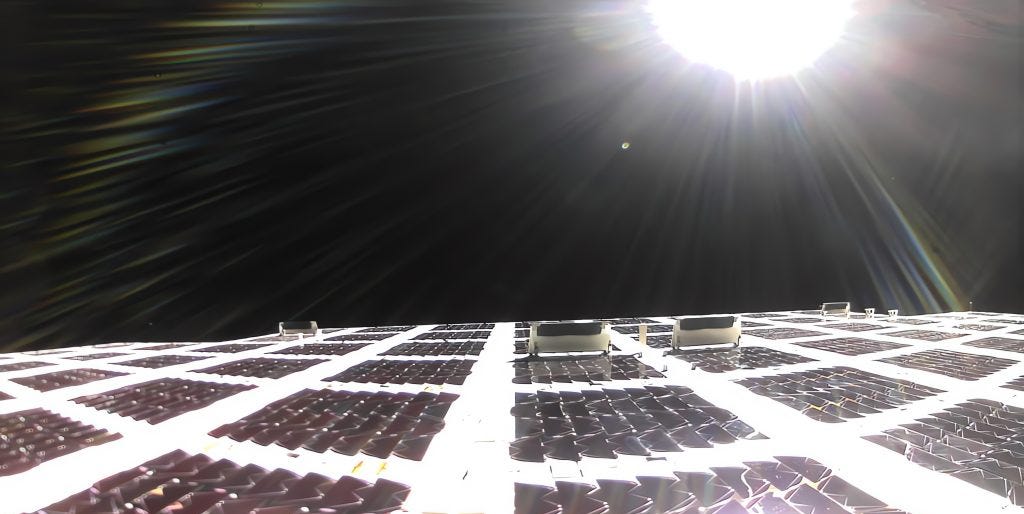
When BlueWalker 3 deployed its huge antenna array, it became one of the brightest human-made objects in low Earth orbit. Measurements reported in scientific research found it could reach an apparent magnitude around 0.4, placing it near the brightness of some of the most prominent stars in the night sky. For a satellite, that is not just bright. That is “walking into a movie theater with your phone flashlight on” bright.
Why BlueWalker 3 Is So Bright
BlueWalker 3 is not a typical small satellite quietly doing its job like a polite metal shoebox. Its most attention-grabbing feature is a large phased-array antenna, roughly 64 square meters in area. Once unfolded, it presents a broad reflective surface that can bounce sunlight toward Earth. To the human eye, that reflected sunlight can look like a moving star.
Brightness in astronomy works on a backward scale that feels designed by someone who wanted to keep students humble. The lower the magnitude number, the brighter the object. A magnitude 6 object is barely visible to the naked eye under dark skies. A magnitude 1 object is very bright. Sirius, the brightest star in the night sky, is around magnitude -1.46. So when a satellite hits magnitude 0.4, astronomers do not shrug. They start calculating, emailing, and possibly stress-eating observatory snacks.
The International Astronomical Union has recommended that low Earth orbit satellites should generally appear fainter than magnitude 7 to reduce interference with professional astronomy. BlueWalker 3, during its brightest moments, was far brighter than that guideline. The issue is not that one satellite looks impressive during a backyard skywatching session. The issue is what happens if dozens, hundreds, or thousands of similarly bright satellites join the orbital party.
Why Astronomers Are Worried
Modern astronomy depends on long exposures, sensitive detectors, and dark skies. Telescopes are built to capture faint light from distant galaxies, asteroids, supernovae, exoplanets, and other cosmic objects that do not exactly shout for attention. A bright satellite crossing the field of view can leave a streak across an image, contaminate data, or create artifacts that software must remove later.
In a casual photograph, a satellite streak might look artistic. In scientific data, it can be a headache wearing a neon jacket. Some images can be corrected. Some data can be masked. But correction is not magic. Every streak adds processing work, uncertainty, and potential loss of information.
This matters especially for wide-field survey telescopes, such as the Vera C. Rubin Observatory in Chile. Rubin’s Legacy Survey of Space and Time is designed to repeatedly scan the sky, helping scientists track moving objects, discover transient events, map dark matter, and study how the universe changes over time. If bright satellites frequently cross those images, they can interfere with exactly the kind of time-sensitive discoveries Rubin was built to make.
The Problem Is Bigger Than One Satellite
BlueWalker 3 is a prototype, but it represents a much larger trend: satellite megaconstellations. Companies are racing to build space-based internet and direct-to-device networks. Starlink, OneWeb, Amazon’s Project Kuiper, AST SpaceMobile, and other operators are part of a new orbital economy where low Earth orbit becomes a busy commercial neighborhood.
The benefits are real. Satellite connectivity can help remote communities, disaster response teams, ships, aircraft, researchers, farmers, and anyone who has ever watched their phone say “SOS only” at the worst possible time. Nobody wants to dismiss the value of communication access. A phone signal can be more than convenient; in emergencies, it can be life-saving.
Still, the night sky is not empty real estate. It is a scientific instrument, a cultural heritage site, a navigation tool, an ecological resource, and, frankly, the world’s oldest free entertainment system. When satellites become brighter and more numerous, they change that shared environment.
How Bright Satellites Affect Optical Astronomy
Optical astronomy studies visible light and nearby wavelengths. When a bright satellite crosses a telescope’s exposure, it can create a trail. The trail may saturate pixels, produce ghosting, or generate electronic artifacts in the detector. For big survey cameras, one streak can affect more than the narrow line it appears to occupy.
Scientists can use prediction software to estimate when satellites will pass over a telescope’s field of view. They can adjust schedules, avoid certain pointings, or remove contaminated pixels. But as satellite numbers grow, avoidance becomes harder. Imagine trying to photograph a quiet landscape while a parade keeps marching through the frame. At first, you wait for a gap. Eventually, the parade becomes the landscape.
Bright satellites are especially troublesome during twilight. Low Earth orbit satellites can still catch sunlight after the ground below has entered darkness. That makes them visible when astronomers are trying to observe the early evening or pre-dawn sky. Unfortunately, those times are important for finding near-Earth asteroids and other objects close to the Sun’s direction in the sky.
Radio Astronomy Has Its Own Headache
BlueWalker 3 also raises concern because direct-to-cell satellites use radio frequencies to communicate. Radio astronomers study natural signals from space, many of which are extremely faint. Their instruments are designed to detect whispers from the universe. A strong human-made radio signal nearby can be like someone starting a leaf blower during a library poetry reading.
Radio observatories often operate in protected frequency bands, but interference can still occur through out-of-band emissions, reflections, harmonics, or sheer signal strength. As more satellites transmit from orbit, coordination between satellite operators and radio astronomers becomes increasingly important.
Why the Night Sky Matters Beyond Science
The satellite brightness debate is not just a technical argument among people with telescopes and impressive coffee mugs. The night sky matters to everyone. For Indigenous communities, the stars are part of cultural knowledge, seasonal calendars, navigation, and storytelling. For wildlife, artificial light can affect migration, feeding, and reproduction. For ordinary people, a dark sky offers wonder, perspective, and the occasional reminder that our email inbox is not the center of the universe.
Light pollution on the ground has already erased the Milky Way from many urban skies. Satellite constellations add a new layer: moving points of light overhead, visible even from places that have worked hard to protect darkness. A remote dark-sky site can reduce streetlights, but it cannot put curtains on low Earth orbit.
Can Satellite Operators Fix the Problem?
The good news is that mitigation is possible. Satellite brightness depends on size, shape, surface materials, altitude, orientation, and how sunlight reflects from the spacecraft. Operators can reduce reflectivity, adjust satellite attitude, use darker coatings, change antenna design, share accurate orbital data, and coordinate with observatories.
SpaceX, for example, has tested various approaches to reduce Starlink brightness, including darker surfaces and visor-style modifications. Results have varied, but the broader lesson is clear: design choices matter. A satellite does not have to be as shiny as a disco ball at a raccoon wedding.
For large antenna satellites like BlueWalker 3 and future BlueBird spacecraft, the challenge is harder because the very feature that makes them usefulthe huge array needed to communicate with ordinary phonescan also make them reflective. Engineers may need to balance performance, thermal control, power generation, radio function, and optical brightness. That is not easy, but it is exactly the kind of problem engineers are paid to solve while surrounded by whiteboards.
Regulation Is Still Catching Up
Space technology is moving faster than the rules designed to manage it. In many countries, satellite approvals focus on spectrum, orbital debris, collision risk, and business licensing. Optical brightness has historically received less regulatory attention. That gap is becoming harder to ignore.
Astronomers and policy experts increasingly argue that satellite brightness should be treated as an environmental impact. The sky is shared globally, but satellite approvals happen nationally. A spacecraft licensed in one country can affect observatories and communities around the world. That makes international standards important.
Organizations such as the International Astronomical Union and NOIRLab have promoted recommendations for satellite operators, including keeping satellites fainter than magnitude 7 where possible, providing accurate position data, and working directly with observatories. The goal is not to ban satellites. The goal is coexistence: better connectivity without turning the sky into a scrolling notification bar.
What Makes BlueWalker 3 a Turning Point
BlueWalker 3 captured attention because it made the issue visibleliterally. Many people can understand a bright moving object crossing the sky more easily than a spreadsheet about orbital population growth. It became a symbol of a larger question: how bright is too bright?
The satellite also shows why prototypes matter. A prototype is not only a test of business technology; it is also a test of environmental impact. If a single spacecraft can become one of the brightest objects in the sky, then future fleets deserve careful review before they scale up.
AST SpaceMobile’s mission is ambitious. Direct-to-cell satellite service could help close coverage gaps and support emergency communication. But ambition in space now requires a broader definition of responsibility. Successful satellite design should consider customers on Earth, other spacecraft in orbit, astronomers at observatories, and the billions of people who still look up.
Specific Examples of Scientific Risk
Asteroid Detection
Finding near-Earth asteroids requires repeated imaging of the sky. A bright satellite trail can obscure faint moving objects or create false detections. Since asteroid surveys often work near twilight, they overlap with times when low Earth orbit satellites can be especially visible.
Supernova Searches
Supernovae and other transient events appear, change, and fade. Survey telescopes compare images over time to identify new points of light. Satellite streaks and artifacts can complicate that process, making it harder to separate real cosmic events from human-made clutter.
Deep Galaxy Surveys
Deep images of galaxies require clean, sensitive data. Even when satellite trails are removed, they can leave residual noise or force scientists to discard affected pixels. Over millions of images, small losses add up.
Radio Observations
Radio telescopes study pulsars, hydrogen gas, fast radio bursts, and distant galaxies. Satellite transmissions near sensitive bands can interfere with observations, especially when satellites are numerous or pass directly through telescope beams.
The Human Side: Why People Still Love Satellites
It is worth admitting something: satellites can be beautiful. Many people remember their first time seeing the International Space Station glide across the sky. It looks calm, purposeful, almost magical. Satellite tracking apps turned skywatching into a fun hobby. For years, bright satellite flares were treated like little celestial Easter eggs.
The emotional conflict is real. We want global connectivity. We want emergency communication. We want scientific discovery. We want dark skies. We want technology to help people without accidentally photobombing the universe. This is not a simple “satellites bad” story. It is a “please stop launching shiny problems faster than we can solve them” story.
What Responsible Satellite Growth Could Look Like
A smarter future would include brightness standards before launch, not after astronomers notice a new artificial star doing laps overhead. Operators could publish detailed ephemerides so observatories know where satellites will be. Regulators could require optical-impact assessments. Engineers could design spacecraft with anti-reflective materials and orientations that reduce glints. Scientists and companies could share data openly.
There is also room for public awareness. Most people do not know that satellites can affect astronomy. When they learn, they often care. The night sky has a rare ability to turn strangers into stakeholders. Nobody owns Orion. Nobody trademarks the Milky Way. The sky belongs to all of us, which is exactly why it is so easy to damage and so hard to govern.
Experience Section: Looking Up in the Age of Bright Satellites
The first time you notice a bright satellite moving across the sky, it can feel like catching a secret. It does not twinkle like a star. It does not blink like an airplane. It simply glides, steady and silent, as if someone dragged a tiny bead of light across a pane of glass. For many skywatchers, that moment is delightful. You point it out to a friend. Everyone briefly stops talking. The sky wins.
But imagine setting up a telescope after weeks of waiting for clear weather. You drive away from city lights, pack snacks, align the mount, check the focus, and finally begin a long exposure of a faint galaxy. Then a bright satellite crosses the frame like a cosmic scratch mark. You take another exposure. Another streak appears. At some point, the experience shifts from wonder to frustration. The satellite is not just passing by; it is interrupting a conversation between Earth and the distant universe.
Amateur astrophotographers already know this feeling. They often stack dozens or hundreds of images to create one clean final picture. Software can reject some satellite trails, but not all. The brighter the satellite, the harder it is to cleanly remove. A faint streak is a small smudge on the windshield. A bright one is a paint roller.
For families at a campsite, the experience is different but still meaningful. A child may ask, “Is that a star?” A parent may explain that it is a satellite bringing internet or phone service. That can spark curiosity. Yet if the sky becomes crowded with moving objects, the ancient pattern of constellations becomes harder to recognize. The Big Dipper competes with hardware. Orion gets company he did not invite.
There is something quietly powerful about a truly dark sky. It slows people down. It makes the universe feel enormous and personal at the same time. The concern around BlueWalker 3 is really a concern about losing that experience piece by piece. Not in one dramatic disaster, but through gradual normalization: one brighter satellite, then ten, then hundreds, until future generations assume the night sky was always busy.
A balanced future should let someone in a remote area call for help using a satellite-connected phone while also letting a student discover Saturn’s rings through a school telescope. It should allow companies to innovate without treating the sky as an afterthought. The best technology does not merely ask, “Can we build it?” It also asks, “What does it change for everyone else?”
BlueWalker 3 is a warning, but not a reason to panic. It is a bright, moving reminder that space is no longer distant from everyday life. The choices engineers, regulators, astronomers, and companies make now will shape what people see when they look up. The sky can handle some satellites. What it cannot handle is carelessness at constellation scale.
Conclusion
BlueWalker 3 shines brighter than some stars because it reflects sunlight from a large antenna array in low Earth orbit. Its brightness has alarmed astronomers because modern telescopes depend on dark, clean skies to study faint and distant objects. Satellite trails can contaminate images, interfere with surveys, complicate asteroid detection, and create problems for radio astronomy.
At the same time, satellite communications can bring real benefits, especially for remote regions and emergency coverage. The challenge is not choosing between science and connectivity. The challenge is designing, regulating, and operating satellites responsibly so both can thrive.
The night sky is not just a backdrop. It is data, heritage, beauty, and shared human property. If companies want to build the future in orbit, they should make sure the future still has stars in it.

