
Makeup
The 10 Weirdest Octopuses In The Ocean
Aug
Octopuses are what happens when evolution gets eight arms, a flexible body, a sophisticated nervous system, and absolutely no interest in looking normal. Even familiar species can squeeze through absurdly small gaps, taste with their suckers, change appearance in seconds, and manipulate objects with remarkable precision. They have three hearts, blue blood, no bones, and enough problem-solving talent to make some office printers look emotionally defeated.
Yet the ocean contains octopuses that make ordinary octopuses look almost conventional. Some resemble flying elephants. Others carry portable houses, impersonate venomous neighbors, glow with electric-blue warning rings, or drift through deep water with most of their bodies nearly invisible. One species looks as though it has seven arms, another manufactures a shell without technically having a shell, and one ghostly deep-sea octopus still lacks a formal scientific name.
Here are 10 of the weirdest octopuses in the ocean, ranked not by scientific law but by a highly serious standard: how quickly each one makes you say, “The ocean invented what?”
1. Dumbo Octopus: The Deep-Sea Ear-Flapper
Why It Looks Like a Cartoon
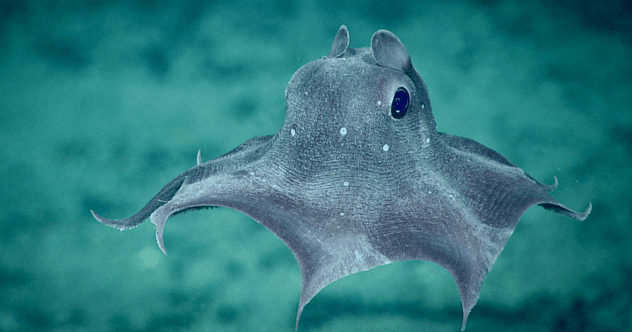
Dumbo octopuses belong to a group of deep-sea cirrate octopods, including species in the genus Grimpoteuthis. Their most famous features are the rounded fins rising from the mantle like oversized ears. Those fins are not decorative accessories. They help the animal move gently through the water, while webbing between its arms can open like an umbrella.
NOAA has documented dumbo octopuses thousands of meters below the surface. Some have been found around 4,000 meters, or roughly 13,120 feet, deep, placing them among the deepest-living octopuses known.
Its Weird Survival Strategy
At those depths, producing a dramatic cloud of ink would be about as useful as turning off the lights in a cave. Dumbo octopuses lack an ink sac and rely on slow, efficient movement rather than flashy escapes. Some species also have fingerlike cirri near their suckers, giving the arms a slightly feathery appearance.
The overall result is an animal that looks like a tiny umbrella, a winged dumpling, and an alien choir conductor at the same time.
2. Flapjack Octopus: The Pancake That Learned to Swim
From Lumpy Breakfast to Floating Umbrella
The flapjack octopus, usually placed in the genus Opisthoteuthis, spends time resting on muddy deep-sea bottoms with its soft body spread into a shape that strongly resembles an undercooked pancake.
When it moves, it can pulse its webbed arms, flap its small fins, and drift downward like an umbrella. Monterey Bay Aquarium reports that flapjack octopuses may grow to about 20 inches and feed on small worms, crustaceans, and other invertebrates hidden in the sediment.
Cute, Gelatinous, and Not Built for Speed
Flapjacks are cirrate octopuses, so they differ from many shallow-water relatives. They lack the dramatic skin-texture changes associated with classic octopus camouflage, and they do not have ink sacs. Their red or orange coloring may look obvious in photographs, but red light does not penetrate far into deep water. To many deep-sea observers, those warm colors effectively disappear into darkness.
It is camouflage by lighting conditionsthe marine equivalent of wearing black to a midnight event.
3. Glass Octopus: The Nearly Invisible Drifter
A Body Made for Disappearing
The glass octopus, Vitreledonella richardi, is a gelatinous open-ocean species that is almost transparent. In clear footage, the most noticeable structures may be its eyes, optic nerves, and digestive tract. The rest of the animal seems to dissolve into the surrounding water.
Transparency helps reduce its silhouette in the dim midwater environment, where being difficult to see is more practical than carrying armor or finding a rocky hiding place.
So Rare That Predators Became Research Assistants
Live observations have historically been scarce. Schmidt Ocean Institute reported rare Pacific sightings and explained that scientists previously had to learn much of what they knew from specimens recovered from predator stomachs. That is not an ideal research program for the octopus.
Its see-through body gives it a supernatural appearance, as though the ocean forgot to finish rendering the animal before releasing it.
4. Mimic Octopus: The Ocean’s One-Animal Theater Company
Camouflage Is Only the Opening Act
The mimic octopus, Thaumoctopus mimicus, does more than match sand or mud. It changes color, posture, movement, and arm arrangement to resemble other animals. Documented impersonations include lionfish, flatfish, jellyfish, and sea snakes.
To perform the sea-snake routine, it may hide most of its body in a burrow while extending and rippling two banded arms. When imitating a flatfish, it pulls its arms into a leaf-shaped outline and swims with the flattened profile of its model.
It Chooses the Costume for the Audience
The most impressive part is not simply having several disguises. The octopus appears able to deploy a particular imitation in response to a particular threat. National Geographic describes sea-snake mimicry used when the octopus is harassed by damselfish, which are preyed upon by sea snakes.
This suggests a flexible defensive performance rather than one automatic costume. In human terms, the mimic octopus is not merely wearing a uniform. It is reading the room, identifying the audience, and selecting the most terrifying character from its wardrobe.
5. Blanket Octopus: The Superhero Cape With Tentacle Weapons
The Most Unequal Couple in the Sea
Female blanket octopuses can reach several feet in length, while males may be smaller than an inch. National Geographic reports that large females can outweigh males by tens of thousands of times, making this one of the most extreme examples of sexual size dimorphism in the animal kingdom.
The male uses a specialized reproductive arm called a hectocotylus. It can detach during reproduction and be retained by the female until she uses the sperm to fertilize her eggs.
A Living Cape and Borrowed Stingers
Females have dramatic sheets of webbing between certain arms. When unfurled, the membranes create a flowing blanket-like silhouette that makes the animal appear larger and more intimidating.
Blanket octopuses also have resistance to the stinging cells of the Portuguese man-of-war. Individuals have been observed carrying detached pieces of the siphonophore’s tentacles as defensive weapons. Apparently, being a giant floating cape was not weird enough; the octopus also needed a borrowed electric fence.
6. Coconut Octopus: The Tool User With Carry-On Luggage
Portable Shelter, Some Assembly Required
The coconut octopus, also called the veined octopus, is Amphioctopus marginatus. It gathers coconut-shell halves or suitable seashells, carries them across exposed seafloor, and assembles them into a protective shelter when needed.
Researchers have treated this as tool use because hauling the shells creates an immediate cost and vulnerability, while the protective benefit arrives later. The shell is not permanently attached to the animal. It is transported for future use, much like a camper carrying a tent.
Walking Awkwardly for a Smarter Future
To move with its shell collection, the octopus may lift itself and “stilt-walk” across the bottom, holding the material beneath its body. It looks comically inconvenient because it is inconvenient. The octopus could move faster without the shells, but then it would have nowhere to hide on an open stretch of sediment.
The animal accepts a short-term disadvantage to keep emergency housing available. Humans call this planning ahead. The coconut octopus calls it Tuesday.
7. Blue-Ringed Octopus: Tiny Body, Serious Warning Lights
The Rings Are Not Decorative
Blue-ringed octopuses in the genus Hapalochlaena are small, visually striking, and dangerously venomous. When disturbed, their bright blue rings become much more conspicuous against the skin. The display is a warning rather than an invitation to get a closer photograph.
Specialized color and reflective structures help create the startling signal. When the rings begin flashing, the octopus is communicating that the situation has already become far too personal.
A Venom That Can Stop Breathing
The venom contains tetrodotoxin, a potent neurotoxin that interferes with nerve signaling and can cause progressive muscle weakness and paralysis. Severe poisoning can paralyze respiratory muscles and requires immediate emergency care and breathing support.
Bites may be small or initially easy to overlook, which is another excellent reason to admire these animals without touching them. The blue rings are essentially a neon sign reading, “Personal space is not optional.”
8. Seven-Arm Octopus: Eight Arms, One Naming Problem
Yes, It Really Has Eight
The seven-arm octopus, Haliphron atlanticus, is named for an illusion. Males keep their specialized reproductive arm tucked inside a sac beneath the right eye, so the animal can appear to have only seven arms.
Females are dramatically larger than males. Large individuals may reach about 13 feet in total length and weigh approximately 165 pounds, placing the species among the largest known octopuses.
A Gelatinous Giant That Eats Jellies
This rarely observed octopus lives through broad areas of the open ocean, including the twilight zone. MBARI observations and museum evidence show that it feeds on jellyfish and other gelatinous animals.
Researchers have seen individuals holding jellies and may reuse the trailing stinging tentacles for defense after eating part of the bell. It is a giant octopus using jellyfish as both lunch and security equipmentan efficient arrangement, if not a comforting one.
9. Argonaut: The Octopus That Builds a “Shell”
Not Actually a Nautilus
Argonauts are often called paper nautiluses, but they are open-ocean octopuses rather than true nautiluses. Female argonauts secrete a thin, spiraled egg case using specialized expanded areas of their front arms.
The case resembles a delicate shell and protects the eggs, yet it is not the same kind of chambered shell produced by a nautilus. It is a separate evolutionary inventionone that happens to look like expensive porcelain made by an underwater mollusk.
Built-In Nursery and Buoyancy Device
The female can trap air in the egg case and use it to help control buoyancy in the open ocean. Argonauts also display strong sexual dimorphism: WWF reports that females may be eight times larger and hundreds of times heavier than males.
Early naturalists imagined these animals sailing with their arms. The truth is less poetic but much stranger: the female manufactures a paper-thin nursery and uses trapped air to manage life at sea.
10. Casper Octopus: The Nameless Ghost of the Abyss
Discovered Live on a Global Broadcast
In 2016, NOAA’s remotely operated vehicle Deep Discoverer encountered a small, pale, nearly translucent octopus more than 4,000 meters below the surface near Hawaii. Viewers quickly nicknamed it “Casper” because of its ghostlike appearance.
The sighting set a depth record for an incirrate octopod, the broad group that lacks the fins and fingerlike cirri seen in dumbo-style octopuses.
Still Waiting for a Scientific Name
Similar animals have since been observed, including females apparently brooding eggs on dead sponge stalks. Yet Casper remains scientifically undescribed because researchers have not collected a specimen needed for detailed anatomical and genetic comparison.
Its striking lack of obvious pigment is also not fully understood. Ten years after the first famous sighting, the ocean’s cutest ghost is still carrying the taxonomic equivalent of a handwritten name tag.
Why the Weirdest Octopuses Matter
These species are not strange merely for our entertainment. Their unusual bodies and behaviors are solutions to difficult ecological problems. Transparency reduces visibility in open water. Webbing makes a small animal appear larger. Portable shells provide shelter on bare sediment. Mimicry turns predators’ fears against them, while deep-sea fins allow economical movement in places where food may be scarce.
Their unconventional reproductive anatomy is equally important. Open-ocean animals may be scattered across enormous distances, so evolution has produced detachable mating arms, dramatic differences between males and females, portable egg cases, and extended brooding behaviors.
The weirdness is not random. Every bizarre structure exists because, somewhere in the species’ evolutionary history, it helped an animal survive long enough to reproduce.
These octopuses also show how much remains unknown. Deep-sea species can be too fragile for conventional collection, too rare for frequent observation, and too remote for ordinary diving. Remotely operated vehicles, human-occupied submersibles, museum collections, and genetic tools are gradually revealing lives that once appeared only as damaged specimens or blurry shapes.
Ocean Encounter Experiences: What Seeing These Octopuses Can Feel Like
Experience 1: Meeting a Mimic on a Sandy Dive
Imagine descending over a pale Indonesian sand flat where almost nothing seems to offer shelter. A striped shape suddenly rises, spreads its arms, and glides like a venomous flatfish. Seconds later, it collapses into a different posture and appears to become something else.
The memorable part is not simply the camouflage. It is the sense that the animal is actively responding to attention. Its body is not just changing color; it is becoming a moving argument about why a predator should look elsewhere.
Responsible divers keep their distance, avoid blocking the octopus’s retreat, and resist provoking another “performance.” The best encounter is one in which the animal chooses what to do next rather than being chased into a costume change.
Experience 2: Watching a Coconut Octopus Move House
A coconut octopus encounter can begin with what looks like a shell shifting for no reason. Then arms appear, followed by an octopus hauling its shelter across the sediment in a wonderfully awkward walk.
The scene is funny, but it also creates a flash of recognition: this animal is carrying something now because it may need it later. Divers often remember the intelligence implied by the behavior more than the octopus’s color or size.
It is like watching a camper drag a tent across a parking lotexcept the camper has eight arms, no bones, and a much better excuse. When the animal finally disappears inside its portable shelter, the comedy gives way to admiration. What looked ridiculous was actually a carefully organized survival strategy.
Experience 3: Seeing the Deep Sea Through an ROV Feed
Most people will never physically visit the habitat of a dumbo, glass, seven-arm, or Casper octopus. The realistic experience comes through an ROV livestream: a dark screen, drifting particles, quiet scientific conversation, and sudden excitement when an unfamiliar shape enters the vehicle’s lights.
Scale can be difficult to judge until laser dots, robotic equipment, or nearby rocks provide a reference. The animal may remain visible for only a few minutes before swimming beyond the cameras.
That brief appearance feels less like visiting an aquarium and more like receiving a transmission from another worldone that has always been here, directly below the waves. Because some species are rarely observed alive, a few minutes of video may become useful scientific evidence rather than merely beautiful footage.
Experience 4: The Blue-Ringed Octopus Reality Check
A blue-ringed octopus may be small enough to tempt a careless tide-pool visitor into treating it like a collectible. The experience should instead trigger immediate respect. When the rings brighten, the animal is communicating stress or warning.
Backing away protects both the person and the octopus. No photograph is worth handling a venomous wild animal, and no wildlife encounter improves when the subject is cornered, moved, or placed on someone’s hand for social media.
The most impressive memory should be the sudden electric colornot an emergency trip caused by ignoring one of nature’s clearest signs.
Experience 5: Looking at an Argonaut’s Impossible Design
Seeing an argonaut, whether alive, in high-quality footage, or represented by an empty egg case in a museum, can scramble familiar categories. It looks shelled but is an octopus. The “shell” is an egg case made by the female. It functions as a nursery and contributes to buoyancy.
The animal lives in open water rather than crawling through a permanent rocky den. Its fragile case seems decorative, but every curve has a practical role in reproduction and survival.
This is the broader experience offered by all 10 species: each one breaks a rule that was never truly a ruleonly an assumption humans formed after seeing too little of the ocean.
Conclusion
The weirdest octopuses in the ocean demonstrate that evolution is less like a tidy engineer and more like a brilliant inventor working without adult supervision. Dumbo octopuses fly with ear-like fins. Flapjacks become umbrellas. Glass octopuses nearly vanish. Mimics perform a rotating cast of dangerous animals, while blanket octopuses unfold capes and borrow stinging weapons.
Coconut octopuses carry houses, blue-ringed octopuses flash toxic warnings, seven-arm octopuses hide the arm that inspired their misleading name, argonauts manufacture delicate egg cases, and Casper remains a ghost without an official scientific identity.
The deeper lesson is not that the ocean is full of monsters. It is that life becomes wonderfully unfamiliar when it adapts to environments humans rarely see. Each strange octopus is a working answer to darkness, predators, scarce shelter, open water, or the challenge of finding a mate.
We laugh because they look bizarre, but their designs are serious, successful, and often astonishingly elegant. The next time someone says aliens would be impossible to imagine, show them a transparent octopus, a living blanket, and a coconut carrying its own bunker.
Note: This article synthesizes established information from marine research institutions, museums, aquariums, scientific publications, and ocean-exploration organizations. Wildlife should be observed without touching, chasing, feeding, collecting, or deliberately provoking defensive behavior.

