
Hair Care
I Travelled 25000 Km In Siberia To Photograph Its Indigenous People, 6 Months Later Here’s The Result
Jun
There are travel stories, and then there are travel stories that make your passport look like it has been living a very quiet life. “I travelled 25,000 km in Siberia to photograph its Indigenous people” is not a casual weekend caption. It is the kind of sentence that carries frostbite, train smoke, road dust, tea served in remote kitchens, and a camera bag that probably deserved its own frequent-traveler card.
The journey was led by photographer Alexander Khimushin, born in Yakutia, Siberia, and known for The World in Faces, a portrait project dedicated to documenting Indigenous peoples and traditional cultures around the world. Over six months, he crossed enormous distances through Siberia, visiting remote communities and photographing people whose cultures are often discussed in footnotes but rarely seen with dignity, color, and human closeness.
Siberia is not just “a cold place” where movie villains build secret bases. It is a vast region stretching from the Ural Mountains toward the Pacific, from Arctic tundra to taiga forests, steppe, mountains, rivers, and settlements so distant from one another that “nearby” can mean “see you after two fuel stops and a snowstorm.” The result of this 25,000 km Siberian photography journey is more than a gallery. It is a visual reminder that Indigenous Siberian people are not relics of the past. They are living communities with languages, clothing, ceremonies, humor, pride, and stories that deserve more than a passing glance.
A Journey Across Siberia: More Than Miles on a Map
Covering 25,000 km in Siberia is not the same as taking a scenic road trip with a playlist and a gas station cappuccino. Distances here are heroic. Weather has opinions. Roads may exist, disappear, or transform into a philosophical question. Trains, boats, winter tracks, local vehicles, and plenty of patience all become part of the route.
Khimushin’s route carried him from areas around Lake Baikal to the Russian Far East, from steppe landscapes influenced by Mongolia to Yakutia, one of the coldest inhabited regions on Earth. That geographical range matters because Siberia is not one culture, one language, or one story. It is a mosaic of peoples, including groups such as the Evenki, Nenets, Sakha, Buryat, Dolgan, Nganasan, Ulchi, Chukchi, Yukaghir, Ket, and many others. Some communities are larger and widely known within Russia; others are so small that every language speaker, elder, and child matters to cultural survival.
The distance also changes the meaning of a portrait. In a city studio, a photographer can adjust lights, brew coffee, and ask for another take. In remote Siberia, every photograph depends on trust. The person in front of the camera is not a “subject” in the museum-label sense. They are a host, a storyteller, a guardian of clothing and customs, and sometimes the bridge between a photographer and an entire community.
Who Are Siberia’s Indigenous People?
Russia has more than 100 identified ethnic groups, and dozens are legally recognized as Indigenous small-numbered peoples of the North, Siberia, and the Far East. The legal category is narrow: groups must generally have fewer than 50,000 members, maintain traditional ways of life, live in specific remote territories, and identify as distinct peoples. That definition leaves out some larger Indigenous or native peoples, such as the Sakha and Buryat, who remain culturally central to Siberia’s story.
Traditional livelihoods vary across the region. Reindeer herding, hunting, fishing, gathering, horse breeding, craftwork, and seasonal migration all appear in different forms. A Nenets herder’s relationship with tundra, reindeer, and migration routes is not the same as a Buryat community’s Buddhist and shamanic traditions near Lake Baikal, or an Evenki family’s life shaped by taiga forests and reindeer. Putting them all under the label “Indigenous Siberian people” is useful for search engines, but real life is more specific, more local, and far more interesting.
The Evenki: Reindeer, Taiga, and Elegant Clothing
The Evenki are spread across huge areas of Siberia and the Russian Far East. Many are historically connected with reindeer herding, hunting, and forest mobility. In Khimushin’s portraits, Evenki clothing often appears with striking detail: fur, beadwork, ornament, and silhouettes shaped by both beauty and survival. This is fashion with a job description. It is meant to move, warm, protect, and signal identity.
The Nenets: Migration Across the Arctic
The Nenets are widely known for reindeer herding on the Yamal Peninsula and other Arctic regions. Some Nenets families migrate hundreds of miles each year with their herds. Their seasonal movement is not a romantic postcard; it is demanding labor shaped by weather, pasture, family knowledge, and increasingly by climate change and industrial development. When pipelines, roads, and gas fields enter migration routes, the challenge is not abstract. It can affect animals, food security, and the rhythm of life.
The Sakha, Buryat, and Other Larger Peoples
The Sakha, also called Yakuts, are one of Siberia’s major Turkic-speaking peoples and are strongly associated with the Republic of Sakha (Yakutia). Buryat culture, with deep links to Lake Baikal, Buddhism, shamanic traditions, music, and horsemanship, adds another layer to Siberia’s cultural richness. These groups remind us that Indigenous identity is not always about small numbers. It is also about place, memory, language, and continuity.
Why Portrait Photography Matters
A portrait can be simple: face, eyes, light, background. But in the right hands, it becomes a conversation. Khimushin’s Siberian portraits often show people in traditional clothing, not as costumes for outsiders, but as expressions of belonging. The best images do not say, “Look how exotic this person is.” They say, “Look how much humanity you were about to overlook.”
This distinction is important. Photography has a complicated history with Indigenous communities. Too often, cameras arrived with colonial curiosity, staging people as specimens or freezing them in an imagined past. A more respectful approach begins with consent, names, context, patience, and the understanding that beauty does not erase struggle. A gorgeous portrait of an Indigenous Siberian woman in embroidered clothing can inspire admiration, but it should also invite questions: What language does she speak? Is it being taught to children? What pressures does her community face? What does she want outsiders to understand?
That is why The World in Faces has resonated internationally. The project’s power comes from its directness. Instead of treating cultural diversity as an academic chart, it brings viewers face to face with people. Suddenly “endangered language” is not just a phrase. It is someone’s grandmother. “Traditional culture” is not a museum cabinet. It is a young person deciding whether to carry a song, a pattern, a word, or a ceremony into the future.
Siberia: A Landscape That Shapes Culture
To understand the portraits, you need to understand the land. Siberia includes tundra, taiga, mountains, river systems, permafrost, and steppe. Winters can be severe beyond the imagination of anyone who complains when the office air conditioner is set to 68 degrees. In parts of Yakutia, temperatures have reached some of the lowest ever recorded in inhabited places.
Such conditions shape architecture, clothing, food, transportation, and humor. In Siberia, warmth is not just comfort; it is engineering. Clothing is knowledge stitched into fur and fabric. A tent, cabin, or chum is not just shelter; it is a survival system. Tea is not just tea. It is social glue, central heating for the soul, and occasionally the only thing standing between you and becoming a dramatic ice sculpture.
At the same time, Siberia is rich in resources: natural gas, oil, coal, diamonds, gold, timber, and other minerals. This has made the region economically important, but it has also created tension. Extractive industries can bring roads, wages, and infrastructure, but they can also disrupt migration routes, damage pastures, pollute waterways, and pressure Indigenous communities to adapt faster than cultures can safely absorb.
The Result After Six Months: A Human Map of Siberia
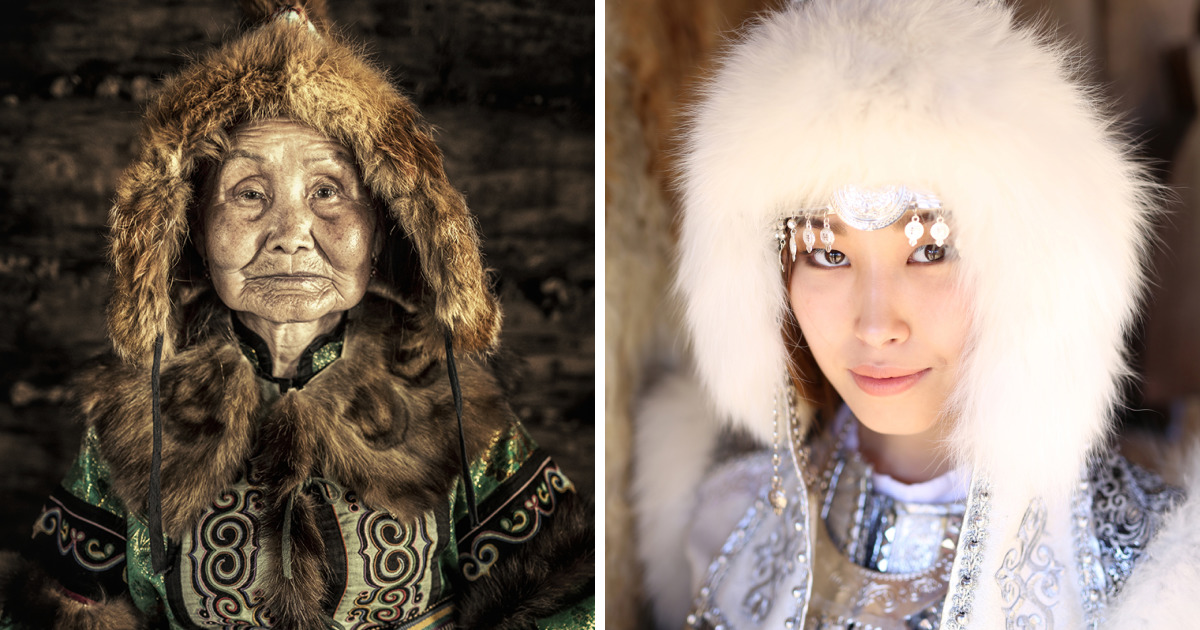
After six months and 25,000 km, the result was a collection of portraits that feels like a human map of Siberia. Not a map of borders, pipelines, or railway lines, but a map of faces: elders with the calm authority of people who have seen more winters than most of us have seen phone updates; children whose clothing carries family tradition; young adults standing between inherited culture and modern life; women and men whose expressions refuse to be simplified.
The photographs are visually striking because of color, texture, and composition, but their deeper strength is intimacy. Many viewers first arrive for the beautiful traditional clothing. They stay because the faces do not behave like decoration. They look back.
That eye contact matters. It breaks the comfortable habit of thinking about remote peoples as “far away.” The portraits suggest that distance is not only geographic. It is also emotional. When we do not see people, it becomes easier to ignore their languages, land rights, schools, and futures. A portrait cannot solve those issues, but it can make indifference harder to maintain. That is not a small achievement. Indifference is a stubborn little creature; sometimes it needs to be stared down by excellent photography.
Indigenous Languages: The Quiet Emergency
One of the most urgent themes behind the project is language. Many Indigenous Siberian languages have small speaker populations, and some are endangered. A language is not merely a translation tool. It carries ecological knowledge, jokes, prayers, family roles, place names, animal behavior, weather patterns, and ways of seeing the world that cannot always be neatly converted into Russian, English, or any global language.
When an Indigenous language weakens, a community loses more than vocabulary. It loses a library of lived experience. Imagine deleting a thousand years of local weather reports, recipes, lullabies, navigation tips, spiritual concepts, and comedy routines, then saying, “No worries, we backed up the nouns.” That is not how culture works.
This is why visual projects can help. A portrait does not preserve grammar by itself, but it can raise attention, generate pride, and create an entry point for viewers who might never read a linguistic report. For younger members of a community, seeing their culture represented beautifully can matter. Representation is not everything, but it is not nothing either.
What Makes Khimushin’s Approach Stand Out?
Several things make this Siberian Indigenous people photography project memorable. First is scale. Traveling 25,000 km across Siberia takes endurance, logistics, and a willingness to be repeatedly humbled by geography. Second is focus. Khimushin did not treat Indigenous identity as a vague aesthetic. He centered people, traditional clothing, and cultural context.
Third is consistency. The World in Faces is not a one-off viral post; it is part of a long-term global project documenting Indigenous peoples and traditional cultures across many countries. The project has been associated with major international exhibitions, including UN and UNESCO contexts, which helped bring the images into conversations about Indigenous rights, cultural diversity, and language preservation.
Finally, the work feels accessible. You do not need a degree in anthropology to respond to a face. That accessibility is valuable, especially online, where attention spans often have the life expectancy of a snowflake on a laptop charger. A strong portrait stops the scroll. Then, if the viewer is willing, it opens a door to learning.
Ethical Travel Lessons From a 25,000 Km Siberian Journey
Travelers can learn a lot from this project, especially those who dream of photographing remote cultures. The first lesson is simple: people are not props. A traditional coat, a reindeer herd, a wooden house, or a ceremonial object does not exist to improve your Instagram grid. Ask permission. Learn names. Pay attention. Accept “no” gracefully. No photograph is worth disrespecting the person in it.
The second lesson is to research before arrival. Learn the difference between the groups you hope to visit. Read about the region’s history, current challenges, and cultural protocols. If you cannot pronounce a community’s name, practice before you show up waving a camera like a confused tourist wizard.
The third lesson is reciprocity. Ethical photography should not only extract images. It should consider what is given back: prints, donations, visibility approved by the community, collaboration, accurate captions, or support for local initiatives. A respectful photographer understands that the story does not belong solely to the person holding the camera.
Specific Examples That Bring the Story to Life
Consider the image of an Evenki woman in winter clothing. The first impression may be beauty: pale fur, careful ornament, a face framed by softness and cold. But behind that image is a history of mobility across northern lands, knowledge of animals and weather, and a cultural identity that has survived enormous pressure.
Think of Nenets reindeer herders crossing tundra. To outsiders, it may look cinematic. To the families doing it, migration is work, inheritance, and responsibility. Reindeer are transportation, food, economy, and cultural center. When climate patterns shift or industrial infrastructure interrupts routes, the problem is not merely scenic inconvenience. It is a threat to a living system.
Or imagine a portrait made near Lake Baikal, where Buryat culture connects landscape, spirituality, and community memory. The lake itself is famous around the world, but a portrait can redirect attention from postcard geography to human presence. Siberia is not empty wilderness. It is home.
Why the Internet Loved the Result
The project became widely shared because it offered something rare online: beauty with substance. Viewers could admire the artistry immediately, but the images also carried educational weight. They introduced people to Indigenous Siberian communities that many had never heard of. In a digital world stuffed with recycled jokes, suspicious life hacks, and recipes that begin with someone’s entire childhood, a sincere portrait series can feel almost revolutionary.
The popularity also reveals a hunger for human stories. People want to see cultures beyond the usual travel clichés. They want faces, names, details, and the feeling that the world is larger than the algorithm’s tiny living room. Khimushin’s work gave viewers that feeling.
The Bigger Message: Diversity Is Not Decoration
The most important takeaway from this 25,000 km journey is that cultural diversity is not decoration for the modern world. It is knowledge, identity, resilience, and memory. Indigenous Siberian people are not “vanishing” in a passive, poetic way, as if cultures simply fade like old wallpaper. Many communities face real pressures: language loss, climate change, industrial development, migration, limited legal protection, and political challenges.
Yet the portraits do not reduce people to hardship. That is their grace. They show pride, elegance, humor, youth, age, and personality. They make room for beauty without pretending everything is easy. This balance is difficult, and it is what makes the work linger in the mind.
Additional Experiences Inspired by the Topic
A journey like this teaches that travel is not measured only in kilometers. The 25,000 km number is impressive, of course. It has the muscular sound of an expedition and looks fantastic in a headline. But the real distance is between not knowing and paying attention. Before encountering these portraits, many viewers may know Siberia only as a place of snow, exile, forests, and dramatic weather reports. Afterward, the region becomes populated with faces, clothing, languages, and stories.
One experience related to this topic is the feeling of arriving somewhere remote and realizing that your usual assumptions are badly underdressed. In many Indigenous communities, practical knowledge is deep and local. A visitor may know how to operate a camera, book a flight, or complain about Wi-Fi, but local people know how to read snow, animals, river ice, wind, and distance. That kind of intelligence does not always come with a certificate, but it can keep a family alive.
Another experience is learning the value of silence. In travel writing, there is a temptation to narrate everything, to turn every person into a paragraph and every meal into symbolism. But portrait photography often works because it leaves space. The viewer meets a face without being told exactly what to feel. In Siberia, where landscapes can be enormous and settlements widely separated, silence is not empty. It has weight. It allows respect to enter the frame.
There is also the experience of hospitality. Across cold regions of the world, hospitality is not a decorative virtue; it is part of survival culture. A warm drink, a place to sit, a shared meal, or help with directions can matter intensely. For a photographer traveling alone, these gestures become the hidden infrastructure of the journey. The final images may show one person in front of the lens, but behind each portrait is often a chain of introductions, translations, rides, meals, waiting, and trust.
The topic also reminds us that traditional clothing is not a costume box from history. It is design shaped by climate, materials, movement, spirituality, and community taste. Fur trim, beadwork, embroidery, headwear, boots, and ornaments can communicate age, region, family, ceremony, or status. Looking closely at these details changes the way we understand fashion. A runway may chase trends every season, but Indigenous clothing often carries generations. That is style with a memory longer than any luxury logo.
Finally, this story offers a humbling lesson for anyone who creates content: attention is responsibility. A viral image can bring admiration, but it can also simplify. A good article, caption, or gallery should help viewers move beyond “beautiful photo” toward “real people, real cultures, real futures.” The best result of Khimushin’s six-month Siberian journey is not only that the photographs are visually unforgettable. It is that they invite viewers to care, learn, and look again with more patience than the internet usually allows.
Conclusion
“I travelled 25,000 km in Siberia to photograph its Indigenous people” is a title with built-in drama, but the finished result is more than an adventure story. It is a tribute to the faces and cultures of Siberia: Evenki, Nenets, Sakha, Buryat, Dolgan, Nganasan, and many others whose identities are tied to land, language, clothing, memory, and survival.
Alexander Khimushin’s six-month journey shows how portrait photography can become cultural witness. It cannot preserve a language alone, stop climate change, or solve land-rights conflicts. But it can make people visible. It can turn distance into recognition. It can remind the world that remote does not mean irrelevant, and traditional does not mean frozen in the past.
In the end, the most powerful result is not the number of kilometers travelled. It is the feeling that each face carries a world. And once you have seen that world looking back at you, it becomes much harder to pretend you never noticed.

