
Beauty Unlocked
Home Designers Reveal 10 Details That Make a Bathroom Beautiful
Jul
A beautiful bathroom does not need a soaking tub carved from a single piece of Italian marble or a faucet that costs more than your first car. Those things can be lovely, of course, but designers know that successful bathroom design depends more on thoughtful details than spectacular spending.
The most inviting bathrooms balance appearance with everyday function. They provide flattering light, useful storage, durable surfaces, comfortable movement, and a sense of visual order. Every fixture seems to belong, toiletries are not staging a rebellion across the countertop, and even the humble towel hook appears to have received careful consideration.
Whether you are planning a complete bathroom remodel or simply refreshing a dated space, the following ten designer-approved details can help you create a bathroom that feels polished, personal, and genuinely pleasant to use.
What Makes a Bathroom Look Beautiful?
Home designers generally approach bathrooms as complete environments rather than collections of attractive products. A fashionable vanity cannot rescue an awkward layout, and expensive tile loses much of its charm when the room has poor lighting or nowhere to store a hair dryer.
Beautiful bathroom design usually begins with a clear mood. The room might feel airy and coastal, warm and traditional, quiet and minimalist, or dramatic and jewel-like. Once that direction is established, colors, materials, fixtures, lighting, and accessories can support the same story.
1. Layered Lighting That Flatters People and Materials
Lighting is one of the quickest ways to separate a thoughtfully designed bathroom from a purely functional one. A single ceiling fixture may technically illuminate the room, but it can create facial shadows severe enough to make an ordinary Monday morning feel like an interrogation scene.
Designers prefer layered bathroom lighting. Ambient lighting provides general brightness, task lighting helps with grooming, and decorative lighting contributes atmosphere. Sconces placed beside a mirror typically light the face more evenly than a ceiling fixture alone. A light above the mirror can also work when wall space is limited, particularly when the fixture is proportional to the vanity.
Dimmers add flexibility. Bright light is helpful when shaving or applying makeup, while softer illumination makes an evening bath feel more relaxing. Under-vanity lighting, illuminated medicine cabinets, and discreet LED strips can introduce a gentle glow without crowding the room with additional fixtures.
Design Tip: Pay Attention to Light Temperature
Extremely cool bulbs may make a bathroom feel clinical, while overly warm bulbs can distort colors. A balanced, natural-looking light generally works well for grooming and allows tile, paint, wood, and metal finishes to appear as intended.
Research support: layered task, ambient, natural, and adjustable bathroom lighting guidance.
2. A Controlled and Cohesive Color Palette
A beautiful bathroom does not have to be white, although white remains popular because it reflects light and communicates cleanliness. Soft greens, misty blues, warm taupes, clay colors, charcoal, and muted earth tones can be equally elegant.
The secret is control. Instead of introducing five competing colors because each looked charming on a sample card, designers often select one dominant hue, one supporting neutral, and one or two accent finishes. For example, a room might combine warm white walls, an oak vanity, pale green tile, and aged brass hardware.
Small powder rooms can handle surprisingly dramatic colors. Deep blue, forest green, burgundy, or even near-black may create an intimate jewel-box effect. In a larger primary bathroom, quieter colors can support the restorative atmosphere many homeowners want.
Always test paint and material samples inside the actual room. Bathroom colors change throughout the day and can look completely different under artificial light. The serene gray chosen in a showroom occasionally returns home and reveals its secret ambition to become lavender.
Research support: calming palettes, moisture-appropriate paint, warm neutrals, greens, blues, and personalized color stories.
3. Tile With the Right Scale, Texture, and Layout
Tile is both a protective surface and one of the strongest visual elements in bathroom design. Its color matters, but designers also consider scale, finish, pattern, grout, and placement.
Large-format wall or floor tiles can make a bathroom feel calmer because they reduce the number of visible grout lines. Smaller mosaics introduce detail and are especially useful on shower floors, where additional grout joints can improve grip and accommodate the floor’s slope toward the drain.
Texture adds depth. Handmade-look ceramic tile, fluted surfaces, stone-inspired porcelain, and softly irregular glazed tiles reflect light differently across the wall. Even plain subway tile can feel custom when installed vertically, stacked in a grid, arranged in a herringbone pattern, or paired with a carefully selected grout color.
Designers also plan tile cuts before installation. A narrow sliver of tile beside the doorway can make an otherwise expensive project look improvised. Centering the layout on a vanity, bathtub, shower wall, or other focal point produces a more balanced result.
Design Tip: Safety Can Still Be Stylish
Polished tile may look glamorous on a wall, but wet floors generally benefit from matte, honed, textured, or otherwise slip-resistant surfaces. Beauty loses some of its sparkle when entering the shower requires the balance skills of a competitive figure skater.
Research support: grout, tile scale, layouts, wet-area finishes, mosaics, drainage, and slip resistance.
4. A Vanity That Acts as the Room’s Anchor
The vanity is often the visual center of a bathroom, so its proportions and style deserve attention. A bulky cabinet can overwhelm a small room, while an undersized vanity may appear stranded against a long wall.
Furniture-style vanities add character through legs, paneling, hardware, and natural wood grain. Floating vanities create visible floor space, which can make compact bathrooms feel more open. In shared bathrooms, a double vanity may improve morning routines, but two sinks are not automatically better if they eliminate valuable counter and drawer space.
Designers increasingly favor useful drawers over deep, cavernous cabinets. Drawers bring smaller items into view and reduce the likelihood of discovering an ancient bottle of lotion during the next presidential administration.
The countertop should support the room’s material palette. Quartz offers durability and a consistent appearance, while natural stone introduces unique movement and variation. Whichever material you choose, consider the faucet, sink, backsplash, mirror, and lighting together rather than selecting each item in isolation.
Research support: vanity proportions, natural wood, floating forms, storage, integrated sinks, and furniture-inspired designs.
5. A Mirror With Deliberate Shape and Proportion
A mirror is not merely a reflective rectangle installed because the building inspector might wonder where it went. It can introduce shape, contrast, scale, and architectural personality.
Arched and rounded mirrors soften rooms dominated by straight tile lines and rectangular cabinetry. A large frameless mirror can visually expand a small bathroom, while a thick wood or metal frame creates a stronger focal point. In a double-vanity arrangement, designers may use one wide mirror for continuity or two separate mirrors to give each sink its own defined zone.
The mirror should relate to the vanity without matching it mechanically. A mirror slightly narrower than the vanity often feels balanced. Leaving some wall space around it also prevents the composition from appearing squeezed.
Medicine cabinets provide another option. Recessed models offer concealed storage without projecting far into the room, and modern versions may include integrated lighting, electrical outlets, magnifying mirrors, and interior organizers.
Research support: mirror proportion, reflective expansion, framed focal points, and integrated vanity lighting.
6. Metal Finishes That Coordinate Without Looking Overmatched
Faucets, shower controls, cabinet pulls, towel bars, light fixtures, and mirror frames may occupy little physical space, but together they strongly influence the bathroom’s character.
Using one metal throughout creates a clean, unified look. Polished nickel can feel refined, chrome looks crisp, brushed nickel is understated, brass adds warmth, and matte black creates strong definition. Mixing metals can also be beautiful when it appears intentional.
A practical approach is to select one dominant finish and one secondary accent. For example, brushed brass faucets and hardware might be paired with black-framed mirrors or dark bronze lighting. Repeating each finish at least twice helps the combination look planned rather than accidental.
Exact matching is not always necessary. Slight variations can add depth, especially in traditional or collected interiors. However, introducing chrome, brass, copper, black, and nickel in the same small room may create the visual equivalent of five people trying to choose the restaurant.
7. Storage That Keeps Everyday Clutter Out of Sight
Nothing weakens a spa-like bathroom faster than a countertop covered with toothbrushes, cosmetics, charging cords, cleaning sprays, and a family-sized collection of mystery bottles. Designers therefore treat storage as an essential beauty feature.
Vanity drawers, medicine cabinets, recessed wall storage, linen towers, shower niches, and shallow shelves can keep frequently used items close without leaving everything exposed. Electrical outlets inside cabinets or drawers allow grooming tools and toothbrushes to charge discreetly.
Open storage should be used selectively. A few neatly folded towels, an attractive container, or a decorative tray can look welcoming. Twelve half-used products arranged on an open shelf generally communicate something closer to “pharmacy inventory.”
Built-in niches are particularly effective because they add function without consuming floor space. In a shower, align niches with tile joints whenever possible, and make them tall enough for the products actually used in the household.
Research support: recessed shelving, medicine cabinets, floating vanities, wall storage, and clutter reduction.
8. A Shower Designed as an Architectural Feature
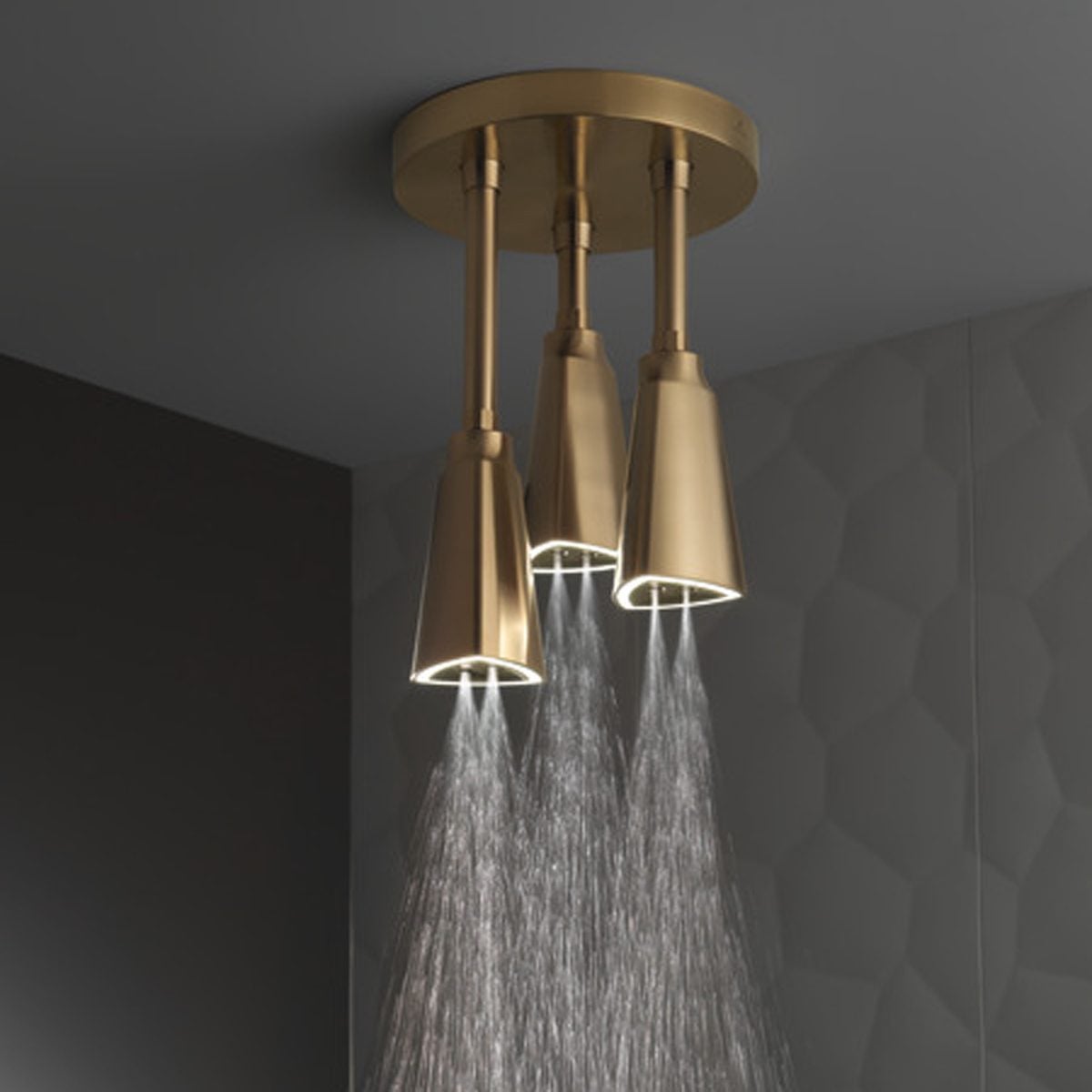
In many modern bathrooms, the shower has replaced the bathtub as the main event. Frameless or minimally framed glass preserves sightlines and allows decorative tile to remain visible. A curbless or low-threshold entrance creates continuity while supporting easier access for users of different ages and mobility levels.
Built-in benches, handheld showerheads, accessible controls, niches, and ledges make the shower more comfortable. These details should be incorporated early in the plan so blocking, plumbing, drainage, and waterproofing can be handled correctly.
The shower wall can provide the room’s primary design statement. A book-matched stone look, vertical tile pattern, contrasting mosaic, or uninterrupted slab surface adds drama without requiring every wall to compete for attention.
Beautiful details still need technical support. Proper slope, waterproofing, drainage, and wet-location materials are more important than the latest shower trend. Water is remarkably persistent and has no respect for your decorating budget.
Research support: low-threshold showers, benches, accessible fixtures, glass enclosures, coordinated wall and floor materials, and waterproof installations.
9. Ventilation That Protects the Design
An exhaust fan may not appear in many glamorous bathroom photographs, but it protects nearly everything that does. Bathrooms produce humidity, and lingering moisture can damage paint, encourage mildew, affect cabinetry, and shorten the life of finishes.
The Home Ventilating Institute commonly recommends approximately one cubic foot per minute of fan capacity for every square foot of bathroom area in rooms up to 100 square feet, with at least 50 CFM for smaller bathrooms. Larger rooms or bathrooms with multiple major fixtures may require additional capacity.
Fan performance also depends on correct installation and exterior venting. Quiet models are more likely to be used consistently, while humidity sensors or timers can keep the fan running long enough to clear moisture after a shower.
Ventilation supports appearance as well as indoor air quality. Clean grout, intact paint, clear mirrors, and cabinets that do not swell at the edges are all beautiful detailseven when nobody compliments the exhaust fan directly.
Research support: bathroom moisture control, exterior exhaust, fan sizing, efficiency, and humidity management.
10. Finishing Touches That Make the Room Feel Lived In
The final layer gives a bathroom warmth and personality. Soft towels, a washable rug, artwork, a stool, attractive dispensers, window treatments, greenery, and a decorative tray can turn a technically correct room into a welcoming one.
Designers edit these accessories carefully. One substantial piece of art may have more impact than several tiny prints. A sculptural vase or branch can introduce organic form. A small wooden stool beside the bathtub provides warmth while offering a useful place for a towel or book.
Textiles are an easy place to introduce color without committing to permanent tile. Towels and rugs can echo a wall color, contrast with a neutral palette, or bring in a seasonal accent. Plants can thrive in bathrooms with sufficient light, but a high-quality artificial plant is preferable to a real fern slowly writing its last will and testament.
Finally, leave some surfaces empty. Negative space allows beautiful materials and fixtures to stand out. A bathroom should feel composed, not as though every decorative object in the house applied for a position and was immediately hired.
Research support: bathroom artwork, plants, seating, decorative lighting, wallpaper, textiles, and personalized sanctuary concepts.
Real-World Experience: What Bathroom Projects Teach Homeowners
One of the most common lessons from bathroom renovations is that the smallest decisions often have the greatest daily impact. Homeowners may spend weeks debating marble veining, yet the feature they appreciate most after completion is frequently a well-placed outlet, a deep drawer, or a shower niche tall enough to hold the enormous shampoo bottle someone keeps purchasing.
Lighting is another area where experience changes priorities. During planning, decorative fixtures naturally receive attention because they are easy to imagine and enjoyable to shop for. After the bathroom is in use, however, homeowners quickly discover that fixture placement matters as much as fixture appearance. Side lighting at the mirror, separate shower illumination, and dimmable ambient lighting usually deliver more satisfaction than one dramatic ceiling light.
Samples also prove their value. Tile, paint, grout, wood, and metal finishes should be viewed together inside the room. A warm white tile may appear cream beside a bright white bathtub. A brass faucet can look elegant beside walnut but unexpectedly yellow beside certain beige stones. Designers frequently create a sample board because memory is unreliable and showroom lighting is a talented liar.
Another recurring experience is that maintenance affects how beautiful a bathroom feels over time. Highly textured surfaces can be attractive but harder to wipe clean. Dark tile may reveal mineral deposits, while very pale grout can show discoloration. Glass shower enclosures preserve openness but benefit from regular squeegee use. There is no universally maintenance-free material, so the best choice depends on how much cleaning the household realistically wants to performnot the fantasy version of the household that joyfully polishes fixtures every morning.
Storage requirements are also easy to underestimate. Before choosing cabinetry, it helps to inventory towels, toiletries, grooming tools, medications, paper supplies, and cleaning products. Measuring tall bottles and electrical devices can reveal whether drawers, cabinets, niches, or a linen tower will work best. Storage should be planned for real possessions rather than the three decorative jars shown in a catalog photograph.
Homeowners who renovate with accessibility in mind often report that those choices improve comfort immediately. A handheld showerhead simplifies cleaning and bathing children or pets. A bench offers convenience regardless of age. Wider pathways feel more generous, lever handles are easy to operate, and a low-threshold shower creates a cleaner visual transition. Universal design does not need to resemble an institution; when integrated early, it can look deliberate and luxurious.
Budget experience produces another useful insight: visual consistency often matters more than luxury pricing. A moderately priced vanity, mirror, faucet, and light fixture can look sophisticated when their proportions and finishes relate to one another. Conversely, several expensive statement pieces may compete so aggressively that the room feels less refined.
The most successful projects usually establish one focal point. It might be a richly veined vanity top, an emerald tile shower, a sculptural tub, a patterned floor, or an antique-style vanity. Supporting materials then remain quieter. When everything attempts to be the star, the bathroom begins to resemble an awards show with no assigned seating.
Finally, experienced renovators leave room for adjustment. Hooks, shelves, mirrors, and accessories are easier to modify than plumbing or tile. Permanent decisions should prioritize layout, waterproofing, electrical planning, ventilation, and durable materials. Decorative layers can evolve as tastes and routines change.
Conclusion: Beauty Comes From Thoughtful Details
A beautiful bathroom is not defined by square footage or an unlimited budget. It emerges from decisions that work together: layered lighting, a focused color palette, properly selected tile, a proportional vanity, a purposeful mirror, coordinated hardware, concealed storage, a comfortable shower, effective ventilation, and restrained finishing touches.
Start with function, choose a clear visual direction, and repeat materials or colors enough to create rhythm. Invest in the permanent elements that are difficult to change, then use paint, towels, artwork, and accessories to add personality. The result should look polished without feeling precious and luxurious without becoming inconvenient.
The ultimate test is simple. A beautiful bathroom should make ordinary routines easier while giving you a small moment of pleasure every time you entereven when the laundry basket is full and someone has once again placed an empty toilet paper roll beside the new one.
Editorial note: This original article synthesizes established bathroom-design guidance from the National Kitchen & Bath Association, Houzz, Architectural Digest, Better Homes & Gardens, House Beautiful, This Old House, ENERGY STAR, the Home Ventilating Institute, Kohler, Daltile, Delta Faucet, Benjamin Moore, Sherwin-Williams, The Home Depot, and Lowe’s.

