
Skincare
Hey Pandas, Draw Your Best Dragon!
Jul
Dragons are the overachievers of the fantasy world. One can guard a mountain of gold, summon a rainstorm, symbolize imperial power, carry a wizard across three kingdoms, and still find time to appear on a fourth grader’s math notebook. That range is exactly why a dragon drawing challenge is so much fun: there is no single “correct” dragon waiting to mark your homework with a red pen.
So, Pandas, sharpen your pencils, charge your stylus, rescue the good eraser from the junk drawer, and draw your best dragon. It can be majestic, ridiculous, ancient, tiny, feathered, mechanical, sleepy, nervous, or deeply offended that someone stole its sandwich. The goal is not to copy the dragon everyone already knows. The goal is to invent the dragon only you could have drawn.
Why Dragons Are Perfect for an Art Challenge
A dragon sits between familiarity and freedom. Western fantasy often favors wings, claws, horns, and fire, while East Asian traditions frequently present long, serpentine creatures connected with clouds, water, rain, good fortune, authority, and wisdom. Dragons may appear as guardians, imperial emblems, dangerous opponents, or loyal companions.
That variety invites research, not careless symbol mixing. A dragon inspired by Chinese or Japanese art may be wingless, flowing, and built from features associated with several animals. “Draw a dragon” is not one prompt; it is a thousand doors wearing the same dramatic nameplate.
Start With a Dragon Idea, Not a Pile of Scales
Before drawing individual teeth, decide who your dragon is. Details work better when they serve a habitat, personality, or story. A cave dragon might have broad paws and pale eyes; a coastal dragon could have fins and a steering tail; a garden dragon might hoard shiny tomato cages.
Ask Five Fast Design Questions
- Where does it live? Desert, glacier, rooftop, swamp, library, or sock drawer?
- How does it move? Fly, swim, climb, burrow, glide, or stomp?
- What does it eat? Livestock, moonlight, mushrooms, electricity, or blue candies?
- What is its temperament? Regal, playful, anxious, vain, or permanently sleepy?
- What makes it recognizable? A split tail, lantern horns, crystal scales, or heroic mustache?
Answering even two questions prevents “generic lizard, but expensive.”
Build the Dragon From Simple Shapes
Complex creatures become manageable when reduced to spheres, boxes, cylinders, wedges, and action lines. Adobe recommends establishing the head, joints, spine, tail, torso, and wings with simple construction shapes. Proko likewise suggests simplifying and exaggerating features from real reptiles.
Step 1: Draw the Line of Action
Use one long curve from nose to tail. An upward S-curve feels elegant; a low arc suggests weight; a tight coil looks defensive or ready to spring. This first line is the dragon’s sentence; everything else is punctuation.
Step 2: Place the Largest Masses
Add the rib cage, pelvis, head, and joints loosely. A bulky chest suggests a powerful flyer; a long torso suits a river dragon; thick shoulders feel like a lizard crossed with a bulldozer.
Step 3: Connect the Forms
Connect the masses with the neck, belly, limbs, and tail. If the head is enormous, the shoulders, tail, or stance should compensate. Fantasy does not require zoological perfection, but it benefits from visual logic.
Borrow Anatomy From Real Animals
The best references are already alive and refusing to pose politely. Study lizards for scales, snakes for twisting torsos, crocodilians for armored heads, bats for wing structure, birds for flight, cats for stalking movement, and goats for horns. Creature design becomes more convincing when anatomy, narrative, and function support one another.
Do not attach a bat wing to a dinosaur like a fantasy refrigerator magnet. Ask where muscles connect, how the wing folds, and how the body balances. Try plantigrade, digitigrade, and reptilian leg structures in quick thumbnails before committing.
Create a Strong Silhouette
Fill the dragon in as a solid black shape. Can you still tell where the head, wings, limbs, and tail are? Can you recognize its attitude? Silhouette studies are widely used in creature design to explore body type, posture, speed, danger, and personality before an artist spends time rendering details.
Separate overlapping parts when possible. Move a wing so it does not disappear into the torso. Angle the tail away from the rear leg. Turn the head enough to expose the jawline or horns. A readable silhouette gives your dragon stage presence before it has a single scale.
Design the Head Like It Has Something to Say
The face is where viewers search for intelligence, emotion, and trouble. Build the skull and jaw before decorating. Short muzzles can look young or stubborn; long snouts feel elegant; forward-facing eyes appear predatory, while side-facing eyes feel cautious or unusual.
Add only a few memorable features. Horn direction changes the profile, frills communicate mood, and ears add expression. A closed mouth and raised eyebrow may be more threatening than forty-seven shaded fangs.
Make Wings That Look Ready to Work
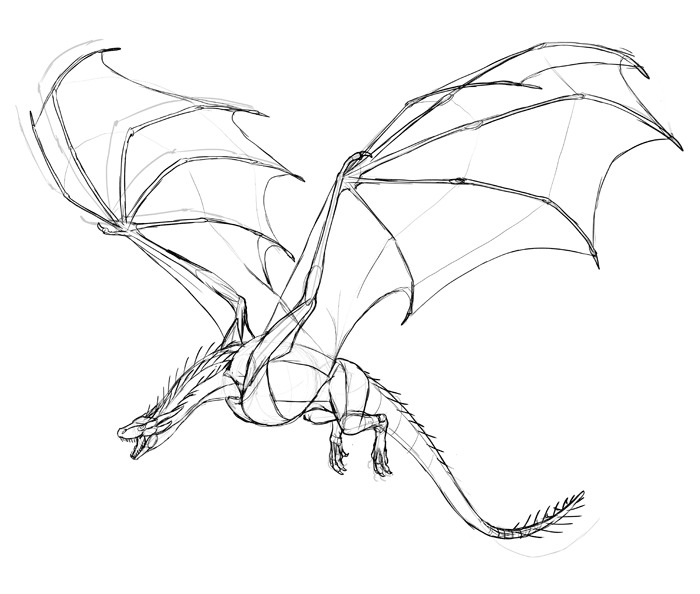
For batlike wings, establish the arm, elbow, wrist, and finger-like supports before the membrane. For bird wings, group feathers around the underlying arm. Insect wings need veins, transparency, and repetition.
Wing size may be realistic, symbolic, or comedic. Torn membranes suggest survival; polished feathers suggest status. Dragons may also be wingless. Flight is an option, not a membership fee.
Use Line, Texture, and Value to Sell the Illusion
Line quality changes mood. Thick, thin, curved, jagged, and diagonal marks carry different energy. Contours clarify edges, hatching adds value, and crosshatching deepens shadow and texture.
Do Not Give Every Surface the Same Texture
Mix large scales, smooth skin, plates, fur, feathers, scars, and soft membranes. Texture suggests how a surface might feel and helps separate forms. Reserve the sharpest detail for the head or nearest claw; simplify distant areas.
Pick One Main Light Source
Choose one light source and shade forms consistently. Cast shadows from horns, wings, and limbs. Light from below feels dangerous; backlighting makes membranes glow; soft overhead light creates a surprisingly polite school-portrait dragon.
Give Your Dragon a Story Through Color
Color should support habitat and personality. Desert dragons might use sand, rust, and bone; forest dragons can borrow moss, bark, and poisonous accents; arctic creatures need subtle blues, grays, and reflected warmth.
Choose one dominant color, one support, and one accent near the face or magical feature. A rainbow dragon should look intentional, not like an art store losing cabin pressure.
Composition: Let the Dragon Do Something
A character sheet is useful, but an action or situation often makes a more memorable submission. Show the dragon squeezing through a doorway, guarding a teacup, diving between clouds, warming a village bakery, hiding from a goose, or discovering that its treasure chest contains tax forms.
Use the background to support scale. A tiny castle makes the dragon enormous. Grass blades make a miniature dragon feel mouse-sized. Overlapping shapes, relative size, and placement can create depth, while line, form, color, value, space, and texture help organize the entire image.
Traditional, Digital, or Drawn on a Coffee Receipt?
Pencil offers speed and easy revision. Ink rewards confident shapes and expressive line. Colored pencils are excellent for controlled texture. Watercolor can produce luminous wings, mist, and atmospheric backgrounds. Markers create bold, clean color. Digital tools make it easy to test silhouettes, resize wings, flip the canvas, and experiment with lighting.
The medium matters less than the idea and the choices. A ballpoint-pen dragon drawn during lunch can have more personality than a polished painting that never decides what its creature is feeling. Use what you have. The dragon will not request proof of purchase.
How to Share Your Best Dragon
Community prompts turn private practice into conversation. Similar “Hey Pandas” posts invite artists to share work, compare progress, and value honest improvement.
Include a title, a brief story, and unusual materials. Show an early sketch beside the final image when possible, and credit collaborations or references. When commenting, offer one specific observation, one question, and one encouraging thought. That gives more value than “cool,” although “cool” remains acceptable when your brain has left the castle.
My Experience Drawing a Dragon From Scratch
I began with the confident belief that I would draw a noble sky dragon. Ten minutes later, I had created something shaped like a nervous zucchini with legal problems. Its wings were attached too high, its back legs appeared to belong to a different taxonomic kingdom, and its expression suggested that it had just remembered an appointment from last Tuesday.
The breakthrough came when I stopped drawing “a dragon” and started designing a specific animal. I decided it lived around old coastal lighthouses and collected objects polished by the sea. That one decision changed almost everything. I replaced the heavy horns with swept-back fins so it could move through strong wind. I broadened the front feet for gripping wet stone. I shortened the hind legs, lengthened the tail for balance, and gave the scales a pattern inspired by overlapping roof shingles and fish armor.
I also drew six tiny silhouettes instead of repairing the first pose forever. That felt wasteful for approximately thirty seconds. Then one thumbnail showed the dragon crouched around the lighthouse lantern, using its wings as a shield against a storm. The pose immediately told a story. It was not attacking the building; it was protecting the light. Suddenly, the creature had a job, a mood, and a reason to be in the picture.
The head caused the next argument. My first version had so many horns, spikes, whiskers, fins, and decorative plates that it looked less like a sea dragon and more like a fantasy cutlery drawer. I removed half the features and kept one strong brow ridge, two backward fins, and a small cluster of whiskers near the jaw. The simpler design made the eyes easier to notice, which mattered because I wanted the dragon to look watchful rather than aggressive.
Texture was both the most satisfying part and the trap. I happily drew scales for an absurd length of time before realizing that the image had become a wallpaper sample. I erased detail from the tail and far wing, then concentrated sharper marks around the face, shoulder, and front claws. The drawing immediately gained depth. Apparently, restraint is a useful art skill, which was disappointing because I had already prepared another twelve hundred scales.
For color, I tried bright ocean blue first. It looked cheerful, clean, and completely wrong for a storm-beaten guardian. A darker blue-gray body worked better, especially with pale green light from the lighthouse reflecting across the jaw and wing membranes. I added small copper accents around the eyes to echo the lantern hardware. The palette finally connected the dragon to its environment instead of making it look pasted on top.
The finished piece was not perfect. One foot still looked slightly confused, and the far wing would probably concern an aeronautical engineer. But the dragon felt alive. More importantly, it felt like mine. The awkward first sketch had not been a failure; it had been a list of questions. Each revision answered one of them: Where does it live? How does it move? What does it protect? What should viewers notice first?
That experience changed the way I approach fantasy drawing. I no longer begin by asking whether I can draw every scale correctly. I ask whether the creature has a clear idea behind it. Technical polish matters, but a memorable dragon needs purpose, personality, and a silhouette that can survive being viewed at phone-screen size. The rest can be learned one wing joint, one shadow, and one mildly suspicious zucchini at a time.

