
Beauty Tools & Accessories
Gay Indian Couple Holds A Traditional Wedding Ceremony In A Hindu Temple, And Their Photos Go Viral
Jun
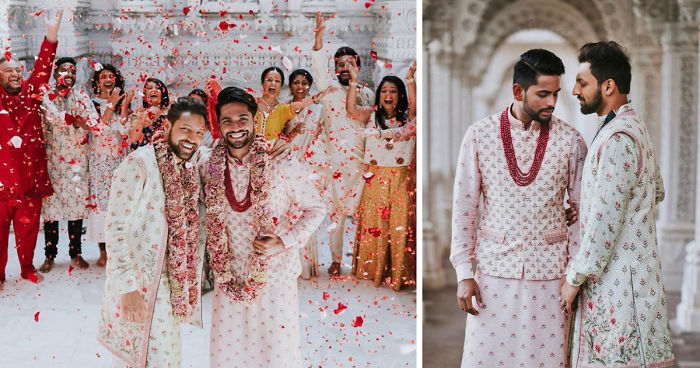
Every now and then, the internet takes a break from arguing about pineapple on pizza and collectively agrees on something beautiful. That is exactly what happened when photos of Amit Shah and Aditya Madiraju, a gay Indian couple, celebrating a traditional Hindu wedding ceremony in a New Jersey temple began spreading across social media. The images were joyful, elegant, colorful, deeply cultural, and quietly revolutionary all at once.
Their wedding was not designed as a political statement. It was, at heart, a celebration of love, family, faith, and heritage. Yet because representation is powerful, the photographs quickly became more than wedding pictures. They became a mirror for many LGBTQ South Asians who had rarely seen themselves reflected in such a public, traditional, and tender way.
In a world where wedding content usually means flower walls, champagne towers, and at least one uncle pretending he does not know the lyrics to a dance song he absolutely knows, Amit and Aditya’s ceremony stood out for a deeper reason. It showed two men honoring Hindu traditions without apologizing for who they are. And that, naturally, made the internet emotional. The good kind of emotional. The “I’m not crying, the mandap is just dusty” kind.
A Wedding That Blended Love, Faith, And Cultural Pride
Amit Shah and Aditya Madiraju held their traditional Hindu wedding ceremony in July 2019 at a Hindu temple in New Jersey after having a civil ceremony earlier that year. Both men come from Indian backgrounds, and Hindu traditions were important to them. Instead of choosing between identity and culture, they chose both.
The ceremony included meaningful rituals such as puja, garland exchange, and pheras, which are often central to Hindu weddings. These rituals are not just decorative moments for the camera, although the photos certainly understood the assignment. They symbolize commitment, spiritual partnership, family blessings, and the beginning of a shared life.
The couple wore coordinated traditional outfits, including stylish kurtas by Indian designer Anita Dongre. The look was sophisticated without feeling stiff, festive without becoming costume-like, and traditional without losing personality. In other words, they managed the rare wedding fashion achievement of looking timeless and comfortable at the same time. Somewhere, every groom who has ever sweated through a three-piece suit in July felt personally attacked.
Why The Photos Went Viral
The photographs, captured by Charmi Peña, quickly gained attention online because they carried emotional weight beyond the usual wedding album. Yes, the colors were stunning. Yes, the styling was impeccable. Yes, the couple looked happy enough to make even the most cynical social media scroller pause mid-doomscroll. But the true reason the images resonated was representation.
For many LGBTQ people in South Asian communities, marriage is not just about romance. It is tied to family approval, religious identity, social belonging, and cultural continuity. Seeing two Indian men celebrated in a Hindu temple challenged the quiet assumption that tradition only belongs to straight couples.
The viral response showed that people were hungry for images like these. Not because every queer person wants a traditional wedding, but because everyone deserves the option to imagine one. Visibility does not solve every legal or social challenge, but it can open a door in someone’s mind. Sometimes, one photograph says what a thousand debates cannot: “You belong here, too.”
The Cultural Importance Of A Same-Sex Hindu Wedding
Hindu weddings vary widely by region, language, family custom, and personal preference. There is no single universal version, which is both beautiful and slightly inconvenient for anyone trying to create one neat wedding checklist. Some ceremonies are grand and multi-day; others are intimate and focused on the essential rituals. What they often share is a sense of sacred commitment witnessed by family, community, and the divine.
That is why Amit and Aditya’s wedding mattered so much. Their ceremony did not treat queerness as something outside culture. It placed their love within the language of culture. The garlands, the temple setting, the blessings, the traditional clothing, and the rituals all said: this is not a rejection of heritage. This is heritage expanding its arms.
For LGBTQ Indians and Indian Americans, that message can be deeply moving. Many queer people grow up fearing they must choose between being honest about their identity and remaining connected to their family traditions. Amit and Aditya’s wedding offered a different possibility. It suggested that culture is not a locked museum cabinet. It is alive, evolving, and capable of holding more love than people sometimes allow it to hold.
Love In The Shadow Of Legal And Social Change
The wedding also gained attention because it existed within a larger conversation about LGBTQ rights in India and the diaspora. In 2018, India’s Supreme Court struck down the colonial-era law that criminalized consensual same-sex relations. That decision was a historic step forward for LGBTQ Indians, but it did not automatically create full equality.
Marriage equality remains a complicated issue in India. In 2023, India’s Supreme Court declined to legalize same-sex marriage, saying the matter should be handled by Parliament. For LGBTQ couples, this means that social visibility and legal recognition are still moving at different speeds. One may go viral overnight; the other may require years of advocacy, petitions, debates, and patience strong enough to survive family WhatsApp groups.
Against that backdrop, a same-sex Indian wedding in a Hindu temple carried symbolic power. It showed what acceptance can look like before the law fully catches up. It also reminded people that LGBTQ lives are not abstract legal questions. They are families, ceremonies, vows, aunties fixing collars, parents taking photos, and couples trying to build ordinary happiness in extraordinary circumstances.
The Role Of Family Support
One of the most touching parts of Amit and Aditya’s story is the presence of family support. Weddings in Indian culture are rarely just about two people. They are family productions, emotional marathons, and logistical puzzles involving relatives, rituals, food, outfits, travel schedules, and at least one person asking whether everyone has eaten.
For a gay Indian couple, family support can transform a wedding from a private milestone into a public act of belonging. When parents and relatives show up, participate, bless, and celebrate, they send a message louder than any speech: this love is part of our family story.
That is why the photos felt so hopeful. They did not frame the couple as outsiders begging for a seat at the cultural table. They showed them already seated, already blessed, already surrounded by ceremony. It was not a side note. It was the main event.
Why Representation Still Matters
Some people may ask, “Why make such a big deal about wedding pictures?” The answer is simple: because images shape imagination. If people never see LGBTQ couples in traditional ceremonies, they may assume such ceremonies are impossible. If young queer South Asians only see love stories that end in secrecy or exile, they may struggle to picture joy for themselves.
Amit and Aditya’s viral wedding photos offered a different picture. They showed joy without hiding. They showed tradition without exclusion. They showed two men wearing Indian wedding attire, standing in a sacred space, and being celebrated. For viewers who needed that image, it was not just pretty. It was oxygen.
Representation is not about pretending every story is easy. It is about making more futures visible. A photo cannot pass a law, change every parent’s mind, or erase prejudice. But it can give someone courage. It can start a conversation. It can make a family member reconsider what love looks like. And occasionally, it can make the internet behave like it has a heart. Rare, but we cherish the moments.
What The Wedding Says About Modern Indian Identity
Modern Indian identity is not one thing. It is global, regional, religious, secular, traditional, experimental, conservative, progressive, and frequently all of those before breakfast. Indian diasporic communities, especially in the United States, often live at the intersection of inherited customs and new social possibilities.
Amit and Aditya’s wedding reflected that intersection beautifully. A civil marriage in New York, followed by a traditional Hindu temple ceremony in New Jersey, created a bridge between legal recognition, cultural celebration, and personal authenticity. It was not about copying a template. It was about making one that fit.
That is why their story continues to resonate years after the photos first went viral. The wedding was not only about being seen as a gay couple. It was about being seen as Indian, Hindu, modern, loving, stylish, and fully themselves. None of those identities had to cancel out the others.
Lessons From Amit And Aditya’s Viral Wedding
1. Tradition Can Evolve Without Losing Its Soul
Tradition is often treated like fragile glass: beautiful, old, and likely to shatter if touched by modern life. But living traditions survive because they adapt. Amit and Aditya’s wedding showed that honoring culture does not require excluding people. A Hindu wedding can retain its spiritual meaning while welcoming a same-sex couple into its rituals.
2. Visibility Can Be A Form Of Care
The couple did not need to become symbols to have a valid marriage. Still, their openness helped others. When LGBTQ people share joyful milestones, they offer reassurance to those who may still feel alone. Their wedding became a public reminder that queer love can be celebrated with dignity, beauty, and family involvement.
3. Families Can Surprise Us
Coming out in traditional communities can be frightening, and not every story ends with acceptance. But Amit and Aditya’s experience showed the impact of supportive families. Their wedding suggested that love can move through hesitation, fear, and old expectations to create something warmer.
4. A Wedding Can Be Personal And Political
The ceremony was personal first. It belonged to Amit and Aditya. But because LGBTQ rights remain contested in many places, a same-sex wedding rooted in religious and cultural tradition inevitably carries public meaning. It becomes a celebration and a statement, even if the statement is simply: “We are here, and we are happy.”
Experiences Related To A Gay Indian Couple Holding A Traditional Hindu Wedding
For many people in the South Asian LGBTQ community, seeing a wedding like Amit and Aditya’s can feel like discovering a room in the house of culture that they were told did not exist. The emotional experience is layered. There is joy, of course, but also grief for the years when such images were rare. There may be memories of hiding relationships, avoiding family questions, or sitting through weddings where every blessing sounded beautiful but painfully out of reach.
Imagine a young gay Indian American scrolling through social media and seeing two grooms in traditional attire at a Hindu temple. The first reaction might be surprise. The second might be disbelief. The third might be a quiet, powerful thought: “Maybe this could be me.” That thought is not small. For someone who has never seen their identity and heritage standing side by side, it can be life-changing.
Families may experience these images differently. Some parents may see the photos and feel challenged. Others may feel moved. A mother who once imagined only one version of her child’s wedding might begin to understand that the real dream was never about gender roles or seating charts. It was about seeing her child loved, respected, and safe. A father might not have all the right words at first, but he may recognize the familiar rituals, the folded hands, the garlands, the temple, and the seriousness of the commitment.
Friends in the community may also feel the impact. A wedding like this gives people language. Instead of discussing LGBTQ acceptance in abstract terms, they can point to a real ceremony and say, “Look, this is possible.” It becomes easier to talk about inclusion when there is a concrete example filled with color, family, ritual, and unmistakable happiness.
There is also a planning experience hidden behind the viral beauty. Same-sex couples from traditional backgrounds often have to think through questions straight couples rarely face. Will the venue welcome us? Will the priest or officiant be supportive? How do we adapt rituals that are usually written around bride-and-groom roles? How do we honor parents while staying honest about ourselves? These are not minor details. They are emotional negotiations wrapped in wedding logistics.
The success of Amit and Aditya’s wedding shows that thoughtful adaptation can be deeply respectful. A same-sex Hindu wedding does not need to imitate a heterosexual ceremony exactly to be meaningful. It can preserve the heart of the rituals while adjusting the language, roles, and flow to fit the couple. The result can feel not less traditional, but more sincere.
For guests, attending such a ceremony can also be transformative. Someone may arrive curious, uncertain, or even skeptical, then leave having witnessed a wedding that felt familiar in its rituals and fresh in its meaning. The experience can soften assumptions. It can remind people that love is not weakened by inclusion. If anything, inclusion makes the celebration larger.
And then there is the experience of the couple themselves. Beyond the headlines and viral shares, there are two people standing together, making vows, trying not to cry, trying to remember the next step, and probably wondering whether the photographer caught their best angle. Their wedding became famous, but its most important meaning was intimate. It was the beginning of a marriage celebrated in a language that belonged to them.
Conclusion
Amit Shah and Aditya Madiraju’s traditional Hindu temple wedding went viral because it was beautiful, but it endured in public memory because it meant something. It showed that LGBTQ love and Indian tradition do not have to stand on opposite sides of a locked door. They can meet under one roof, in sacred ritual, surrounded by family, color, laughter, and hope.
Their photos offered more than wedding inspiration. They offered possibility. For LGBTQ South Asians, for families learning how to love more fully, and for anyone who believes culture grows stronger when it becomes more compassionate, this wedding remains a powerful reminder: tradition is not a wall. At its best, it is a home with room for everyone.

