
Body Care
Best and Worst Baseball Uniforms – History’s Best and Worst Baseball Uniforms
Jun
Baseball uniforms are supposed to do a simple job: help fans identify the team, make players look sharp, and avoid becoming the reason everyone in the stadium says, “Wait, are those shorts?” Yet over more than a century of Major League Baseball, uniforms have become much more than laundry with numbers. They are identity, nostalgia, city pride, marketing, memory, and occasionally a full-body fashion emergency.
The best baseball uniforms feel inevitable. Yankees pinstripes, Dodgers script, Cardinals birds on a bat, A’s green and goldthese looks do not scream for attention. They stroll into the ballpark, tip their cap, and let history do the talking. The worst baseball uniforms, on the other hand, tend to arrive like someone lost a bet in the clubhouse. They are loud, confusing, over-designed, or so ambitious that the ambition needs its own batting helmet.
This guide ranks and analyzes history’s best and worst baseball uniforms, with real examples from MLB history. We will look at what makes a baseball uniform timeless, what makes one unforgettable for the wrong reasons, and why fans still argue about stripes, scripts, powder blues, pullovers, vests, gradients, and one very brave pair of Chicago White Sox shorts.
Why Baseball Uniforms Matter So Much
Baseball is a sport obsessed with time. The scoreboard, the seventh-inning stretch, the box score, the record bookeverything feels connected to what came before. Uniforms are part of that chain. A classic jersey can make a modern player look like he stepped out of a black-and-white photograph and into a high-definition broadcast. A bad uniform can make even a Cy Young winner look like he is late for a company picnic.
The earliest baseball uniforms were practical: wool pants, flannel shirts, and hats that looked more suitable for a picnic than a doubleheader. Over time, teams learned that uniforms could signal professionalism, regional identity, and personality. By the 20th century, many clubs had established visual trademarks: pinstripes, old-English letters, chest scripts, distinctive caps, and color combinations that became inseparable from the franchise.
Good baseball uniform design usually follows three rules. First, it should be recognizable from a distance. Second, it should age well. Third, it should look like baseball. That last rule sounds vague, but fans know when it has been broken. When a uniform looks like a motocross outfit, a fast-food wrapper, or a futuristic pajama set, people noticeand not always kindly.
The Best Baseball Uniforms in History
1. New York Yankees Home Pinstripes
No list of the best baseball uniforms can begin anywhere else. The Yankees’ home pinstripes are not merely a uniform; they are a global symbol. The navy cap with the interlocking “NY,” the clean white jersey, the vertical pinstripes, the absence of player names on the backeverything about the look says tradition without needing to shout.
The genius of the Yankees uniform is restraint. It does not chase trends. It does not need sleeve fireworks, surprise gradients, or a font that appears to have been designed during a power outage. It works because it is clean, severe, and instantly recognizable. Babe Ruth, Lou Gehrig, Joe DiMaggio, Mickey Mantle, Derek Jeter, and Aaron Judge can all be imagined in the same visual language. That continuity is powerful.
Even people who do not follow baseball know the Yankees cap. That is the highest level of sports branding: when the logo escapes the ballpark and becomes culture.
2. Los Angeles Dodgers Home Whites
The Dodgers’ home uniform is another master class in simplicity. The white jersey, royal blue script, red front number, and blue cap create one of baseball’s most balanced looks. It is bright but not loud, classic but not dusty, and elegant without trying to become formalwear.
The Dodgers script feels especially important. It has movement, like a line drive slicing into the gap. The red number gives the jersey just enough contrast to keep it from becoming too plain. From Jackie Robinson to Sandy Koufax to Clayton Kershaw and Mookie Betts, the look has carried enormous baseball history without feeling museum-stiff.
Some uniforms look better in photographs than on the field. The Dodgers uniform does both. Under California sun or stadium lights, it simply works.
3. St. Louis Cardinals Birds on the Bat
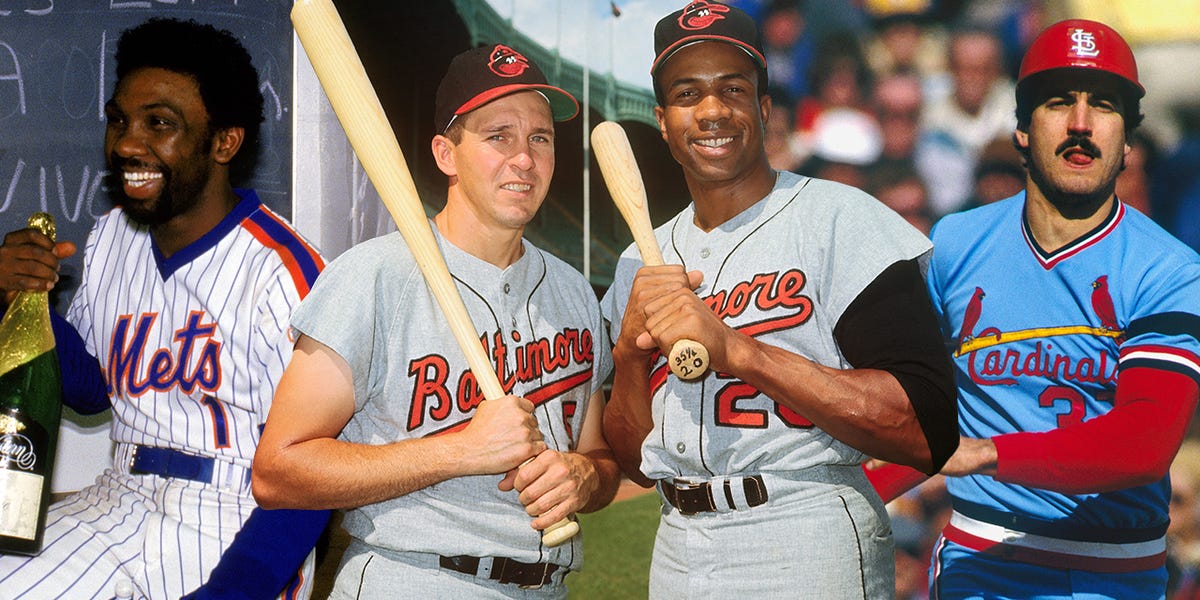
The Cardinals’ “birds on the bat” design is one of the most charming and distinctive uniforms in sports. The red birds perched on a yellow bat across the chest manage to be detailed, playful, and classy at the same time. That is not easy. Many teams have tried decorative chest graphics and ended up looking like a diner menu. St. Louis made it iconic.
The design dates back to the early 20th century and has survived because it has personality. It tells you the team name, gives the jersey color and movement, and still feels appropriate for baseball’s traditional aesthetic. Paired with red caps and crisp white or gray uniforms, the Cardinals look is both friendly and seriouslike a team that will beat you 4-2 and then help you find your parking spot.
4. Detroit Tigers Home Uniform
The Detroit Tigers home uniform is proof that a single great letter can carry an entire identity. The Old English “D” on the chest is bold, historic, and unmistakable. The uniform itself is mostly white with navy details, allowing the logo to do the heavy lifting.
Detroit’s look succeeds because it has confidence. It does not clutter the jersey with unnecessary extras. The cap logo and chest logo create a strong visual connection, and the overall design feels rooted in the city’s tough, traditional sports culture. It is not flashy. It is not trying to win a streetwear contest. It is simply a baseball uniform with backbone.
5. Oakland Athletics Green and Gold
Baseball has plenty of red, navy, black, and gray. The Athletics’ green and gold palette stands out immediately. Introduced during the colorful era associated with owner Charlie Finley, the A’s look brought a fresh, rebellious energy to baseball. White shoes, bright colors, and bold combinations made Oakland feel different.
What keeps the A’s uniforms in the “best” category is that the color scheme became more than a gimmick. Green and gold now feel inseparable from the franchise. The elephant logo, the script marks, and the sunny color contrast give the A’s a visual identity unlike anyone else in MLB. When handled cleanly, it is one of the sport’s most beautiful and original looks.
6. Chicago Cubs Home Pinstripes
The Cubs’ home pinstripes are friendly, historic, and deeply tied to Wrigley Field. The circular “Cubs” logo on the left chest is cheerful without being silly, and the blue pinstripes offer a lighter alternative to the Yankees’ more serious navy-and-white presentation.
A Cubs home uniform looks like summer baseball. It pairs naturally with ivy, day games, and fans who have opinions about bullpen usage before the second inning. The design has enough tradition to feel old-school, but enough brightness to avoid feeling cold. It is one of MLB’s best examples of a uniform matching a ballpark’s personality.
7. Kansas City Royals Powder Blues
Powder blue baseball uniforms can be risky. Done poorly, they look like pajamas. Done well, they look like a cool breeze in July. The Kansas City Royals’ powder blue road uniforms belong in the second group. The soft blue, royal script, and clean white details create one of the most beloved throwback looks in baseball.
The Royals’ powder blues connect strongly to the late 1970s and 1980s, when many teams experimented with colorful road uniforms. Kansas City’s version endured because it was tasteful. It had color, but it did not attack the viewer. It felt bright, regional, and stylish. Today, when the Royals bring powder blue back, it feels less like a costume and more like a welcome return.
8. Milwaukee Brewers Ball-in-Glove Era
The Brewers’ classic ball-in-glove logo is one of the smartest marks in sports history. At first glance it is a baseball glove catching a ball. Look closer and it forms the letters “M” and “B.” That is logo design wizardry. Someone should have received a parade, or at least unlimited bratwurst.
When paired with royal blue and yellow, the Brewers’ retro uniforms have warmth, local flavor, and visual wit. The design feels fun without being goofy. It represents the kind of baseball uniform that fans love because it rewards attention. You do not just see ityou discover it.
The Worst Baseball Uniforms in History
1. 1976 Chicago White Sox Shorts
The 1976 Chicago White Sox shorts are the undisputed heavyweight champion of “What were we thinking?” baseball fashion. Owner Bill Veeck was famous for promotions and spectacle, and the shorts were certainly spectacular. The White Sox debuted them during a doubleheader in August 1976, pairing short pants with collared jerseys and high socks.
To be fair, baseball in the 1970s was experimenting wildly. Pullovers, elastic waistbands, bold colors, and unusual cuts were everywhere. But shorts crossed a line. Baseball involves sliding. Sliding involves dirt, friction, and pain. Shorts plus sliding is a math problem with only bad answers.
The look was retired quickly, but its legend lives forever. In a strange way, that makes it successful. Fans still talk about it. Unfortunately for the White Sox, they usually talk while laughing.
2. 1999 Turn Ahead the Clock Uniforms
The “Turn Ahead the Clock” promotion imagined what MLB uniforms might look like in the future. The future, apparently, involved enormous logos, sleeveless experiments, strange fonts, and jerseys that looked like they were designed by a committee trapped inside a laser tag arena.
The original idea began with the Seattle Mariners in 1998 and expanded to many teams in 1999. Some concepts were fun in a campy way. The Mercury Mets, for example, were so absurd that they became memorable. But as a full league-wide design exercise, the promotion was a beautiful disaster. It proved that predicting the future is hard, especially when the future keeps asking for bigger chest logos.
Today, Turn Ahead the Clock uniforms have nostalgic value. They are so odd that collectors love them. But “collectible” and “good-looking” are not always the same thing. A raccoon in a tiny helmet would also be collectible.
3. Houston Astros Rainbow Uniforms
This one is controversial because the Astros’ rainbow uniforms are both terrible and magnificent. The famous “Tequila Sunrise” look, worn prominently from the mid-1970s into the 1980s, featured bold horizontal bands of orange, yellow, and red across the torso. It looked like a sunset, a traffic cone, and a bowling team all reached a compromise.
So why include it among the worst? Because judged purely by traditional baseball aesthetics, it is chaos. Horizontal stripes across a pullover jersey are difficult to pull off. Add bright colors and large numbers on the pants, and the whole thing becomes louder than a dugout full of sunflower seeds.
But here is the twist: the Astros rainbow is also one of the best identity uniforms ever. It was unique, memorable, and perfectly tied to Houston’s space-age personality. Some fans hate it. Some adore it. The truth is that it belongs in both museums: the Museum of Bad Ideas and the Hall of Fame of Courage.
4. Cleveland’s All-Red 1970s Look
Monochrome uniforms can work. All-red baseball uniforms usually do not. Cleveland’s red-heavy 1970s look is often remembered as one of the era’s least graceful experiments. Red jerseys, red pants, and red caps created a visual blast that felt less like baseball and more like the team had been dipped in marinara sauce.
The issue was not the color itself. Red is a great sports color when used with balance. The problem was saturation. Without enough contrast, the uniform swallowed its own details. From a distance, players looked like moving punctuation marks. It was bold, yes, but boldness without discipline is how uniforms end up on lists like this.
5. San Diego Padres Brown and Mustard Experiments
The Padres have one of baseball’s most debated uniform histories. Brown and gold can be beautiful, distinctive, and deeply connected to San Diego’s identity. But some of the franchise’s 1970s and 1980s combinations pushed the palette into dangerous territory. Mustard yellow pants, brown tops, orange accents, and unusual striping produced looks that were unforgettablebut not always in a flattering way.
Still, the Padres deserve credit. They never looked generic. In a league full of navy and red, San Diego took risks. Modern fans have also warmed up to brown as a unique team color, especially when presented with cleaner lines and better balance. The lesson: a strange palette is not automatically bad. It just needs restraint, and maybe someone in the design room whispering, “Less mustard.”
6. Early Tampa Bay Devil Rays Gradient Uniforms
The original Tampa Bay Devil Rays arrived in MLB with uniforms that were very 1990s: black, purple, teal, and a rainbow gradient across the chest. The concept fit the expansion-team energy of the era, but the execution was busy. The gradient did not whisper “Major League Baseball.” It shouted “new screensaver installed successfully.”
There was charm in the weirdness, and nostalgia has softened the criticism over time. But compared with cleaner franchise identities, the original Devil Rays look felt more like a branding experiment than a timeless baseball uniform. It was exciting, colorful, and deeply allergic to subtlety.
7. Some Modern City Connect Misses
MLB’s City Connect program, launched in the 2020s, has produced some excellent uniforms. The idea is strong: let teams honor local culture with alternate designs. At its best, City Connect gives fans something fresh while telling a city-specific story. At its worst, it creates uniforms that feel disconnected from the team and oddly similar to fashion samples that escaped from a warehouse.
The risk with City Connect is overthinking. A uniform should not require a 900-word design memo to explain why the socks represent a historic bridge, the sleeve trim represents neighborhood energy, and the cap button represents “the emotional spirit of Tuesday traffic.” Fans appreciate meaning, but they also want the uniform to look good from Section 312 while holding nachos.
What Separates the Best from the Worst?
The best baseball uniforms usually have a clear identity. They can be described in one sentence: Yankees pinstripes. Dodgers script. Cardinals birds on the bat. A’s green and gold. Tigers Old English D. The worst uniforms often need too many explanations. They are trying to be futuristic, nostalgic, regional, edgy, playful, and merchandise-friendly all at once. That is a lot of jobs for one jersey.
Color balance matters. Bright colors can be great, but they need contrast and breathing room. The Royals’ powder blue works because it is soft and clean. The Astros rainbow works as an icon because it is unique, but it also shows how quickly color can overpower form. Cleveland’s all-red look shows the danger of going too far in one direction.
Typography also matters. Baseball has always loved scripts, block letters, and old-English marks because they feel hand-crafted and rooted in tradition. When teams choose fonts that look too digital or too trendy, the uniform can age quickly. A jersey should not look outdated before the bobblehead giveaway ends.
Most importantly, the best uniforms create emotional continuity. They make fans feel connected to players across generations. A child watching a game today can see echoes of a grandparent’s favorite team. That is why throwbacks are so powerful. They remind us that baseball uniforms are not just apparel. They are memory machines with buttons.
Best and Worst Baseball Uniforms: Fan Experience and Real-World Takeaways
One of the funniest things about baseball uniforms is that fans often judge them with the seriousness of a Supreme Court hearing. A team can lose 94 games, and the comment section will still spend three days arguing about whether the sleeve piping should be navy or royal blue. That sounds silly until you remember that uniforms are part of how fans experience the game. They shape first impressions, television memories, collectible habits, and even how proud someone feels wearing a cap around town.
Watching baseball over time teaches a simple lesson: the uniform has to survive real life. It must look good on a superstar, a backup catcher, a rookie making his debut, a coach walking to the mound, and a fan buying a replica jersey two sizes too large because “it might shrink.” Some designs look exciting in a launch photo but strange during an actual game. Others look plain on a hanger but beautiful once the grass, dirt, crowd, and scoreboard frame them properly.
The Yankees and Dodgers understand this better than almost anyone. Their uniforms do not need constant reinvention because the ballpark completes the design. The Yankees pinstripes against the green of the field feel ceremonial. The Dodgers’ white and blue under the Los Angeles sun feel crisp and cinematic. These uniforms are not trying to be the whole show. They are part of the show.
Bad uniforms often fail because they ignore the rhythm of baseball. Baseball is slower than football and less visually crowded than basketball. That means the viewer spends more time looking at the pitcher, batter, and fielders. A design that is mildly odd in a highlight clip can become exhausting over nine innings. Huge logos, clashing colors, and gimmicky cuts do not get to hide. Baseball gives every uniform a long audition.
There is also a difference between ugly and beloved. The Astros rainbow uniforms are the perfect example. Many fans would never call them conventionally beautiful, but they are unforgettable. They tell a story about a team, a city, and a wild design era. That kind of personality can turn a “bad” uniform into a cultural treasure. Meanwhile, the truly worst uniforms are not just ugly; they are forgettable, confusing, or disconnected from the team’s identity.
For fans buying jerseys, the same lesson applies. The safest choices are usually the classics: Yankees home, Dodgers home, Cardinals cream or white, Cubs pinstripes, Tigers home, A’s green, Royals powder blue, or Brewers retro. These looks age well because they are built on strong identities rather than temporary trends. A loud alternate might be fun for a season, but a timeless jersey still looks good ten years later, even after nacho cheese has tested its defensive range.
The best experience is when a uniform makes you feel something before the first pitch. Maybe it reminds you of a favorite player. Maybe it brings back childhood broadcasts. Maybe it makes a ballpark feel like home. That is the magic of baseball design. The best uniforms do not merely cover the players. They dress the memories.
Conclusion: Baseball’s Laundry Tells the Story
The history of baseball uniforms is really the history of baseball trying to balance tradition and change. The best baseball uniforms respect the past without feeling trapped by it. The worst uniforms usually chase novelty so hard they trip over second base.
Yankees pinstripes, Dodgers script, Cardinals birds on the bat, Tigers simplicity, A’s green and gold, Cubs pinstripes, Royals powder blues, and Brewers retro designs show how powerful a clear visual identity can be. On the other side, White Sox shorts, Turn Ahead the Clock experiments, all-red overloads, messy gradients, and overcooked alternates prove that courage and good taste are not always in the same dugout.
Still, even the worst baseball uniforms deserve a little affection. They make the sport more colorful, more debatable, and more human. Baseball would be poorer without its fashion disasters. After all, every classic needs a foil, and every museum needs a room where visitors point and say, “They actually wore that?”
Note: This article synthesizes real baseball uniform history, official MLB and club records, Hall of Fame historical materials, and long-running American sports uniform analysis. It is written for web publication without visible source links or citation markers.

