
Hair Care
Mom Complains Their Son Won’t Have Children, Gets Response She Didn’t Expect
May
Some family conversations arrive wearing slippers and carrying casserole. Others kick down the door, spill emotional soup everywhere, and somehow end with everyone discussing reproductive choices at Thanksgiving. The viral story behind “Mom Complains Their Son Won’t Have Children, Gets Response She Didn’t Expect” belongs firmly in the second category.
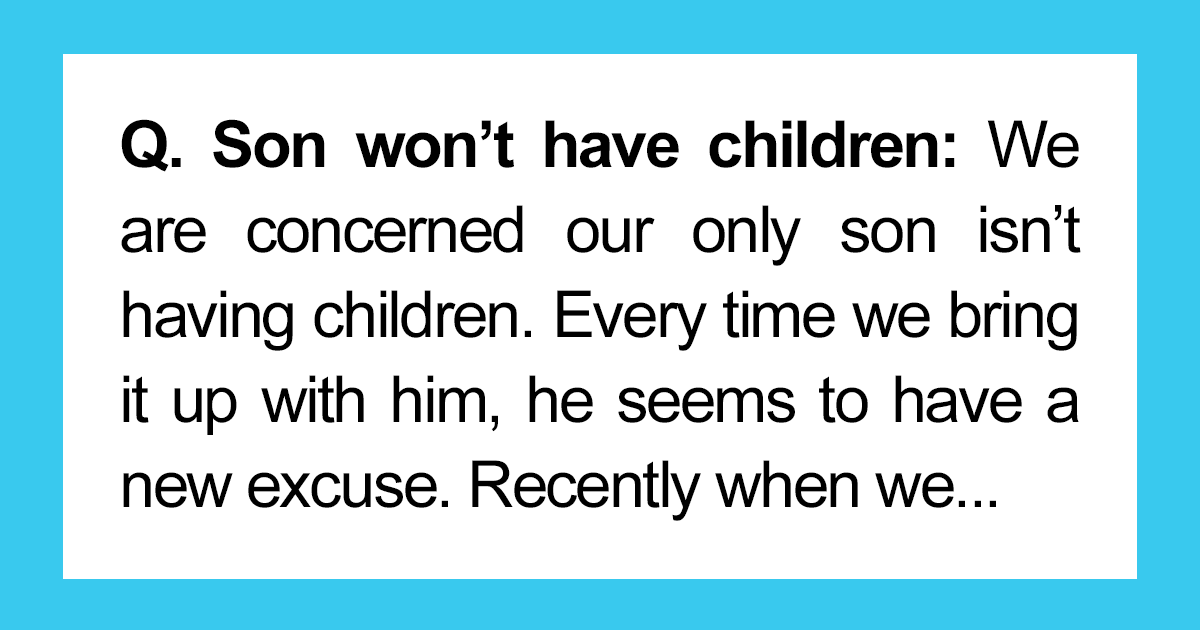
At the center of the story is a mother who wants grandchildren. Not mildly, not casually, not in the “that would be nice someday” way. She wants the pitter-patter of tiny feet, the holiday photos, the sticky fingers on the coffee table, and the grandparent title that sounds like a trophy with reading glasses. Her son and daughter-in-law, however, have made it clear: they do not want children.
The mother, feeling confused and hurt, asked for advice. The response she received was not the gentle pat on the back she may have expected. Instead, the advice was blunt, modern, and deeply relevant: if the couple says they are happy without children, believe them. Stop trying to “convince” them. Their life is not a family committee project.
That response struck a nerve because it reflects a larger cultural shift. More American adults are questioning whether parenthood is right for them, and many are deciding that the answer is no. According to Pew Research Center, the share of U.S. adults under 50 without children who say they are unlikely to ever have kids rose from 37% in 2018 to 47% in 2023. Among younger adults who are unlikely to become parents, the most common major reason is simple: they just do not want to have children.
Why This Story Hit So Many People Right in the Family Group Chat
The reason this story spread is not just that one mother wanted grandchildren. That is common. The real spark is the clash between two different ideas of family happiness.
For many parents, children grow up, marry, buy a house, have babies, and continue the family line. It is the old social conveyor belt: wedding cake, mortgage paperwork, baby shower, repeat. When an adult child steps off that belt, some parents feel stunned. They may interpret the decision as rejection, rebellion, or even a criticism of their own parenting.
But for many adult children, not having kids is not a protest. It is a personal decision about time, money, health, identity, partnership, freedom, and values. Some love children but do not want to raise them. Some want to focus on careers, travel, caregiving, creative work, or simply a quiet home where nobody is using yogurt as wall paint.
The unexpected response to the mother’s complaint worked because it flipped the question. Instead of asking, “How can we make our son give us grandchildren?” it asked, “Why is his happiness only valid if it looks like yours?”
The Modern Childfree Decision Is Not a Phase
One of the most frustrating comments childfree adults hear is, “You’ll change your mind.” It is often delivered with the confidence of someone predicting weather using a knee joint. Yet many adults have thought carefully about the decision for years.
Pew’s research found that adults under 50 who are unlikely to have children cite several major reasons, including not wanting kids, wanting to focus on other priorities, concerns about the state of the world, financial pressure, and environmental concerns. These are not shallow excuses. They are real-world calculations in a country where pregnancy, childbirth, childcare, housing, and education can feel like a subscription plan nobody can cancel.
The financial side is especially hard to ignore. KFF reported that pregnancy, delivery, and postpartum care average more than $20,000 in total health costs for women enrolled in employer plans, including more than $2,700 in out-of-pocket expenses. After that, childcare enters the chat wearing a very expensive hat. Child Care Aware of America found that child care prices rose 29% from 2020 to 2024, outpacing overall inflation during the same period.
In other words, when a couple says, “We can’t afford to raise a child,” they are not necessarily being dramatic. They may simply have opened a spreadsheet.
Parents Want Grandchildren for Understandable Reasons
To be fair, the mother in the story is not a cartoon villain twirling a pacifier. Many parents dream of becoming grandparents because it feels like a continuation of love. Grandchildren can bring joy, meaning, family rituals, and a second chance to enjoy childhood from a softer chair.
For some parents, the desire is also emotional. They may miss the years when their house was noisy and full. They may feel left behind when friends talk about grandbabies. They may fear loneliness, aging, or the end of family traditions. Wanting grandchildren is not wrong.
The problem begins when wanting turns into pressuring.
There is a huge difference between saying, “I would love to be a grandparent someday,” and repeatedly asking, hinting, guilt-tripping, or treating a daughter-in-law’s body like a family-owned factory. The first is honest. The second is invasive. One opens a conversation; the other locks the adult child in an emotional escape room.
Why Pressure Backfires
Parents often believe that if they ask one more time, explain one more reason, or mention “legacy” during one more dinner, their adult child will finally see the light. In reality, pressure usually does the opposite.
When adult children feel that their boundaries are ignored, they may pull away. Psychology Today has noted that parents are more involved than ever in the lives of adult children, but extreme involvement can make adults feel powerless or treated like children. Verywell Mind also emphasizes that healthy parent-adult child relationships require respect for autonomy, individuality, and boundaries.
That is the heart of the issue. A son who says, “We do not want children,” is not asking for a debate tournament. He is sharing a boundary. If the parent responds with persuasion, disappointment, or guilt, the message becomes: “Your decision is only acceptable if I approve it.”
That can damage trust. Eventually, adult children may stop sharing personal information altogether. They may avoid visits, shorten phone calls, or mentally prepare for every family dinner like it is a courtroom deposition with mashed potatoes.
The Daughter-in-Law Problem Nobody Should Ignore
Stories like this often focus on the son and his mother, but the daughter-in-law is central too. In many families, pressure to have children lands hardest on women. Even when a couple makes the decision together, people often assume the woman is the one who can be persuaded, blamed, or “softened up.”
This is unfair and deeply personal. Questions about pregnancy can touch infertility, health risks, trauma, finances, career concerns, relationship conflict, or simply the private truth that someone does not want to be a parent. Nobody owes relatives a medical report, emotional confession, or five-year fertility forecast.
A respectful family does not turn a woman’s reproductive life into small talk. Asking once with sensitivity may be understandable in some relationships. Asking repeatedly after receiving an answer is not curiosity; it is pressure with better manners.
What the Unexpected Response Really Means
The advice the mother received can be summarized in one sentence: your son and daughter-in-law do not need to become parents to prove they are happy.
That sounds simple, but it challenges a powerful assumption. Many people still view parenthood as the final badge of adulthood. You can have a job, a home, a marriage, a retirement account, and a matching set of emotionally stable throw pillows, but if you do not have children, someone will still ask, “So when are you starting a real family?”
The phrase “real family” is the problem. Couples without children are families. Single adults are families with chosen communities. People caring for pets, friends, siblings, aging parents, students, neighbors, or nieces and nephews can live deeply meaningful lives. Parenthood is one form of love, not the only form.
The unexpected response told the mother to stop centering her disappointment and start respecting the couple’s reality. That does not mean her feelings are fake. It means her feelings are hers to manage.
How Parents Can Respond When Adult Children Choose Not to Have Kids
If you are a parent grieving the idea of grandchildren, the healthiest first step is honesty without pressure. You might say, “I had imagined being a grandparent, and I need time to adjust, but I respect your decision.” That sentence does not throw confetti, but it does something better: it keeps the relationship intact.
1. Believe the Answer
If your adult child says they do not want children, accept it as real. Do not treat it as a temporary software bug that can be fixed by nagging.
2. Do Not Blame the Partner
Blaming the spouse or partner is a fast way to create distance. Even if you suspect one person feels more strongly, the couple’s decision is still theirs.
3. Find Other Ways to Nurture
If you long to support younger generations, consider mentoring, volunteering, helping nieces and nephews, joining community programs, or becoming the beloved neighborhood elder who always has snacks and suspiciously good advice.
4. Protect the Relationship You Have
A real relationship with your adult child is more valuable than imaginary grandchildren. Choose the living person in front of you over the fantasy version of the family you expected.
How Adult Children Can Set Boundaries Without Starting World War Brunch
Adult children also need practical language. A boundary does not have to be cruel. It can be calm, short, and repeatable.
Try: “We know you want grandchildren, but we are not having children. We are not discussing it further.”
Or: “I understand this is disappointing for you, but our decision is final.”
Or, when humor fits: “The only baby we are planning is a sourdough starter, and frankly, even that feels needy.”
The key is consistency. If the topic keeps returning, end the conversation or change the setting. Boundaries are not speeches; they are patterns. If a parent learns that every baby question ends the phone call, the baby questions may suddenly become less irresistible.
The Bigger Cultural Shift Behind the Story
U.S. fertility patterns show that the conversation is changing. National birth data showed that the number of U.S. births increased slightly in 2024, but the general fertility rate still declined. At the same time, more adults are delaying parenthood, having fewer children, or choosing not to have children at all.
This does not mean society is collapsing because someone bought a dog stroller instead of a crib. It means people are making more individualized decisions. Parenthood is no longer treated as automatic. For many younger adults, the question is not “When will we have kids?” but “Do we want this life, and can we support it emotionally, financially, and physically?”
That is a healthier question. Children deserve to be wanted, not drafted into existence to soothe a grandparent’s loneliness or complete a holiday card.
Experiences Related to This Topic: The Family Pressure Many People Know Too Well
Ask around, and almost everyone knows someone who has been cornered by the baby question. It happens at weddings, birthday parties, office lunches, religious gatherings, family reunions, and, for reasons science cannot explain, while someone is trying to eat potato salad in peace.
One common experience is the “joke” that is not really a joke. A parent says, “I’m not getting any younger, you know,” or “I guess I’ll just have grand-dogs.” Everyone laughs, but the adult child hears the disappointment underneath. If it happens once, it may slide by. If it happens every visit, it becomes exhausting.
Another familiar experience is the comparison game. A mother mentions that her friend’s daughter just had twins. An uncle brings up a cousin’s baby photos. A neighbor says, “Your parents must be dying for grandchildren.” Suddenly, a private life choice becomes a public performance review. Nobody enjoys being ranked below a cousin’s ultrasound.
Some couples deal with pressure by offering explanations. They mention money, careers, housing, health, or the simple truth that they are happy as they are. Unfortunately, explanations can become invitations for debate. “Money works itself out.” “Nobody is ever ready.” “You’ll regret it.” “Who will take care of you when you’re old?” These replies may sound helpful to the speaker, but to the couple they often feel dismissive.
Other adults stop explaining entirely. They use short answers because long answers have failed. “No, we’re not having kids.” “That’s not up for discussion.” “Please don’t ask again.” This can sound cold, but it is often the result of years of being polite first.
The workplace version is also common. People without children may be asked invasive questions by coworkers who would never ask about someone’s bank balance or medical chart. A person can love children, be a great aunt, coach a youth team, or enjoy babysitting and still not want parenthood. Enjoying kids for two hours is not the same as signing up for eighteen years plus college essays.
There is also grief on both sides. Parents may grieve the grandparent role they imagined. Adult children may grieve not being understood. Couples who cannot have children may feel wounded by questions that assume choice. People who do not want children may feel judged as selfish, immature, or incomplete. The conversation becomes painful because everyone is protecting something tender.
The best experiences come from families that adapt. A parent may need time, but eventually says, “I love you more than I love the idea of grandchildren.” That sentence can change everything. It tells the adult child they are not merely a bridge to the next generation. They are enough.
Some families create new rituals. They travel together. They celebrate career milestones. They include partners warmly. They spoil pets. They support community children. They build family identity around presence rather than reproduction. The family tree may grow differently than expected, but it can still provide shade.
The lesson from the mother’s unexpected response is not that parents should never feel sad. It is that love matures when it stops demanding control. Adult children are not sequels. They are not assigned to finish the dreams their parents started. They are allowed to choose a life that fits them, even if that life has no nursery, no diaper bag, and no tiny socks disappearing in the dryer.
Conclusion: Love Your Adult Child More Than Your Imagined Grandchild
The story of a mom complaining that her son will not have children resonates because it reveals a difficult truth: family love can become selfish when it refuses to respect boundaries. Wanting grandchildren is human. Pressuring adult children to produce them is harmful.
The response she did not expect was also the response many families need. Believe your adult children. Respect their choices. Let them build the life that makes sense for them. If grandchildren arrive someday, wonderful. If they do not, the relationship can still be rich, funny, loyal, and full of meaning.
After all, the goal of raising children is not to own their future. It is to help them become adults who can choose it.

