
Skincare
30 Most Bizarre-Looking Bus Stops Captured By Christopher Herwig
Aug
Note: These extraordinary Soviet-era bus shelters are real roadside structures documented by Canadian photographer Christopher Herwig across the former Soviet Union.
Most bus stops ask very little of the world. A bench. A roof. Maybe a faded route map that appears to have survived three governments and a meteor strike. Christopher Herwig’s photographs prove that bus stops in parts of the former Soviet Union had much bigger ambitions.
Some look like alien spacecraft that landed beside a farm road and decided to wait for Route 12. Others resemble giant seashells, abstract sculptures, concrete birds, traditional hats, colorful mosaics, or tiny homes designed by an architect who had apparently consumed too much coffee and not nearly enough restraint.
Herwig began noticing unusual transit shelters during a 2002 bicycle trip from London to St. Petersburg. What started as a curious roadside observation turned into a years-long photography mission across former Soviet republics, from the Baltic region to Central Asia and the Caucasus. His project eventually became books, exhibitions, and a documentary film devoted to one of the world’s strangest overlooked forms of public architecture.
These bizarre-looking bus stops are more than quirky roadside attractions. They are tiny monuments to local identity, public transportation, artistic freedom, and the strange magic that can happen when an ordinary infrastructure project gets handed to someone with imagination.
Why Soviet Bus Stops Became So Unexpectedly Creative
During the Soviet era, large buildings were often shaped by standardization, bureaucracy, and a serious commitment to concrete. Apartment blocks, factories, government offices, and public buildings frequently followed repeated designs that could be built quickly across enormous distances.
Bus stops, however, occupied a more flexible corner of the architectural universe. They were comparatively small, inexpensive, and often commissioned locally by road departments, farms, village authorities, artists, or regional builders. That gave designers room to experiment.
A major housing complex had to satisfy regulations, budgets, engineering standards, and enough committees to make a grown architect quietly stare at a wall. A rural bus stop could become a miniature artistic rebellion. It might include folk symbols, colorful tile mosaics, bold geometry, local stone, political imagery, or shapes that make modern-day commuters wonder whether the bus is arriving or whether they have entered a dream sequence.
Herwig’s Soviet bus stop photography captures this tension beautifully. These structures served practical purposes, but many were also visual statements. They announced villages, honored local culture, celebrated nature, or simply gave a lonely roadside a dramatic personality.
30 of Christopher Herwig’s Most Bizarre-Looking Bus Stops
The following collection highlights the kinds of unforgettable bus shelters found throughout Christopher Herwig’s photography project. Some are celebrated examples with known locations, while others represent recurring visual styles seen across his vast archive of Soviet-era roadside architecture.
1. The Giant Seashell Stop in Gagra, Abkhazia
One of the most famous examples looks less like a bus shelter and more like a seashell designed by a surrealist architect vacationing on the Black Sea. Its sweeping curves and mosaic-covered surface make it feel part ocean creature, part sculpture, part “please do not touch the art installation.”
2. The Blue-and-Yellow Mosaic Wave
Another Gagra shelter rises in undulating layers that resemble a frozen wave. The colorful mosaic work gives the structure movement even when no bus, car, cyclist, or confused tourist is anywhere nearby.
3. The Folded-Metal Spaceship in Taraz, Kazakhstan
Taraz offers one of Herwig’s most striking images: a sharply folded metal shelter that appears ready to lift off into orbit. It is technically a bus stop, but it has the posture of a spacecraft that missed its launch window.
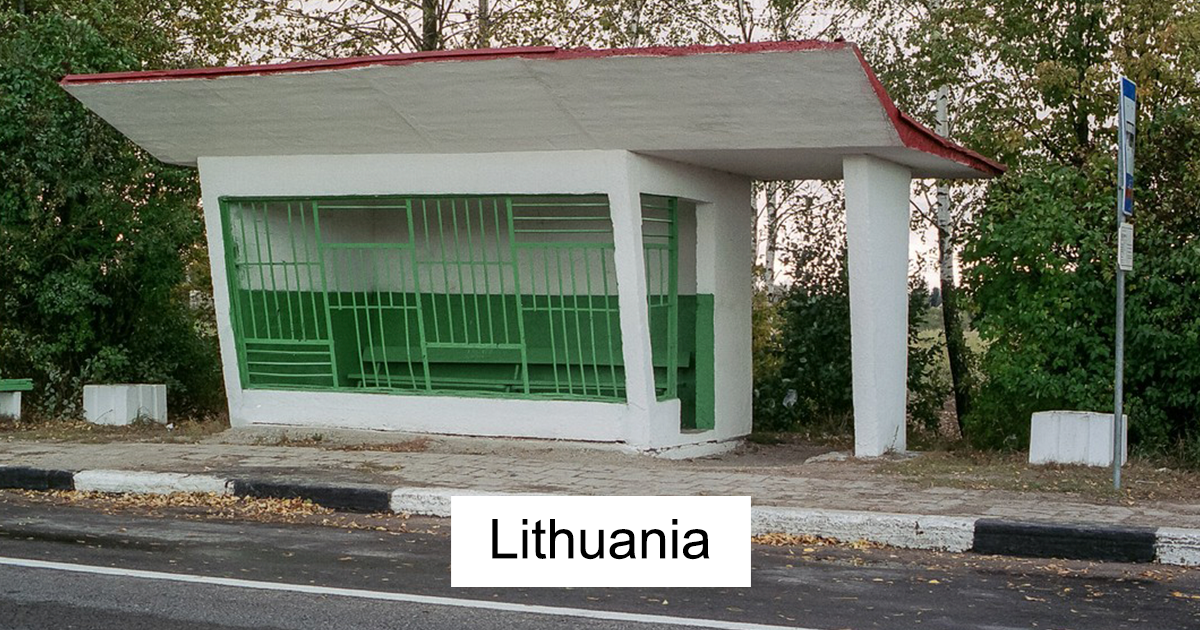
4. The Neon Concrete Box in Rokiškis, Lithuania
This shelter takes a basic concrete form and turns it into an eye-popping visual event with bright color. It proves that even a rectangular roadside structure can become memorable when someone decides beige has suffered enough.
5. The Crown-Like Pavilion in Abkhazia
One open-sided bus stop features a crown-shaped canopy that seems more suitable for a ceremonial procession than a rainy Tuesday commute. It offers artistic drama first and weather protection second, which is a bold but understandable choice.
6. The Bird-Shaped Shelter at Goderdzi Pass, Georgia
High in Georgia’s Goderdzi Pass, a bus stop resembling a bird or star-like creature appears almost ready to flap into the mountain air. Its shape suits the landscape so well that it feels like a roadside guardian watching over snowy routes.
7. The Traditional Kalpak Hat Stop in Balykchy, Kyrgyzstan
Near Lake Issyk Kul, one bus shelter borrows the form of a traditional Kyrgyz kalpak hat. It is practical, culturally specific, and delightfully impossible to mistake for a generic transit shelter.
8. The Tiny House Stop in Uralsk, Kazakhstan
In Uralsk, a bus stop resembles a small house with windows, a blue-framed doorway, and a chimney-like feature. It has the cozy confidence of a cottage that got tired of real estate prices and moved beside a highway.
9. The Polka-Dot Chimney Shelter
The Uralsk stop’s decorative chimney detail adds even more personality. A plain roof would have been too predictable. Naturally, it needed polka dots.
10. The Serpentine Mosaic Pavilion
Along the former Soviet Riviera, several stops designed with twisting lines and colorful tiles appear almost reptilian. They slither through the visual landscape instead of sitting politely beside it.
11. The Concrete Starburst Stop
Some shelters explode outward with angular forms that feel halfway between a modernist monument and a prop from a 1970s science-fiction television show. They turn waiting for a bus into a small encounter with cosmic geometry.
12. The Brutalist Bunker with a Secret Personality
At first glance, this type of stop looks like a compact concrete bunker. Then the details emerge: a mural, a sculpted opening, a strange roofline, or an unexpected color combination. It is the architectural equivalent of someone wearing a gray suit with glittery socks.
13. The Mountain Stone Shelter
In parts of Georgia and Armenia, local stone gives bus stops a rugged, almost ancient quality. These shelters seem to rise from the landscape rather than being placed on it.
14. The Mosaic Fish Stop
Near coastal areas, marine imagery appears in decorative mosaics. Fish, waves, shells, and abstract aquatic forms turn a transit shelter into a tiny roadside aquarium, minus the water and inconvenient sea lions.
15. The Half-Open Concrete Flower
Some stops use curved concrete slabs that open outward like petals. They do not always provide full cover from rain, but they are undeniably more charming than a standard metal box with a scratched-up timetable.
16. The Abstract Animal Shelter
Several of Herwig’s photographs feature structures that seem inspired by animals without clearly representing any one creature. They might be birds, fish, beetles, dragons, or what happens when a sculptor says, “I’ll know it when I see it.”
17. The Concrete Rocket Stop
Central Asian roadside architecture occasionally leans hard into space-age fantasy. Pointed forms, wing-like supports, and sweeping angles make certain bus stops look prepared for interplanetary public transit.
18. The Geometric Prism Pavilion
Sharp triangles, trapezoids, and faceted walls appear frequently in Soviet modernist design. At bus-stop scale, they feel playful rather than intimidating, like a math textbook learned how to have fun.
19. The Folk-Motif Shelter
Many bus stops incorporate regional patterns, decorative symbols, or references to traditional crafts. These designs reject the idea that a national transportation network must erase local identity.
20. The Wooden Bus Stop in Estonia
Not every strange-looking bus stop is made of concrete. In Estonia, wooden shelters reflect local building traditions and rural craftsmanship. They may be quieter than the giant mosaic shells, but they have their own charm.
21. The Lonely Steppe Monument
On the broad Kazakh steppe, a single bus stop can become the only vertical object for miles. Even a modest shelter gains theatrical power when surrounded by sky, road, wind, and seemingly infinite grassland.
22. The Monumental Red Star Shelter
Some stops incorporate Soviet iconography directly, using stars, heroic symbolism, or political imagery. These structures are reminders that public design often carried ideological messages, even when the audience was simply waiting for a bus.
23. The Roadside Mosaic Theater
Large decorative panels turn some bus stops into miniature outdoor galleries. Mosaics of workers, animals, landscapes, industry, sports, and local legends create public art in places far from museums.
24. The Cave-Like Concrete Shelter
Rounded openings and thick walls make several stops feel almost prehistoric. They appear as though someone carved a waiting room directly into a roadside boulder.
25. The Futuristic Winged Roof
Wide, swooping rooflines are a recurring theme. They make the shelters appear aerodynamic, which is amusing because buses are not generally known for breaking the sound barrier.
26. The Village Landmark Stop
In many rural communities, a bus shelter was more than a place to wait. It was a meeting point, a visual marker, and sometimes the first architectural impression visitors received when entering the village.
27. The Concrete Portal
Some structures look like portals to another dimension. They frame the road or landscape dramatically, making a simple act of boarding a bus feel like the beginning of a fantasy quest.
28. The Decorative Brick Shelter
Brickwork, patterned masonry, and local materials gave many bus stops personality without requiring enormous budgets. The result is often modest, handmade, and more memorable than a multimillion-dollar airport lounge.
29. The Almost-Useless Art Object
Some shelters prioritize artistic expression so boldly that protection from wind, snow, or rain becomes secondary. They may not be perfect in practical terms, but nobody forgets them.
30. The Bus Stop That Looks Like It Has a Backstory
The best examples in Herwig’s collection feel like characters. You want to know who designed them, who waited there, what stories unfolded nearby, and whether the local bus driver ever got tired of tourists taking photos instead of boarding.
What Christopher Herwig’s Photography Reveals About Public Design
Christopher Herwig’s bus stop photographs are funny, strange, beautiful, and occasionally baffling. But their deeper value lies in what they reveal about public space.
Modern infrastructure is often designed to disappear into the background. Bus shelters are usually standardized because standardization is cheap, efficient, easy to repair, and unlikely to inspire anyone to write poetry. Yet these Soviet-era bus stops demonstrate that public utility does not have to mean visual boredom.
A transit shelter can protect commuters while also telling a story about local culture. It can reference regional landscapes, folk traditions, local materials, historical symbols, or artistic movements. It can be a piece of civic identity instead of a metal afterthought attached to a pole.
That does not mean every bus stop should become a giant concrete squid. There are practical matters such as accessibility, safety, maintenance, weather protection, lighting, and seating. Still, Herwig’s photographs make a persuasive case that cities and rural communities can make ordinary infrastructure more human.
Why These Bizarre Bus Stops Matter Today
Many of the structures documented by Herwig are aging, damaged, abandoned, altered, or vulnerable to demolition. They were not always treated as important heritage sites. To some local residents, they may simply be old shelters from another era. To architecture lovers, photographers, historians, and travelers, they are irreplaceable examples of vernacular public art.
The photographs preserve more than unusual forms. They preserve a moment when local creativity found an outlet inside a highly controlled system. The designs are reminders that artistic expression can appear in unexpected places: on a highway shoulder, beside a village road, under a curved slab of concrete decorated with a mosaic fish.
That is part of what makes the project so compelling. These bus stops are absurd in the best possible way. They are evidence that imagination can survive paperwork, budgets, regulations, weather, and the occasional bus running twenty minutes late.
Experiences Inspired by Christopher Herwig’s Bizarre Bus Stops
Looking through Christopher Herwig’s photographs can change the way you travel. Suddenly, a bus stop is no longer just a pause between Point A and Point B. It becomes a small stage where architecture, weather, history, and local life meet for a few minutes at a time.
Imagine driving through a rural road in Kazakhstan. The horizon is vast, the wind is moving through dry grass, and the road appears to stretch forever. Then, without warning, a strange angular metal shelter appears beside the pavement. It looks like a spacecraft that made an emergency landing and decided to become municipal infrastructure. You slow down. You look again. You realize that the bus stop is the most interesting object you have seen for fifty miles.
That is the joy of Herwig’s project. It encourages travelers to pay attention to places that are normally ignored. Most people photograph cathedrals, castles, museums, dramatic coastlines, and meals that arrive with tiny flowers on top. Herwig photographed bus stops. In doing so, he found an entire hidden world of roadside creativity.
There is something refreshing about that approach. Travel often comes with pressure to see the famous thing, the tallest thing, the oldest thing, or the thing with the longest line. But unusual bus stop architecture rewards curiosity instead of checklist tourism. It asks travelers to notice the overlooked details that make a place feel alive.
For photographers, these structures offer nearly endless creative possibilities. A stop may look completely different at sunrise, during a snowstorm, under harsh afternoon light, or when surrounded by a group of locals carrying groceries. A bright mosaic shelter against a gray sky can feel dramatic. A concrete pavilion in the middle of an empty field can feel lonely, funny, mysterious, or unexpectedly beautiful.
For architecture lovers, the experience is equally rewarding. These structures blur the line between practical design and public sculpture. They show how small-scale buildings can carry enormous visual impact. A bus shelter may be only a few feet wide, but when its form echoes a mountain, bird, wave, traditional hat, or local folk pattern, it becomes part of the cultural landscape.
For ordinary commuters, the experience may be simpler but no less meaningful. Waiting for a bus is rarely anyone’s favorite hobby. It involves checking the time, checking the road, checking the weather, and checking whether the bus schedule is more of a philosophical suggestion than a binding promise. A memorable bus stop can make that wait a little more pleasant.
It can offer shade, shelter, a bench, a meeting point, and perhaps a splash of color on an otherwise ordinary day. It can remind people that public spaces belong to them, not just to budgets and traffic engineers. It can say, “Yes, you are waiting for the bus, but you are also standing inside something someone cared enough to make interesting.”
Herwig’s work also inspires a different kind of road trip. Instead of hunting for famous landmarks, travelers could create their own unofficial route of strange infrastructure. Search for old bus shelters, unusual roadside signs, forgotten service stations, local murals, abandoned train platforms, or small-town monuments. The reward is not just a good photograph. It is the feeling of discovering a place that has not been polished for tourists.
There is also a lesson here for cities and communities everywhere. Public transit does not have to look sterile. A bus stop can be functional, accessible, safe, and visually memorable at the same time. Local artists can create murals. Students can help design seating. Communities can use regional materials, patterns, and colors. A simple shelter can become a tiny landmark.
Christopher Herwig’s bizarre bus stops ultimately remind us that the world is full of design surprises. Sometimes they are hidden in famous museums. Sometimes they are beside a rural highway, waiting quietly for a bus that may or may not arrive on schedule.
Either way, it is worth looking up from your phone once in a while. You never know when the next bus stop will look like a seashell, a spaceship, a bird, a concrete flower, or an architectural joke that somehow became public transportation history.
Conclusion
Christopher Herwig’s collection of bizarre Soviet bus stops proves that even the humblest public structure can become art. From shell-shaped shelters in Abkhazia to spacecraft-like forms in Kazakhstan and folk-inspired designs in Kyrgyzstan, these roadside creations reveal a surprising mix of utility, local identity, and fearless imagination.
They are not merely quirky relics of the Soviet era. They are visual reminders that infrastructure can be practical without becoming forgettable. A bus stop can shelter a commuter, mark a community, preserve a tradition, and make a lonely highway feel a little less lonely.

