
Hair Care
How to Find a Safety Data Sheet (SDS): 5 Steps
Jul
Trying to find a Safety Data Sheet can feel like looking for a smoke detector battery at 2 a.m.: you know it exists, you know it matters, and somehow it is never exactly where you expect it to be. The good news is that finding an SDS is usually straightforward once you know what to search, where to search, and how to tell whether the document you found is the right one.
A Safety Data Sheet, often shortened to SDS, is the standardized document that explains the hazards, safe handling, storage, emergency measures, exposure controls, and disposal considerations for a chemical product. In older workplaces, you may still hear people say “MSDS,” which stands for Material Safety Data Sheet. Same general idea, older name. OSHA’s modern Hazard Communication Standard uses the SDS format, which is organized into 16 sections so workers, supervisors, emergency responders, lab teams, custodial crews, maintenance staff, and safety managers can quickly find the information they need.
This guide walks through how to find a Safety Data Sheet in five practical steps. No lab coat required. A little detective work helps, but you do not need to be Sherlock Holmes with goggles.
Why Safety Data Sheets Matter
An SDS is not just paperwork for a binder that has not been opened since the printer made fax-machine noises. It is a core chemical safety tool. A proper SDS can tell you whether a product is flammable, corrosive, toxic, reactive, irritating to the skin, dangerous if inhaled, or incompatible with certain materials. It also explains what personal protective equipment may be needed, what to do after a spill, how to store the product, and what first-aid steps apply after exposure.
For workplaces in the United States, SDS access is tied to hazard communication. Employees must be able to access SDSs for hazardous chemicals in their work area without barriers during their shift. Electronic SDS systems are commonly used, but the key phrase is “without barriers.” If the only SDS is on a password-protected computer locked in the manager’s office during the night shift, that is not exactly instant access. That is a scavenger hunt with legal consequences.
How to Find a Safety Data Sheet (SDS): 5 Steps
Step 1: Identify the Exact Product
The fastest way to find the correct SDS is to start with the exact product identity. “Cleaner” is not enough. “Blue floor cleaner” is better, but still risky. “AcmePro Neutral Floor Cleaner, Lemon Scent, product number NF-204, 1-gallon bottle” is the kind of detail that makes SDS searching much easier.
Before searching, collect as many identifiers as possible:
- Product name as printed on the label
- Manufacturer or supplier name
- Product number, catalog number, SKU, or part number
- UPC or barcode number
- CAS number for single chemicals
- Concentration or grade, such as 70% isopropyl alcohol or reagent grade acetone
- Revision date, if an older SDS or label is available
This matters because similar products can have very different hazard profiles. A disinfectant wipe, a concentrated disinfectant, and a ready-to-use disinfectant spray may share a brand name but require different handling instructions. Likewise, “sodium hydroxide” at 0.5% is not the same practical risk as sodium hydroxide pellets. The name is the front door; the product number is the key.
Step 2: Search the Manufacturer’s Website First
The manufacturer or importer is usually the best source for the current SDS because the document is specific to that product formulation. Many companies maintain regulatory document libraries where you can search by product name, product number, SDS number, UPC, or catalog number.
Use searches like these:
- “Product name” “SDS” manufacturer name
- “Product number” “Safety Data Sheet”
- site:manufacturer.com “product name” “SDS”
- “CAS number” “SDS” supplier name
For example, if you need an SDS for a 3M product, search 3M’s SDS/regulatory document tool using the product name, product number, UPC, SDS number, or 3M ID. If you need a laboratory chemical from Fisher Scientific, the SDS can often be found by searching the catalog number, CAS number, chemical name, or supplier part number. Many product pages also include SDS links directly under documents, certificates, compliance information, or product resources.
When you find a PDF, do not celebrate too soon. Open it and verify that it matches the product in your hand. Check the company name, product identifier, intended use, and revision date. If the document is for a different country, language, formulation, or concentration, keep searching. SDS requirements and wording can vary by jurisdiction, and a U.S. workplace usually needs the U.S. version when available.
Step 3: Check Your Workplace SDS System or Chemical Inventory
If the product is already used at work, your organization may already have the SDS stored in a chemical inventory system, EHS software platform, shared drive, QR-code station, SDS binder, or lab-specific database. Start where your workplace tells employees to look. That may be the safety office, a chemical inventory cabinet, a tablet near the storage area, a lab management platform, or a clearly marked binder near the point of use.
Use the internal system carefully. Search by product name first, then by manufacturer, then by product number. If your workplace uses abbreviations or nicknames, avoid them at first. “IPA” may mean isopropyl alcohol to the lab team, but a database may only recognize “2-propanol” or “isopropanol.” Chemical names are excellent at making everyone feel like they forgot high school chemistry.
If you cannot find the SDS internally, ask a supervisor, safety coordinator, purchasing team, or Environmental Health and Safety department. For high-risk materials, do not wait until a spill or exposure occurs. SDS access should be part of onboarding, chemical approval, and routine safety checks, not a dramatic emergency scene with someone yelling, “Where is the binder?”
Step 4: Use Reputable SDS Databases and Chemical Safety References
If the manufacturer website does not solve the mystery, use reputable SDS databases and chemical safety references. University EHS pages often maintain curated lists of SDS sources. Large suppliers and distributors, including laboratory, industrial, janitorial, and maintenance suppliers, may host SDS documents for products they sell. Free SDS search databases can also help, especially when the product is common or the manufacturer is hard to identify.
For pure chemicals, chemical references such as the NIOSH Pocket Guide to Chemical Hazards and PubChem’s chemical safety information can provide useful hazard context, including synonyms, CAS numbers, exposure information, GHS classifications, pictograms, hazard statements, and first-aid details. These tools are excellent for research and cross-checking, but they do not always replace the manufacturer-specific SDS for a mixture or branded product.
Here is the simple rule: public chemical references can help you understand the hazard; the manufacturer SDS tells you about the specific product. A database page for “hydrogen peroxide” is useful, but an SDS for 3% household hydrogen peroxide is not the same as an SDS for 30% laboratory-grade hydrogen peroxide. One belongs in a first-aid cabinet; the other deserves far more respect and probably better gloves.
Step 5: Verify, Save, and Share the Correct SDS
Once you find the SDS, verify it before filing it away. A reliable SDS should contain the standard 16-section structure:
- Identification
- Hazard identification
- Composition/information on ingredients
- First-aid measures
- Fire-fighting measures
- Accidental release measures
- Handling and storage
- Exposure controls/personal protection
- Physical and chemical properties
- Stability and reactivity
- Toxicological information
- Ecological information
- Disposal considerations
- Transport information
- Regulatory information
- Other information, including preparation or revision date
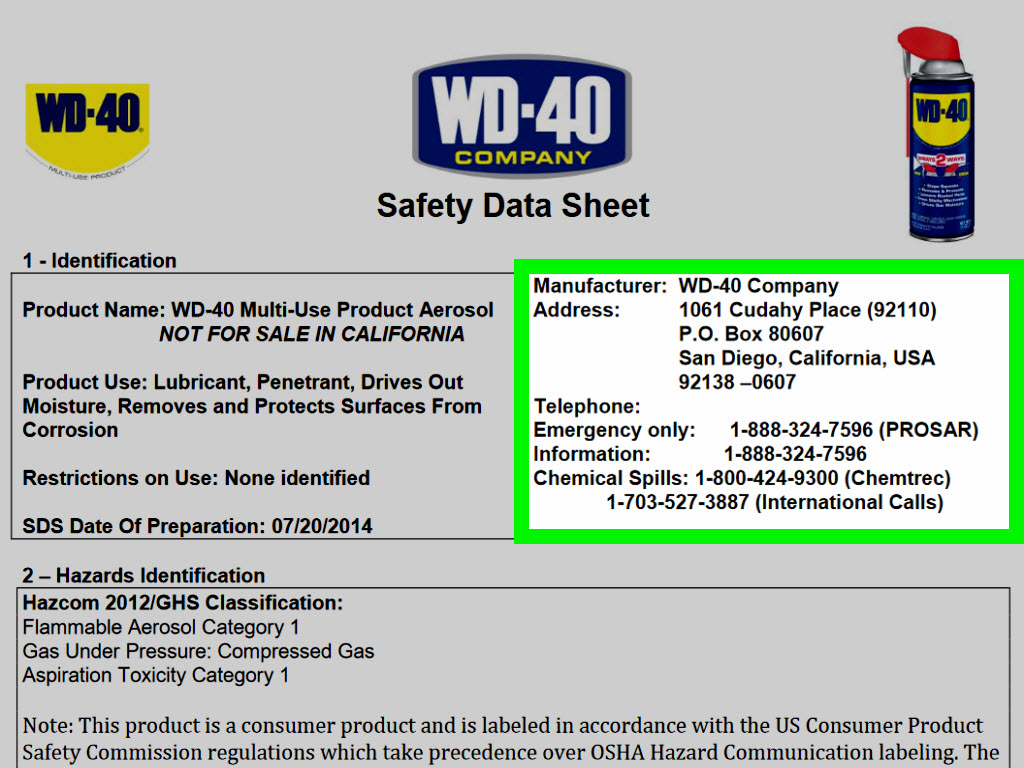
Pay special attention to Sections 1, 2, 4, 6, 7, and 8. Section 1 confirms the product identity and emergency contact. Section 2 summarizes the hazards and label elements. Section 4 covers first aid. Section 6 explains spill response. Section 7 covers handling and storage. Section 8 lists exposure controls and personal protective equipment. These sections are the “open this first” parts when time matters.
After verifying the SDS, save it in the correct workplace system and name the file clearly. A file called SDS.pdf is a tiny act of chaos. Use a naming format like Manufacturer_ProductName_ProductNumber_SDS_RevisionDate.pdf. Then make sure affected employees know where it is and how to access it. If the SDS changes, update the saved copy and remove outdated versions from active use.
Common Mistakes When Searching for an SDS
Using the Wrong Product Variant
Many brands sell multiple versions of the same product. Fragrance-free, lemon scent, concentrated, ready-to-use, aerosol, gel, powder, and wipe formats may all have different SDSs. Always match the label and product number.
Choosing an Outdated MSDS
Older Material Safety Data Sheets may still appear in search results. They can be useful for historical context, but modern SDS documents follow the standardized 16-section format. Choose the current SDS whenever possible.
Assuming a Retail Label Is Enough
A product label is important, but it is not the same as an SDS. Labels provide immediate use and warning information. SDSs provide broader workplace safety, exposure, storage, spill, firefighting, transport, and disposal details.
Ignoring Country or Region
A product may have different SDS versions for the United States, Canada, the European Union, or other regions. Use the version appropriate for your workplace location and regulatory context.
Example: Finding an SDS for Acetone
Suppose your shop uses acetone. A vague search for “acetone SDS” returns thousands of results. Instead, look at the container. If it was purchased from Fisher Scientific, search the Fisher site using the catalog number or CAS number. If it came from a paint supplier, search the supplier and brand name. If it is a hardware-store product, check the manufacturer’s site and product page.
Then verify the SDS. Does Section 1 list the same supplier? Does the product identifier match the label? Does Section 2 identify flammability hazards? Does Section 8 recommend appropriate ventilation and PPE? Does the revision date look current? If yes, save it in your SDS system. If no, keep looking. Close enough is fine for horseshoes, not chemical safety.
Experience Notes: What Real SDS Searches Teach You
After helping people look for SDS documents in practical settings, one lesson becomes obvious: the hard part is rarely the search engine. The hard part is product identity. A worker may say, “I need the SDS for the degreaser,” while the storage shelf has four degreasers from three suppliers, one unlabeled spray bottle, and a mystery jug that looks like it has lived several lives. At that point, the safest first step is not typing faster. It is stopping, reading the label, checking the purchasing record, and making sure the container is properly identified.
Another common experience is the “almost right” SDS. This is the document that looks perfect until you notice it is for the aerosol version instead of the liquid, the Canadian version instead of the U.S. version, or the old formulation before a supplier changed ingredients. In a calm office, that seems like a small paperwork issue. During a spill, it becomes a big deal. The wrong SDS may recommend the wrong gloves, the wrong storage conditions, or the wrong emergency response steps. The lesson is simple: verify before you rely.
Small businesses often discover SDS management during a moment of mild panic. A new cleaning chemical arrives, someone asks where the SDS is, and everyone points at everyone else like a safety-themed sitcom. The fix is not complicated. Add SDS collection to the purchasing process. Before a new chemical is approved for use, require the product label, intended use, storage location, and SDS. Save the PDF in one shared location and add it to the inventory. This turns SDS management from a rescue mission into a routine habit.
Laboratories teach a different lesson: synonyms matter. One person searches for “ethyl alcohol,” another searches for “ethanol,” and a third searches by CAS number. The CAS number often wins because it cuts through naming confusion. For single chemicals, CAS numbers are incredibly useful. For mixtures, product numbers and manufacturer names usually matter more.
Warehouses and maintenance teams teach the value of access. An SDS that exists but cannot be found quickly is not very useful. QR codes near chemical storage areas, a simple digital folder, backup paper copies for high-risk materials, and short employee training can prevent the classic “I know we have it somewhere” problem. Somewhere is not a location. Somewhere is where safety documents go to retire.
The best SDS systems are boring in the nicest possible way. They are organized, searchable, updated, and easy for employees to use under pressure. Nobody should need advanced database skills to find first-aid measures after exposure or spill cleanup instructions after a container tips over. When SDS access is simple, people use it. When it is complicated, people guess. In chemical safety, guessing is not a strategy; it is a plot twist.
Final Checklist for Finding the Right SDS
- Match the exact product name and manufacturer.
- Use product numbers, catalog numbers, UPCs, or CAS numbers when available.
- Search the manufacturer or supplier website first.
- Check your workplace SDS system or EHS inventory.
- Use reputable SDS databases and chemical references for backup research.
- Confirm the SDS is for the correct country, formulation, and revision date.
- Save it where employees can access it quickly during every shift.
Conclusion
Finding a Safety Data Sheet is not complicated when you follow a clear process: identify the product, search the manufacturer or supplier, check your workplace system, use reputable databases when needed, and verify the document before saving it. The right SDS helps people understand hazards, choose proper PPE, respond to spills, store chemicals safely, and act quickly in emergencies.
The most important habit is accuracy. Do not settle for a similar product, a mystery PDF, or a document from the wrong region. Match the SDS to the container in front of you. Keep it accessible. Train people to find it. Chemical safety becomes much easier when the information is ready before anyone needs it.

