
Beauty Unlocked
The Disappearing Home Office
Jul
The home office is not exactly vanishing. It is being folded, hidden, shared, downsized, and occasionally evicted by a guest bed. As hybrid work replaces the five-day remote routine for many Americans, the dedicated office is evolving into something more flexible: a workspace that appears when needed and politely disappears when the workday ends.
The Room That Arrived Overnight
For a few strange years, the home office became the most important room nobody had planned for. Dining tables turned into command centers. Spare bedrooms acquired monitors, ring lights, and office chairs large enough to qualify as minor infrastructure. Closets became “cloffices,” which sounded charming until somebody needed a winter coat during a quarterly review.
The transformation was fast because it had to be. Millions of Americans began working from home during the COVID-19 pandemic, and residential design scrambled to catch up. A house was no longer simply where people slept, ate, relaxed, and argued about the thermostat. It also had to function as an office building, classroom, cafeteria, video studio, and technology support department.
Now the emergency phase has passed. Employers are calling workers back to company offices, housing remains expensive, and homeowners are reconsidering whether an entire room should be permanently reserved for a laptop that leaves the house three days a week. The result is the disappearing home officea shift away from the formal, dedicated office toward smaller, smarter, multifunctional workspaces.
Yet the story is not as simple as “remote work is over.” It is closer to “remote work changed shape, and the furniture is trying to keep up.”
Remote Work Did Not DisappearIt Settled Down
Return-to-office headlines can make it seem as though every remote employee has packed up the ergonomic keyboard and marched back to a cubicle. The data tells a more complicated story.
The U.S. Census Bureau reported that 13.8% of American workers usually worked from home in 2023. That was lower than the pandemic peak but still more than twice the 2019 share. Pew Research Center has also found that most workers with jobs that can be performed remotely continue to work from home at least part of the time.
Gallup’s workplace research shows why the home workspace remains relevant: hybrid work is the dominant arrangement among remote-capable employees. Most are not working at home every day, but they are not commuting every day either. Their calendars may look like a checkerboardoffice Tuesday through Thursday, home Monday and Friday, plus one mysterious meeting that could have been an email.
Hybrid Work Changes the Space Equation
A full-time remote employee can justify a room with a permanent desk, file storage, acoustic treatment, and perhaps a tasteful ficus that appears more organized than its owner. A hybrid employee faces a different calculation. Is it worth sacrificing 120 square feet to a workspace used twice a week?
For many households, the answer is no. The work function remains, but the office room begins to dissolve. It moves into a guest bedroom, landing, kitchen alcove, finished basement, built-in cabinet, or wall-mounted desk. The home office is becoming less of a destination and more of a setting.
Why the Dedicated Home Office Is Shrinking
1. Every Square Foot Has a Job Interview
Housing affordability has forced buyers and homeowners to become ruthless space managers. A room that performs only one task may feel luxurious when the same area could serve as a nursery, guest room, workout zone, media room, or storage space for the exercise equipment everyone fully intends to use next Monday.
Research from the National Association of Home Builders shows that buyers still value work and study space. In a 2024 analysis, 66% of buyers preferred exactly one home office, while another 13% wanted at least two. The important phrase, however, was “home office or space dedicated to work or study.” Buyers want the function, but they may not require a traditional room with a door, executive desk, and shelves full of books purchased primarily because the spines look intelligent on camera.
2. Return-to-Office Policies Reduced Daily Use
Many companies have increased in-person attendance requirements. Pew found that a growing share of hybrid workers are subject to employer rules specifying how often they must appear at the workplace. Large organizations have introduced three-, four-, or even five-day office expectations.
That does not eliminate work-from-home days, but it reduces the value of a single-purpose room. When employees use a home office only occasionally, the room starts looking suspiciously available to everyone else in the household.
3. Pandemic-Era Design Trends Lost Their Novelty
During the remote-work boom, listing descriptions celebrated Zoom rooms, office sheds, dual workstations, and closet offices. Zillow’s home-trend analysis later found that mentions of several of these highly specific work-from-home features declined substantially.
This does not necessarily mean buyers stopped caring about productivity. It suggests that the novelty wore off. People no longer want their homes to look like emergency coworking facilities. They want workspaces that blend into the architecture instead of announcing, “A regional sales manager lives here.”
4. Households Need Flexibility More Than Formality
Modern family life changes quickly. A guest room may become a nursery. A nursery becomes a homework room. A homework room becomes a gaming bunker with enough glowing equipment to guide aircraft. Spaces that can adapt are more valuable than spaces designed around a single stage of life.
Homeowners are therefore choosing built-ins, movable partitions, foldaway desks, modular storage, and furniture that can support multiple uses. The disappearing home office is part of a wider movement toward flexible home design.
Where the Home Office Is Going
The Guest Room Office
The guest room has become the natural habitat of the hybrid workspace. A compact desk sits against one wall, while a sleeper sofa, daybed, or Murphy bed handles visitors. This arrangement works because neither function is usually needed every day.
The key is to prevent one use from sabotaging the other. Guests should not have to sleep beside six months of expense reports. Workers should not begin every Monday by folding laundry off the keyboard. Closed storage, cable management, and furniture scaled to the room help maintain an uneasy but functional peace treaty.
The Built-In Work Nook
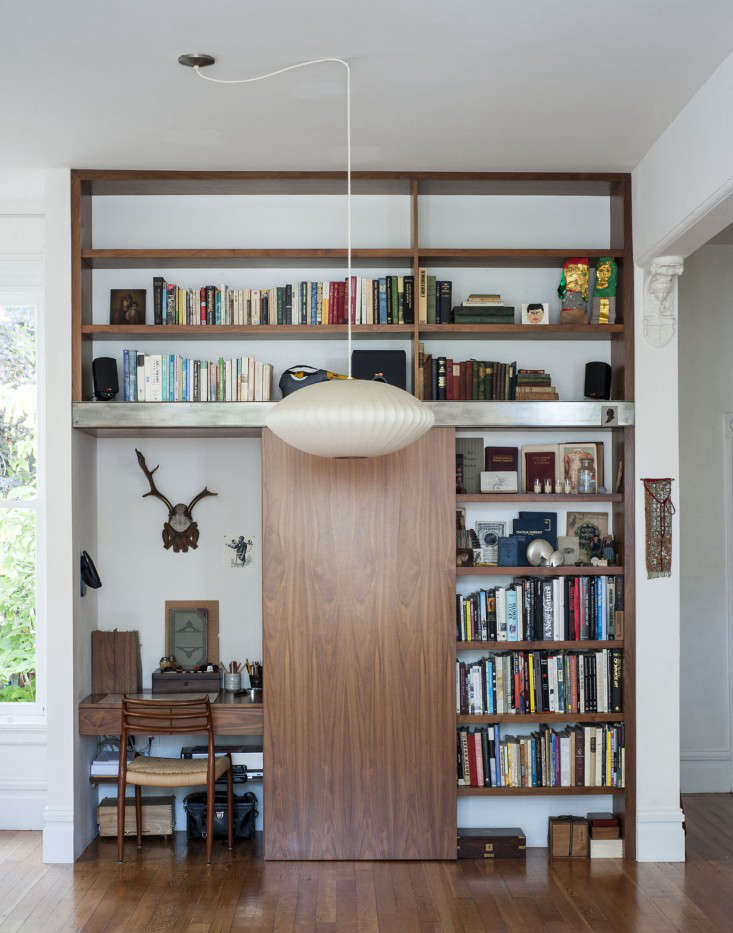
A shallow alcove can hold a desk, task lighting, shelves, and power outlets without consuming an entire room. Designers are placing these work nooks under stairs, between kitchen cabinets, along hallways, and inside oversized landings.
The best versions look intentional. They use cabinetry, matching finishes, and hidden wiring so the workspace feels like part of the house rather than a desk that became stranded during a move.
The Concealed Office
The concealed office takes disappearing literally. Pocket doors, cabinet fronts, curtains, or folding panels hide the monitor after work. Some wall units include a desktop that folds upward, leaving behind what appears to be ordinary millwork.
This design has a psychological advantage. Closing the workspace creates a visible end to the workday. The computer is no longer staring across the room during dinner like a disappointed supervisor.
The Shared Family Work Zone
Instead of one executive-style office, some homes now include a shared study area with two or three smaller stations. Parents can answer email while children complete homework. Partners can work side by side, assuming neither has discovered the joy of taking video calls on speakerphone.
Shared zones require more planning than simply buying a longer desk. Each person needs adequate lighting, outlets, storage, and acoustic separation. Headphones help, but they should not be the entire architectural strategy.
The Mobile Office
For occasional remote work, the office may be nothing more than a well-designed kit: laptop stand, compact keyboard, mouse, headset, charger, and document tray stored in a rolling cart or cabinet. The equipment moves to the dining table during work hours and disappears afterward.
This approach is especially useful in apartments, but it depends on discipline. Without a reliable reset routine, the “mobile office” becomes “random electronics covering every horizontal surface.”
What We Lose When the Office Disappears
Multifunctional space sounds efficient, but efficiency has trade-offs. A dedicated office provides privacy, acoustic control, secure storage, and a strong mental boundary between work and personal life.
The American Psychological Association has long identified blurred work-family boundaries as a challenge for remote workers. When the workspace occupies a bedroom or living area, work can feel permanently present. A glowing monitor on the dining table is not technically sending email, but emotionally it is clearing its throat.
Privacy is another concern. Confidential conversations are difficult in an open kitchen. Dual-career couples may have overlapping meetings. Children, pets, delivery drivers, leaf blowers, and smoke detectors with low-battery warnings have all developed an extraordinary ability to contribute during important calls.
There is also an ergonomic cost. A disappearing office can easily become a laptop on a couch, bed, or counter. OSHA and NIOSH guidance emphasizes neutral posture, appropriate monitor height, back support, relaxed shoulders, and properly positioned keyboards. These recommendations are harder to follow when a worker’s “desk” is also where the family serves tacos.
How to Design a Flexible Workspace That Actually Works
Protect the Body Before Decorating the Background
A beautiful workspace is not successful if it causes neck pain by lunchtime. Start with an adjustable chair or supportive seating, a screen positioned near eye level, and a keyboard and mouse that allow the arms to remain relaxed. Laptop users working more than occasionally should consider an external keyboard and a stand or monitor.
Ergonomics may not produce dramatic social-media photographs, but neither does a heating pad wrapped around your shoulders during a budget meeting.
Create a Visual Boundary
A door is ideal, but it is not the only way to separate work from home. A folding screen, curtain, cabinet, rug, paint change, or distinct lighting zone can define the workspace. The goal is to communicate that the area has a specific purpose during certain hours.
When work ends, close the laptop, turn off the task light, and put away visible materials. This physical transition helps replace the psychological function once performed by a commute.
Invest in Closed Storage
Open shelves look attractive when they hold three art books and a ceramic bowl. They look less attractive when they contain printer paper, tax folders, charging cables, and an unidentified adapter nobody dares discard.
Drawers, cabinets, boxes, and cable channels allow a work zone to return to domestic use quickly. In a multifunctional room, the ability to reset the space is more important than the ability to display every office supply.
Plan for Sound, Not Just Sight
Video calls made homeowners intensely aware of what was behind them. The next design challenge is what can be heard around them. Rugs, curtains, upholstered furniture, bookcases, and acoustic panels can reduce echo. A solid-core door is helpful when a separate room is available.
In shared spaces, directional microphones and quality headsets can improve calls. They cannot completely defeat a barking dog, but they may reduce the dog’s role from keynote speaker to distant panelist.
Make Technology Easy to Deploy
A flexible office should not require a 20-minute cable ceremony every morning. Install accessible outlets, USB charging, reliable Wi-Fi, and a simple docking setup. Store frequently used equipment together so the workspace can be activated and cleared with minimal effort.
The Home Office Is Becoming a Feature, Not a Room
The most useful way to understand the disappearing home office is to separate the room from the activity. Americans have not stopped working at home. Hybrid work remains deeply established, and Stanford research has shown that well-designed hybrid schedules can preserve productivity while improving employee retention.
What is changing is the architectural response. A formal office modeled after a corporate suite is no longer the onlyor even the most practicalsolution. The future may be a guest room with a foldaway workstation, a quiet alcove with excellent lighting, or a wall of cabinetry that opens into a complete digital workspace.
Gensler and other workplace researchers have repeatedly emphasized that different tasks require different settings. Focus work, collaboration, private conversations, and creative thinking do not all benefit from the same environment. Homes are beginning to follow that logic. Instead of one room labeled “office,” they may contain several work-capable locations designed for different needs.
A quiet bedroom desk may handle concentrated writing. A kitchen station may support quick administrative tasks. A shared table may work for homework and planning. A backyard studio may serve someone who works remotely full time. The home office is no longer a single box on a floor plan. It is a network.
Experience Notes: Living With the Disappearing Home Office
Consider a typical hybrid worker in a one-bedroom apartment. During the pandemic, the dining table became a permanent office. A large monitor occupied one end, cables trailed toward the nearest outlet, and meals migrated to the couch. The setup worked professionally but slowly erased the dining area from daily life.
When office attendance resumed three days a week, keeping the table permanently occupied no longer made sense. The worker replaced the sprawling setup with a wall-mounted desk, monitor arm, small drawer unit, and folding chair. On remote days, the workstation opens in seconds. At 5:30 p.m., the laptop and keyboard go into the drawer and the desktop folds upward. The apartment does not gain square footage, but it feels as though it has.
Now consider a family in a suburban three-bedroom house. One bedroom became an office for two adults, complete with matching desks and an optimistic shared calendar. The arrangement lasted until simultaneous video calls revealed that enthusiasm is not the same as acoustic separation.
Instead of building a larger office, the family divided the work. One person kept the bedroom desk for meetings and focused tasks. The other added a compact workstation to an upstairs landing for email, scheduling, and individual work. A rolling cart holds supplies and moves between the two locations. It is not a magazine-perfect solution, but it matches how the household actually operates.
A third example involves a homeowner who converted a spare bedroom into an impressive office in 2021. There was a substantial desk, custom shelving, dual monitors, and a chair that looked capable of launching a small spacecraft. By 2025, the owner was commuting four days a week, while relatives regularly needed a place to stay.
The room was redesigned around a Murphy bed flanked by built-in cabinets. A narrower desk remained beneath the window. Work files moved behind closed doors, and the monitor was mounted on an adjustable arm so it could be pushed aside. The office did not disappear completely; it learned to share.
These experiences reveal a consistent lesson: the best home workspace is not necessarily the largest one. It is the one that can be started easily, used comfortably, and shut down completely.
People often focus on the opening ritualturning on the computer, arranging coffee, checking the calendar. The closing ritual may matter more. Putting equipment away, switching off a dedicated lamp, closing cabinet doors, or taking a short walk creates a boundary between professional and personal time.
There are failures, of course. A desk placed inside a closet may become hot, dark, and claustrophobic. A kitchen office can attract clutter with supernatural efficiency. A guest-room setup may require workers to relocate whenever visitors arrive. A shared workspace can become a territorial negotiation involving chargers, chairs, and suspiciously disappearing pens.
The solution is rarely to chase a perfect Pinterest image. It is to observe real behavior. Where does noise occur? Which equipment is used daily? How often do guests actually stay? Does the workspace need to support eight-hour days or two hours of Friday paperwork? Honest answers produce better design than copying a room built for someone with different needs and, quite possibly, no children.
The lived experience of the disappearing home office is therefore not about giving up on remote work. It is about reclaiming the rest of the home while preserving a functional place to earn a living. That balance is less dramatic than a full renovation, but it is often more valuable.
Conclusion: The Office Leaves, but the Work Stays
The dedicated home office may be losing its automatic claim to an entire room, but working from home remains a durable part of American life. Hybrid schedules, housing costs, smaller floor plans, and changing family needs are pushing workspace design toward flexibility.
The winners will not be homes with the biggest desks. They will be homes that manage transitions well: from work to rest, employee to parent, office to guest room, and video conference to dinner without requiring anyone to balance a plate on a printer.
The disappearing home office is not a funeral for remote work. It is a redesign. The room is fading, but the function is becoming more thoughtful, more integrated, andmercifullyeasier to hide at the end of the day.

