
Beauty Unlocked
Japanese Sample Return Spacecraft Reaches Target Asteroid
Jun
When Japan’s Hayabusa2 spacecraft reached asteroid Ryugu on June 27, 2018, it did not arrive with fireworks, dramatic music, or a tiny astronaut planting a flag. Instead, it quietly pulled off something far more impressive: a precision rendezvous with a dark, spinning, boulder-covered asteroid millions of miles from Earth. In space exploration, “quietly” often means “with absurdly complicated math, years of engineering, and enough patience to make a monk look fidgety.”
The mission marked a major milestone for asteroid sample return science. Hayabusa2, operated by the Japan Aerospace Exploration Agency, or JAXA, had launched from Tanegashima Space Center in December 2014 aboard an H-IIA rocket. After a gravity-assist flyby of Earth in 2015 and more than three years of deep-space travel, the spacecraft finally reached its target: 162173 Ryugu, a near-Earth, carbon-rich asteroid shaped a bit like a cosmic spinning top.
That arrival was not the end of the story. It was the opening chapter of one of the boldest robotic exploration campaigns ever attempted. Hayabusa2 would survey Ryugu, deploy small robotic explorers, fire a copper projectile into the asteroid, touch down twice, collect pristine material, and eventually send a capsule full of asteroid samples back to Earth. Not bad for a spacecraft that weighed less than many compact cars and had to work in a place where gravity is more of a polite suggestion than a rule.
What Was Hayabusa2?
Hayabusa2 was Japan’s second major asteroid sample return mission, following the original Hayabusa mission, which returned tiny particles from asteroid Itokawa in 2010. The name “Hayabusa” means “peregrine falcon” in Japanese, a fitting title for a spacecraft designed to swoop in, grab material, and fly home. Hayabusa2 built on the lessons of its predecessor, but it aimed at a very different kind of asteroid.
Its target, Ryugu, is a C-type asteroid. That means it is rich in carbon-bearing materials and may preserve chemical clues from the earliest days of the solar system. If planets are the finished cake, asteroids like Ryugu are the leftover ingredients still sitting on the cosmic kitchen counter. Scientists study them because they may reveal how water, organic molecules, and rocky building blocks moved through the young solar system.
The spacecraft carried a suite of instruments, including optical cameras, a near-infrared spectrometer, a thermal infrared imager, sampling equipment, small rovers, and a small lander called MASCOT, developed with European partners. It was not merely sent to take pretty pictures, although it did that too. Hayabusa2 was designed to read Ryugu’s surface like a detective reads a crime scene: texture, temperature, color, structure, composition, and every suspicious-looking boulder included.
The Long Road to Ryugu
Hayabusa2 launched on December 3, 2014. Space missions often sound simple when reduced to a timeline: launch, cruise, arrive, collect, return. In reality, reaching a small asteroid is like trying to meet a specific grain of pepper flying through a dark stadium while you are also moving, the stadium is moving, and nobody is allowed to use headlights at full blast.
After launch, Hayabusa2 spent about a year circling the Sun before performing an Earth gravity assist in December 2015. That maneuver used Earth’s gravity to reshape the spacecraft’s orbit and send it toward Ryugu. Gravity assists are one of the great tricks of spaceflight: the spacecraft steals a tiny bit of orbital energy from a planet, and the planet does not even notice. It is the interplanetary version of grabbing a ride from a friend who has a much bigger engine.
Over the next several years, Hayabusa2 used ion engines to fine-tune its path. Ion propulsion does not deliver the dramatic roar of a chemical rocket, but it is extremely efficient. It pushes gently for long periods, building up speed gradually. Think less “drag race” and more “patient treadmill session,” except the treadmill is in deep space and the stakes are an asteroid rendezvous.
Arrival at the Target Asteroid
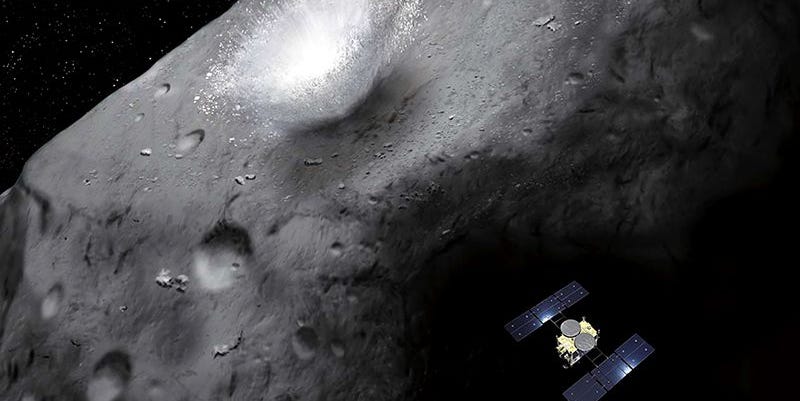
On June 27, 2018, Hayabusa2 officially arrived at Ryugu. The spacecraft took up a “home position” roughly 20 kilometers from the asteroid, close enough to study it in detail but far enough to operate safely. The achievement was historic because Ryugu was not a large, easy target. It was less than a kilometer wide, extremely dark, and covered in rugged terrain that would later complicate landing plans.
The first close-up images immediately surprised scientists. Instead of a smooth dust-covered world, Ryugu looked like a flying pile of rubble. Its surface was packed with rocks and boulders, leaving few obvious safe places for touchdown. Its shape, with a raised equatorial ridge, gave it the appearance of a diamond or spinning top. If asteroids held beauty contests, Ryugu would not win “smoothest complexion,” but it would absolutely take home “most scientifically interesting face.”
Ryugu’s roughness mattered. Hayabusa2 was not built to land and stay. It had to descend, make brief contact, fire a small projectile into the surface, collect stirred-up particles, and retreat. That required a touchdown zone with enough room to avoid hazards. The asteroid’s unexpectedly rocky surface forced the mission team to rethink and refine its plans. In other words, Ryugu greeted Hayabusa2 with the space-rock equivalent of, “Good luck parking here.”
Why Ryugu Was Worth the Trouble
Ryugu is valuable because it is primitive. In planetary science, “primitive” does not mean boring or simple. It means old, chemically revealing, and less altered than many larger worlds. Earth has weather, oceans, volcanoes, plate tectonics, and human beings who keep misplacing coffee cups. All of that changes rocks. Asteroids, by contrast, can preserve ancient material that dates back about 4.6 billion years, near the birth of the solar system.
Scientists were especially interested in Ryugu because carbon-rich asteroids may contain hydrated minerals and organic compounds. These materials help researchers explore big questions: Did asteroids deliver some of Earth’s water? Did they bring organic molecules that later became important for life? How did small bodies form, break apart, and reassemble over billions of years?
Ryugu also matters for planetary defense. Near-Earth asteroids are not just science museums; some are objects whose orbits bring them relatively close to our planet. Understanding their structure, density, surface strength, and composition helps scientists model how asteroids behave. A loose rubble-pile asteroid responds differently to impacts than a solid rock would. If humanity ever needs to nudge a dangerous asteroid away from Earth, details like that become more than academic trivia.
Rovers, Landers, and a Very Bold Touchdown Plan
After arrival, Hayabusa2 began a detailed survey of Ryugu. The spacecraft mapped the asteroid from different distances and angles, collecting data that helped scientists select landing sites. It also deployed small robotic explorers. In September 2018, two MINERVA-II1 rovers were released onto the asteroid’s surface. These tiny robots did not roll like Mars rovers. Ryugu’s gravity is too weak for normal wheels to work well, so they hopped.
That detail alone deserves applause. Engineers looked at a tiny asteroid with almost no gravity and said, “Wheels? No. Let’s make it bounce.” And it worked. The rovers returned images from the surface, giving humanity a low-angle view of a world that had never before hosted a robotic visitor.
In October 2018, Hayabusa2 released MASCOT, a small lander built by the German Aerospace Center and the French space agency CNES. MASCOT carried instruments to study Ryugu’s surface properties and operated for roughly 17 hours. Its observations helped researchers understand the asteroid’s rocks, temperature behavior, and surface environment.
Then came the sample collection attempts. In February 2019, Hayabusa2 successfully touched down on Ryugu and collected surface material. Later, in April 2019, the spacecraft deployed the Small Carry-on Impactor, which fired a copper projectile into Ryugu to create an artificial crater. The spacecraft hid behind the asteroid to avoid debris, because even a sophisticated space probe knows when to duck. In July 2019, Hayabusa2 performed a second touchdown near the crater area, collecting material that may have come from below the weathered surface.
The Science Behind Sample Return
Remote sensing is powerful, but nothing beats having real extraterrestrial material in a laboratory. Telescopes and spacecraft instruments can tell scientists a lot, but a returned sample can be studied with equipment too large, delicate, or advanced to send into space. Laboratories can measure isotopes, minerals, organic molecules, magnetic properties, and microscopic textures in extraordinary detail.
That is why sample return missions are so valuable. They bring space material home without the contamination and uncertainty that can affect meteorites found on Earth. Meteorites are useful, but they fall through the atmosphere, land in uncontrolled environments, and may sit exposed to water, heat, and microbes. Hayabusa2’s sample capsule was designed to protect Ryugu material from Earthly contamination, giving scientists a cleaner look at ancient asteroid chemistry.
When Hayabusa2’s capsule returned to Earth in December 2020, it landed in the Woomera area of the Australian outback. Inside were precious grains from Ryugu, more than enough for years of research. The mission returned about 5.4 grams of material. That may sound tiny if you are weighing snacks, but in asteroid science, it is a treasure chest. A few grams can keep laboratories busy for decades.
What Scientists Learned From Ryugu
Early analysis of Ryugu samples confirmed that the asteroid is rich in primitive, carbon-bearing material. Researchers found hydrated minerals, evidence of water-related chemical processes, and a wide variety of organic compounds. These discoveries support the idea that asteroids like Ryugu are time capsules from the early solar system.
Ryugu samples have been compared to carbonaceous chondrite meteorites, especially rare CI-type materials that are chemically close to the Sun’s overall composition, minus volatile gases. That comparison is important because it links returned asteroid material with meteorites already studied on Earth. However, Ryugu samples are cleaner and better documented because scientists know exactly where they came from.
Research has also identified amino acids and other organic molecules in Ryugu material. More recent studies have reported nucleobases, chemical components related to DNA and RNA, in the samples. This does not mean life was found on Ryugu. Nobody discovered tiny asteroid microbes wearing helmets. But it does show that important prebiotic ingredients can form in space and survive inside small bodies. That strengthens the idea that asteroids may have delivered some of life’s raw materials to early Earth.
How Hayabusa2 Changed Asteroid Exploration
Hayabusa2 proved that a spacecraft could do far more than visit an asteroid. It could arrive, map, deploy robots, create a crater, sample more than once, and return material safely to Earth. Each step required careful planning and real-time adaptation. The mission team had to respond to Ryugu’s rugged landscape, choose safer touchdown sites, and operate with long communication delays.
The mission also complemented NASA’s OSIRIS-REx mission, which returned samples from asteroid Bennu in 2023. Ryugu and Bennu are both carbon-rich near-Earth asteroids, but they are not identical. Comparing their samples helps scientists understand the diversity of primitive bodies. It also shows the value of international cooperation. Space science is at its best when countries trade data instead of just trading dramatic press releases.
Hayabusa2’s success gave future missions a stronger foundation. Engineers learned more about autonomous navigation near small bodies, touchdown targeting, sample capture, and spacecraft operations in weak gravity. Scientists gained rare material from a known asteroid. The public got a reminder that some of the most exciting exploration today is done by robots the size of household appliances, traveling through the solar system with heroic determination and no bathroom breaks.
The Extended Mission: Hayabusa2 Keeps Flying
One of the most impressive parts of the story is that Hayabusa2 did not retire after dropping off its sample capsule. The main spacecraft flew past Earth and continued into an extended mission. Its future targets include asteroid 2001 CC21 for a flyby and 1998 KY26 for a rendezvous planned in the 2030s.
This extended journey turns Hayabusa2 into more than a sample return spacecraft. It becomes a long-term explorer of small bodies. The spacecraft has already completed its primary mission, but its remaining systems can still provide science. That is the spaceflight equivalent of finishing a marathon and then saying, “Since I’m warmed up, how about another decade?”
The extended mission is especially interesting because 1998 KY26 is a small, fast-rotating asteroid. Studying it could help scientists understand a different class of near-Earth objects. The more we learn about these bodies, the better we understand the population of objects sharing Earth’s neighborhood around the Sun.
Why This Mission Still Matters Today
The headline “Japanese Sample Return Spacecraft Reaches Target Asteroid” captures a single moment, but the importance of that moment keeps expanding. Arrival at Ryugu made everything else possible: surface exploration, sample collection, laboratory discoveries, and future mission planning. Without that successful rendezvous, there would be no returned Ryugu grains, no detailed comparison with Bennu, and no new evidence about organic chemistry from this specific asteroid.
Hayabusa2 also changed how people think about small worlds. For a long time, asteroids were often imagined as simple rocks drifting through space. Ryugu showed something more complex: a fragile rubble pile with a dramatic shape, a rugged surface, a history of heating and alteration, and chemical clues connected to water and organics. It is not just a rock. It is a record keeper.
The mission also made asteroid science feel surprisingly personal. The returned sample was tiny, but the achievement was huge. It represented thousands of people working across years and continents: engineers, scientists, mission planners, tracking teams, recovery crews, and laboratory researchers. Space exploration is often described in terms of machines, but Hayabusa2 reminds us that behind every spacecraft is a very human combination of curiosity, stubbornness, and spreadsheets that probably looked terrifying.
Experiences and Reflections Related to Hayabusa2 Reaching Ryugu
There is a special kind of excitement in watching a spacecraft reach a world no human has ever touched. It is not the loud excitement of a rocket launch, where fire and smoke do most of the public relations work. It is quieter, slower, and in some ways more powerful. When Hayabusa2 reached Ryugu, the thrill came from knowing that a machine built on Earth had crossed deep space and matched paths with a tiny asteroid moving around the Sun. That is not just navigation. That is cosmic choreography.
For anyone following the mission, the first images of Ryugu were unforgettable. Before arrival, Ryugu was a dot with a name and an orbit. After arrival, it became a place. It had shape, shadows, boulders, ridges, craters, and personality. The asteroid looked rougher and stranger than many expected, and that made the mission feel more real. Suddenly, Hayabusa2 was not visiting an abstract object from a science textbook. It was hovering beside a dark, rocky world that looked like it had been assembled by the universe during a particularly messy afternoon.
One of the best lessons from the mission is that exploration rarely goes exactly as planned. Engineers may design with incredible care, but nature always gets a vote. Ryugu’s surface was more hazardous than expected, forcing the team to adapt. That is a useful lesson beyond space science. Whether someone is building a spacecraft, writing a research paper, starting a business, or assembling furniture with suspiciously vague instructions, success often depends on adjusting when reality says, “Cute plan. Try again.”
Hayabusa2 also gives a powerful example of patience. The spacecraft launched in 2014, reached Ryugu in 2018, collected samples in 2019, and returned them in 2020. Scientists are still studying those grains years later. In a culture used to instant updates and same-day delivery, asteroid sample return is refreshingly slow. It reminds us that some of the most meaningful results require long timelines. The universe does not rush because humans are impatient.
The mission can also inspire students and young researchers because it shows that science is not only about giant telescopes or astronauts in spacesuits. It is also about small instruments, clever navigation, careful teamwork, and asking precise questions. Why is Ryugu shaped that way? What minerals does it contain? How did water alter its parent body? Could organic molecules from asteroids have contributed to early Earth’s chemistry? Each question opens another door.
There is even something poetic about bringing home a few grams of asteroid dust. On Earth, dust is what people wipe off shelves. From Ryugu, dust becomes evidence from the dawn of the solar system. The difference is context. A tiny grain can hold a history older than mountains, oceans, forests, dinosaurs, and every human story ever told. Hayabusa2 turned that ancient material into something scientists could hold, protect, and study.
In the end, the experience of Hayabusa2 reaching Ryugu is a reminder that exploration does not always require footprints. Sometimes it requires a robotic falcon, a dark asteroid, a brave little sampling horn, and a team willing to spend years chasing answers across millions of miles. The mission reached its target, but it also reached something larger: a deeper understanding of where Earth’s ingredients may have come from and how much history can be hidden inside a handful of cosmic crumbs.
Conclusion
Hayabusa2’s arrival at Ryugu was one of the defining moments in modern asteroid exploration. What began as a daring rendezvous with a small, dark near-Earth asteroid became a landmark sample return mission that reshaped scientific understanding of primitive solar system material. The spacecraft studied Ryugu up close, deployed robotic explorers, collected surface and subsurface samples, and delivered them safely to Earth.
The mission’s legacy continues through laboratory analysis and Hayabusa2’s extended journey to new asteroid targets. Ryugu has already taught scientists about carbon-rich materials, water-related minerals, organic chemistry, rubble-pile structures, and the challenges of operating around tiny worlds. For the rest of us, it offers a simpler but equally valuable lesson: even the smallest objects in space can hold enormous stories.
Note: This article synthesizes real mission information and scientific findings from reputable space and science sources, including JAXA, NASA, NASA Goddard, The Planetary Society, Space.com, Smithsonian Magazine, Science, Nature-related publications, and international mission partner reports. It is rewritten in original language for web publication.

