
Hair Care
Ancient Chinese Tomb Reveals Stunning Murals with Blonde Man
Jun
Every so often, archaeology taps history on the shoulder and says, “You missed a spot.” That is exactly what happened when an ancient Chinese tomb near Taiyuan, in Shanxi Province, revealed a set of remarkably vivid Tang dynasty murals. Among the painted scenes of food preparation, labor, animals, trees, guardians, and domestic life, one figure has attracted global attention: a blond, bearded man who appears to be leading camels.
At first glance, the discovery sounds like the setup for a historical mystery novel. A tomb in northern China. A quiet burial chamber. Murals sealed away for roughly 1,200 years. Then suddenly, there he is: a light-haired foreigner standing inside a Chinese funerary world, looking like he wandered in from another chapter of Eurasian history and forgot to sign the guestbook.
But the ancient Chinese tomb with the blonde man mural is not just a curiosity. It is a rare visual clue to the cosmopolitan world of the Tang dynasty, a period when China was deeply connected to Central Asia, Persia, India, Korea, Japan, Southeast Asia, and beyond. The mural may represent a Sogdian, a Central Asian people famous for their role as merchants and cultural brokers along the Silk Roads. In other words, this tomb is not merely saying, “Look at this unusual person.” It is saying, “Look how connected the world already was.”
A Tang Dynasty Tomb Hidden Beneath Modern Roadwork
The tomb was reportedly discovered in 2018 during road construction near Taiyuan, the capital of Shanxi Province in northern China. Like many archaeological discoveries, it did not arrive with trumpets. It arrived because modern infrastructure met ancient brickwork. That is archaeology’s favorite jump scare.
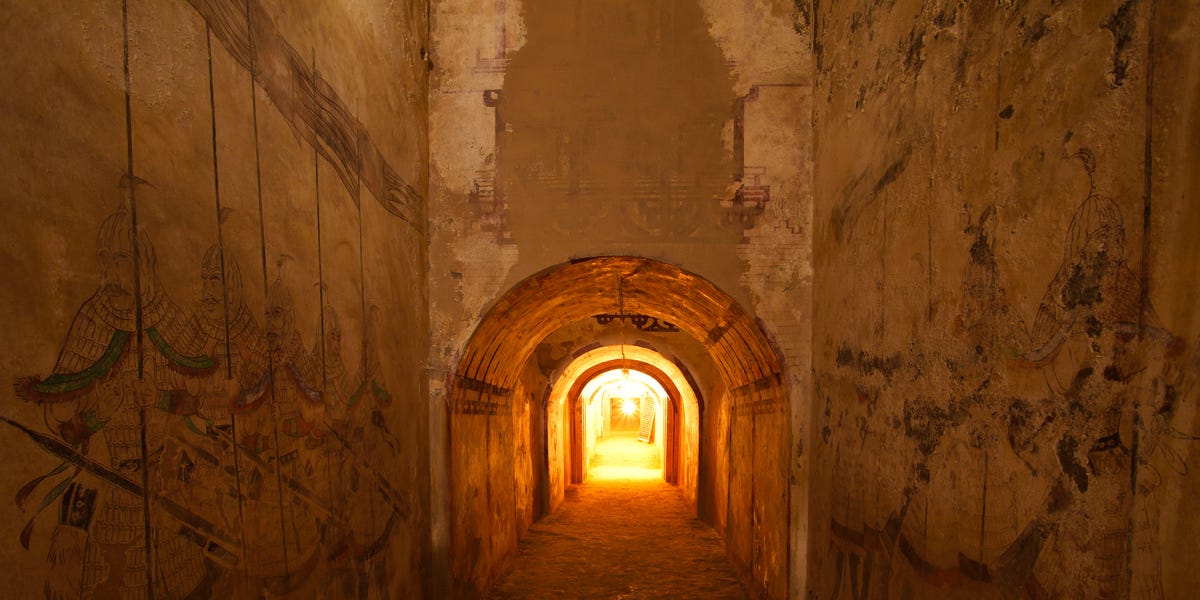
The burial is dated to A.D. 736, during the Tang dynasty, which ruled from A.D. 618 to 907. An epitaph indicates that the tomb held a 63-year-old man and his wife. The structure itself is a brick chamber with a corridor, entrance, domed ceiling, and coffin platform. What makes it extraordinary is the painted decoration spread across the walls, passage, doorway, and chamber surfaces.
Instead of only showing imperial splendor or mythic scenes, the murals focus heavily on ordinary activity. The images include people grinding flour, making noodles, pounding grain, fetching water, tending animals, carrying objects, and moving through landscapes. It feels less like a royal propaganda poster and more like a painted documentary of Tang-era life. Think “ancient lifestyle vlog,” except nobody asks you to like and subscribe.
Why the Blonde Man Mural Is So Fascinating
The most talked-about figure in the tomb is a blond, bearded man shown with camels. His hair, beard, clothing, and association with caravan animals make him stand out from the surrounding figures, many of whom appear to represent the tomb’s Chinese owners or their world. Scholars have suggested that this man may be a Sogdian from Central Asia.
The Sogdians lived mainly in areas corresponding to modern Uzbekistan and Tajikistan. During the first millennium, especially from the fourth through eighth centuries, they became some of the most influential traders of the Silk Roads. They were mobile, multilingual, commercially skilled, and culturally adaptable. If the ancient Silk Roads had frequent-flyer miles, the Sogdians would have had elite status and probably a very complicated luggage situation.
In Tang China, foreign merchants, envoys, musicians, dancers, monks, and artisans were not fictional outsiders. They were part of urban and trade life, especially in major hubs such as Chang’an, the Tang capital. Central Asian fashions, music, dance, horses, camels, textiles, metalwork, and luxury goods influenced elite taste. The presence of a foreign-looking camel leader in a tomb mural fits this broader world of exchange.
The Silk Road Context: More Than Silk
The term “Silk Road” can make ancient trade sound like one tidy highway with a gift shop at the end. In reality, historians increasingly speak of the Silk Roads, plural. These routes formed a vast network of land and sea connections linking China with Central Asia, South Asia, the Middle East, the Mediterranean, and parts of Africa.
Silk mattered, of course, but the routes carried much more than fabric. Merchants and travelers moved horses, spices, glassware, silver, ceramics, manuscripts, religious ideas, music, artistic motifs, technologies, and fashion. The Tang dynasty was especially open to these international currents. Its art often absorbed foreign forms, from Central Asian clothing styles to camel imagery and lively depictions of foreign entertainers.
That is why the blonde man in the Chinese tomb is not necessarily an isolated oddity. He may represent a real type of person Tang Chinese communities encountered: a Central Asian trader or caravan handler connected to camels, goods, and long-distance movement. The mural turns global history into a single painted human figure.
What the Murals Reveal About Daily Life
While the blonde man gets the headlines, the rest of the tomb deserves the spotlight too. The murals are unusually rich in scenes of daily labor. Men and women are shown performing practical tasks, not merely posing in stiff ceremonial grandeur. They grind, cook, carry, lead animals, and work with tools.
This matters because elite tomb art often emphasizes status, ritual, military success, or the afterlife. Here, the murals preserve glimpses of ordinary routines that are rarely shown with such personality. The scenes suggest that everyday labor was worthy of remembrance, or at least worthy of being carried symbolically into the next world.
The images may also represent stages in the tomb owner’s life, household responsibilities, social identity, or idealized abundance. In ancient Chinese funerary culture, tombs were not only resting places. They were carefully arranged afterlife environments. The dead were provided with symbols of protection, comfort, status, and continuity. In that sense, a mural of food preparation is not just a charming kitchen scene. It may be a promise that the household remains supplied forever. Eternal noodles, frankly, are hard to argue with.
The “Figures Under Trees” Style
The murals are associated with a style often described as “figures under trees.” As the phrase suggests, people are painted beneath or beside stylized trees while carrying out activities. This visual tradition has earlier roots and appears in several regions of China. In the Taiyuan tomb, the style creates a rhythmic sequence of human scenes framed by natural elements.
The technique is direct, lively, and readable. Strong outlines and relatively simple shading help the figures stand out. The trees, mountains, animals, and banners provide structure and atmosphere. The result is not just decoration; it is storytelling. The tomb becomes a painted scroll wrapped around the viewer.
Art historians are especially interested in the relationship between these murals and other Tang or late Tang tomb paintings. Some reports have noted stylistic similarities to murals associated with high-status burials. Whether or not the same workshop or artistic tradition was involved, the Taiyuan tomb shows that sophisticated mural production was not limited to emperors and princes.
Guardians, Dragons, and a Painted Afterlife
The tomb’s decoration also includes guardian figures near the entrance. These figures, sometimes shown in yellow robes and with weapons, likely served a protective function. In Chinese tomb art, guardians helped defend the burial space against harmful forces. They were the ancient version of a security system, except more stylish and less likely to ask you to verify a captcha.
The domed ceiling reportedly includes mythical imagery, possibly including dragon and phoenix-like forms. These symbols connected the tomb to cosmic order, good fortune, power, and transformation. The combination of domestic labor, foreign traders, animals, guardians, and mythic creatures gives the chamber a layered meaning. It is at once a household, a memory album, a spiritual shelter, and a map of a connected world.
Was the Blonde Man Really “Western”?
Many headlines call the figure a “Westerner,” but that word needs careful handling. In modern English, “Western” often suggests Europe or North America. In Tang-era Chinese contexts, however, “western” could refer broadly to Central Asia and lands west of China. The likely interpretation is not that a medieval European tourist stumbled into Shanxi with a camel and a dramatic beard. The more historically grounded idea is that the figure represents a Central Asian person, probably Sogdian.
This distinction matters. The mural should not be used to flatten history into a simple “East meets West” cliché. The ancient world was more complex. Central Asia was not a hallway between civilizations; it was a dynamic region with its own cities, languages, religions, art, and commercial power. Sogdians were not background extras in someone else’s movie. They were major players.
So yes, the blonde man is visually striking. But his deeper importance is not his hair color. It is what he represents: movement, trade, cultural mixing, and the reality that Tang China was part of a wide Eurasian network.
Why This Discovery Matters for Modern Readers
The ancient Chinese tomb revealing stunning murals with a blonde man matters because it pushes back against the idea that ancient societies were isolated, sealed, or culturally pure. The Tang world was busy, international, and curious. Foreign goods shaped fashion. Foreign music shaped entertainment. Foreign merchants shaped trade. Religious travelers carried Buddhist texts and ideas across enormous distances. Artists absorbed and adapted what they saw.
For readers today, the tomb is a visual reminder that globalization did not begin with smartphones, shipping containers, or awkward video meetings. Long before modern technology, people crossed deserts, mountains, and seas to exchange goods and ideas. They did it slowly, dangerously, and without GPS. Somewhere, a camel deserves a historical achievement award.
The murals also show that archaeology is not only about kings, wars, and treasure. Sometimes the most valuable discoveries are scenes of work, food, clothing, travel, and ordinary gestures. A person making noodles can be as historically revealing as a gold crown. A camel leader can tell us about trade routes. A painted tree can point to artistic tradition. A tomb can become a classroom.
Specific Examples of Cultural Exchange in Tang China
The Tang dynasty is famous for its international flavor. Chang’an was one of the largest and most cosmopolitan cities in the world. Foreign envoys visited the court. Merchants brought goods from Central Asia and beyond. Central Asian clothing styles influenced Chinese fashion, including short tunics, boots, and fitted sleeves. Imported music and dance became fashionable among elites. Horses from the west were prized for military and symbolic reasons.
Tomb art and ceramic figurines from the Tang period often show camels, foreign grooms, musicians, and travelers. These objects were not random decorations. They reflected the importance of long-distance trade and the prestige associated with exotic goods and foreign connections. The blonde man mural belongs to this broader visual vocabulary.
What makes the Taiyuan tomb special is the way the foreign figure appears alongside domestic scenes. The mural does not separate international exchange from everyday life. It places them in the same world. That may be the most powerful message of the discovery: the Silk Roads were not abstract lines on a map. They entered kitchens, stables, markets, workshops, and imaginations.
How Archaeologists Read a Tomb Like This
Interpreting a painted tomb requires caution. Archaeologists and art historians consider inscriptions, burial structure, artistic style, pigments, clothing, objects, posture, animals, and comparisons with other known sites. A single image can be tempting, but responsible interpretation depends on context.
For the blonde man, the argument rests on several clues: his hair and beard, clothing, association with camels, and similarity to known depictions of Central Asians in Tang art. The Sogdian identification is plausible because Sogdians were prominent in the right period, region, and trade context. Still, scholars avoid pretending that one mural gives us a complete biography. We do not know his name, his exact homeland, or whether he represents a real person, a type, a memory, or a symbolic figure.
That uncertainty is not a weakness. It is part of the excitement. Archaeology often gives us fragments, and the work is to connect them without forcing them to say more than they can. The best discoveries invite questions, not just answers.
Experience Notes: What This Tomb Teaches Us When We Look Closely
One of the most rewarding ways to think about the ancient Chinese tomb with the blonde man mural is to imagine entering the chamber slowly, as a visitor rather than a headline reader. At first, the eye would probably go to the bold figures, the movement of robes, the trees, the animals, and the unusual foreign face. But after a few minutes, the mood would change. The tomb would stop feeling like a mystery box and start feeling like a lived-in world.
That is the real experience this discovery offers. It reminds us that ancient people had routines. They prepared food, moved water, cared for animals, managed households, honored the dead, and decorated spaces with meaning. They also noticed outsiders. They saw different clothing, different faces, different beards, different animals, and different ways of moving through the world. Instead of disappearing, those impressions were preserved in paint.
For anyone interested in history, this is a valuable lesson: do not rush past the ordinary details. The noodle-making scene is not filler. The flour grinding is not background noise. The camels are not props. Each detail is part of a social world. When combined, they show a Tang household imagining prosperity, protection, and connection in the afterlife.
There is also a modern experience hidden in the discovery. Many readers today encounter the story through a headline about a “blonde man” and immediately feel surprise. That surprise says something about our assumptions. We often picture ancient China as distant from Central Asia or separate from the wider world. The mural gently corrects us. It says that people, goods, and ideas were already traveling widely. The past was not black-and-white. It was colorful, busy, and occasionally bearded.
If you have ever visited a museum and found yourself staring longer at a tiny daily-life object than at a famous masterpiece, this tomb explains why. Ordinary things create emotional bridges. A painted worker grinding grain can feel closer than an emperor. A camel handler can make a trade route human. A guarded tomb doorway can remind us that grief, memory, and hope are universal.
The experience of studying this tomb is also a lesson in humility. We know enough to be fascinated, but not enough to be smug. The blonde man may be Sogdian. The murals may show the tomb owners at different stages of life. The style may connect to broader artistic traditions. But the tomb still keeps some secrets. That is not frustrating; it is beautiful. History is not a vending machine where you insert a question and receive a perfectly labeled answer. Sometimes it is a painted wall, a camel, a tree, and a face looking back across twelve centuries.
Conclusion: A Small Tomb with a Big World Inside
The story of the ancient Chinese tomb that reveals stunning murals with a blonde man is more than an archaeological headline. It is a window into the Tang dynasty’s multicultural reality, the importance of Silk Road exchange, and the richness of Chinese tomb art. The blond, bearded figure may be the star attraction, but the full mural program is the real treasure.
Inside this brick chamber, daily chores meet mythic symbols. Guardians stand watch. Camels hint at long-distance trade. Trees frame human action. A husband and wife are remembered through scenes that may reflect labor, status, identity, and afterlife hopes. The tomb is small in physical size, but historically, it opens onto a vast world.
For modern readers, the discovery is a reminder that the ancient past was not silent, simple, or isolated. It was connected, observant, artistic, and surprisingly relatable. And sometimes, all it takes to reopen that world is a road project, a buried chamber, and one blond man with a camel who refuses to be forgotten.

