
Skincare
Steampunk Sculptures That I Create From Trash
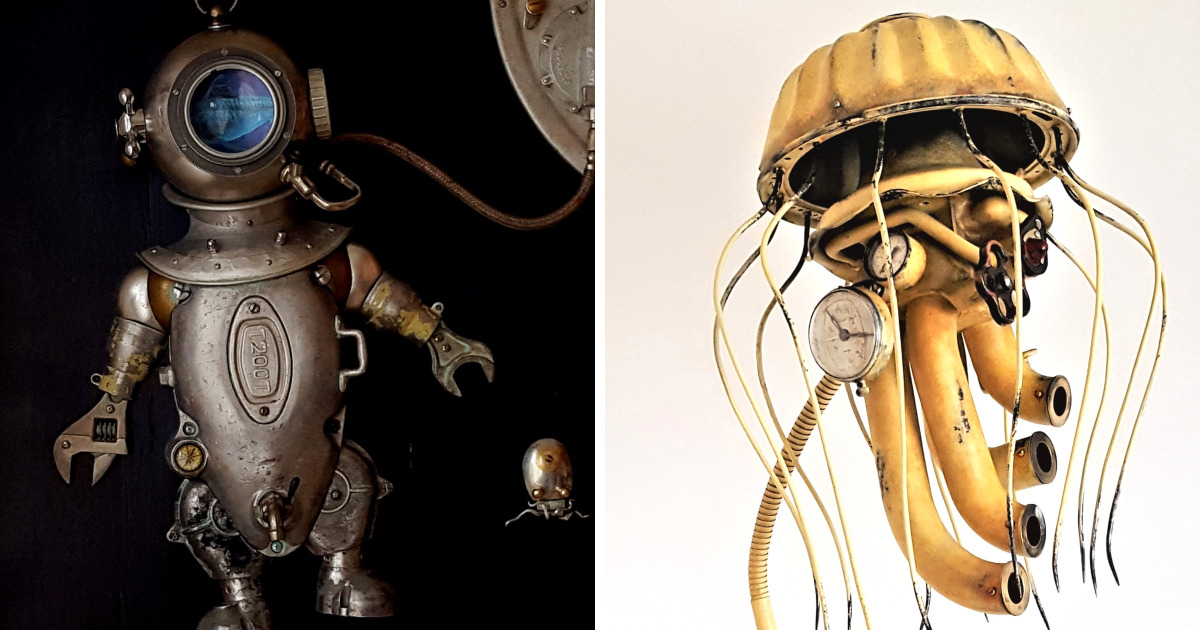
Jun
Old metal does not die. It waits patiently in a dusty box until someone with a soldering iron, questionable storage habits, and too much imagination gives it a second career as a mechanical octopus.
That is the wonderfully odd magic behind steampunk sculptures created from trash. A cracked teapot becomes a diver’s helmet. A discarded turbine turns into a snail shell. Watch springs become feathers. A saxophone bend suddenly looks less like a broken instrument and more like the elegant neck of a turbocharged ostrich. Somewhere, a vacuum cleaner loses its dignity and gains a personality.
Steampunk sculpture sits at the crossroads of fantasy, industrial design, recycling, and pure artistic mischief. It borrows the brass-and-gear romance of the Victorian age, adds the imagination of science fiction, and then raids the scrap pile like a raccoon with a fine arts degree. The result is a form of upcycled art that feels both antique and futuristic, serious and playful, mechanical and strangely alive.
Artists such as Lithuanian sculptor Artūras Tamašauskas have helped make this style especially memorable by transforming unwanted metal parts, flea-market finds, broken household objects, and scrap materials into whimsical characters: chameleons, penguins, bathyscaphe whales, cactus bottle holders, divers, snails, birds, insects, and strange little creatures that look ready to march into a Jules Verne novel and demand better lighting.
What Makes Steampunk Sculptures From Trash So Addictive?
The appeal of steampunk sculptures from trash is not only that they look cool, though they absolutely do. Their real charm comes from transformation. Viewers recognize a familiar object, then suddenly realize it has been reborn as something completely different.
A spoon is no longer a spoon. It is a wing. A faucet knob is no longer plumbing. It is a robot eye. A watch gear is no longer a tiny mechanical part. It is a decorative joint, a feather, a scale, a spine, or a suspiciously fancy eyebrow.
This kind of found-object sculpture rewards curiosity. The longer you look, the more you discover. At first glance, you may see a steampunk animal. A few seconds later, you notice the body is made from a kitchen utensil. Then you spot the old clock parts, the motorcycle component, the jewelry fragment, the broken lamp piece, and the handle from something your grandparents definitely owned.
The Beauty of Assemblage Art
Steampunk sculpture belongs naturally to the tradition of assemblage art, which uses ordinary, found, or purchased objects to create three-dimensional artworks. Instead of carving a figure from marble or modeling it from clay, the artist builds meaning by combining existing fragments.
That matters because every object already has a past. A scratched metal cup has been touched, dropped, washed, forgotten, and maybe insulted by someone who could not find the matching saucer. When it becomes part of a sculpture, it does not lose that history. It brings the history with it.
That is why upcycled steampunk art often feels warmer than brand-new decorative objects. It carries dents, patina, rust, scratches, and accidental textures. In normal life, these would be “flaws.” In steampunk art, they are character development.
The Steampunk Look: Victorian Dreams, Industrial Bones
Steampunk is usually described as a retro-futuristic style inspired by 19th-century industrial machinery, Victorian design, and speculative science fiction. In plain English: imagine the future if it had been invented by people wearing waistcoats, polishing brass, and taking steam engines very personally.
The visual language is instantly recognizable. Brass, copper, dark steel, leather, rivets, pressure gauges, pipes, clock faces, gears, lenses, springs, and weathered wood all feel at home in the steampunk world. The style loves visible mechanisms. It prefers machines with personality over machines that hide everything behind a smooth plastic shell.
That is one reason trash and steampunk work so well together. Modern garbage often contains hidden mechanical beauty. Broken clocks, old cameras, motorcycle parts, sewing machine covers, lamps, instruments, tools, hinges, locks, keys, and kitchenware are full of shapes that already look half-invented. The artist simply helps them remember what they wanted to become.
From Scrap Metal to Character: How the Process Begins
Creating a steampunk sculpture from trash rarely begins with a perfect blueprint. More often, it begins with a strange object that refuses to be ignored.
You pick up an old part at a flea market or scrap yard. You turn it over in your hands. You stare at it longer than normal people stare at lunch. Suddenly, the curve of a saxophone piece looks like an ostrich neck. A cake mold suggests a jellyfish cap. A sewing machine cover becomes the body of a submarine-whale hybrid. A turbine becomes a snail shell. The object whispers, “I am not trash. I am clearly a dramatic animal.”
At that moment, the sculpture starts making demands.
Step 1: Finding the Main Shape
Every successful steampunk sculpture needs a strong central form. This might be a teapot, a metal bowl, a vacuum cleaner part, a motorcycle engine cover, a glass holder, an old instrument piece, or a machine casing.
The best main pieces already suggest movement or anatomy. A rounded object can become a body. A long curved pipe can become a neck. A flared metal part can become a shell, wing, or fin. A perforated piece might become armor. Once the main shape is chosen, the rest of the sculpture becomes a puzzle.
Step 2: Hunting for Matching Parts
This is where the studio starts to look like a hardware store sneezed into a museum. Boxes of screws, springs, gears, handles, chains, jewelry pieces, washers, valves, hinges, cutlery, gauges, and mystery objects all become potential anatomy.
The trick is not simply to glue random objects together. The trick is to make the parts feel inevitable, as if they were always waiting to become that creature. A good steampunk sculpture should look surprising but not accidental. It should make people say, “Of course that old tap is a nose. How did I not see that before?”
Step 3: Building Personality
A sculpture becomes memorable when it has character. A penguin can look royal. A snail can become a racer. A chameleon can look sly and observant. A diver can feel adventurous. A cactus can become both decorative and functional. The personality often appears through small details: a tilted head, a tiny gauge, a pair of mechanical eyes, a carefully balanced stance, or a ridiculous little accessory that has no business being so charming.
Humor is essential. Without humor, steampunk can become too serious, like a grandfather clock applying for a bank loan. The best recycled sculptures invite people to smile first and think second.
Specific Examples: When Trash Becomes a Tiny Mechanical Myth
Some of the most delightful steampunk sculptures built from discarded materials are animal-inspired. Animals work well because their forms are familiar, but their mechanical reinterpretation feels fresh. A chameleon made from metal parts becomes not just a reptile, but a little armored observer. A penguin assembled from polished fragments can look like a royal explorer who definitely owns a monocle. An octopus jewelry box becomes both sculpture and secret keeper.
One especially imaginative idea is the sperm whale bathyscaphe, a hybrid between a sea creature and an underwater vessel. The concept works because whales and submarines already share a visual language: rounded bodies, deep-sea mystery, and a sense that they belong in places where humans should probably bring better equipment.
Another memorable example is the turbo ostrich. The long, elegant curve of a saxophone part can suggest the bird’s neck, while metal legs and mechanical details transform speed and grace into something delightfully absurd. It is nature redesigned by an engineer who had too much coffee.
The snail-racer is equally funny. A turbine makes a perfect shell, while added gauges, trumpet-like parts, and mechanical details create a creature that seems determined to break land-speed records at approximately one mile per afternoon.
Then there is the cactus, proof that even a plant can receive the full steampunk treatment. With rivets serving as spines and metal parts forming the body, the sculpture turns a desert plant into an industrial conversation piece. The fact that it can also function as a bottle holder adds a practical wink: art, but make it useful.
Why Trash Is Not Really Trash in the Artist’s Studio
One of the deepest ideas behind recycled steampunk sculpture is that waste is often a failure of imagination. A broken object may no longer serve its original purpose, but that does not mean it has no future.
This connects with the broader idea of reuse, which sits higher than recycling in the waste hierarchy because it keeps objects and materials in use longer before they are processed, melted down, or discarded. In art, reuse becomes more than an environmental choice. It becomes a creative language.
When a sculptor uses scrap metal, the material is not anonymous. It comes with texture, weight, and evidence of use. New metal can be beautiful, but old metal has stories. It has survived kitchens, workshops, garages, factories, markets, drawers, sheds, and at least one person saying, “We might need this someday.” For once, that person was right.
The Environmental Message Without the Lecture
Upcycled steampunk art does not need to shout, “Please consider sustainable materials management!” while wearing a tiny recycled hat. Its message is quieter and often more effective.
It simply shows what is possible. A viewer sees a sculpture made from discarded objects and begins to question the speed at which we throw things away. If a broken watch spring can become a feather, if a teapot can become a diver’s helmet, if a turbine can become a snail shell, what else are we mislabeling as useless?
That shift in perception is powerful. Art cannot solve the global waste problem by itself, but it can change how people see materials. It can turn disposal into curiosity. It can make the scrap yard feel less like an ending and more like a waiting room for second chances.
How to Read a Steampunk Sculpture
Looking at steampunk sculpture is part detective work, part daydreaming. Start with the whole figure. What is it? An animal? A machine? A character? A tool from an alternate universe? Then move closer and identify the parts. Where did the eyes come from? What forms the legs? Is that a spoon, a gear, a faucet, a hinge, a musical instrument, or the lid from something that once held cookies?
Finally, ask what changed. Why does this combination feel alive? Why does this broken object suddenly look proud? Why does a pile of discarded metal now seem to have a backstory, a job, and possibly a passport?
Good steampunk sculpture invites repeated looking. It is not a flat joke. It is a layered visual puzzle.
Tips for Creating Steampunk Sculptures From Trash
Collect Shapes, Not Junk
The first lesson is simple: do not collect everything. That way lies madness, and possibly a garage that no longer opens. Instead, collect interesting shapes. Look for curves, textures, holes, symmetry, patina, and mechanical details. Ask what an object could become, not only what it used to be.
Let the Material Suggest the Idea
Some artists begin with sketches. Others begin with a single object. For steampunk assemblage, both approaches work, but the material often has the better idea. A part with a strong shape may suggest a creature more naturally than a planned design ever could.
Balance Chaos With Structure
Because steampunk art uses many details, it can easily become visual soup. The best sculptures have a clear silhouette. Viewers should understand the main figure immediately, then enjoy the smaller discoveries afterward.
Use Humor Like a Secret Gear
A tiny absurd detail can make the entire sculpture memorable. A snail with racing equipment, a penguin with royal dignity, or a cactus with an unexpected function gives viewers a reason to connect emotionally. Humor makes metal feel human.
Why These Sculptures Belong in Modern Interiors
Steampunk sculptures created from trash work beautifully in modern interiors because they break the perfection of mass-produced design. A room full of smooth surfaces and clean lines can feel cold. Add one strange metal chameleon or mechanical bird, and suddenly the room has a pulse.
These pieces also spark conversation. A painting may receive a polite nod. A sculpture made from a teapot, motorcycle part, old watch spring, and mystery bracket usually receives questions. People lean in. They point. They argue about what the parts used to be. Someone inevitably says, “I think my uncle had one of those.” This is how art wins the room.
Extra Experience: What Creating Steampunk Sculptures From Trash Teaches You
Working with trash as an art material changes the way you move through the world. After a while, you stop seeing objects as finished things. You start seeing possibilities. A broken lamp on the sidewalk becomes a potential insect body. A drawer handle looks like a jaw. A bent fork looks like a claw. A rusty hinge looks like a shoulder joint. This is both a gift and a mild inconvenience, because suddenly you cannot throw anything away without holding a dramatic internal debate.
The first experience every trash-to-steampunk artist learns is patience. Found objects do not obey you immediately. New art supplies are predictable; scrap is stubborn. A clean sheet of metal will do what the tool tells it to do. An antique piece has opinions. It may be too heavy, too thin, too curved, too fragile, or so perfect that you are terrified to drill into it. You learn to negotiate with materials rather than dominate them.
The second lesson is respect for old craftsmanship. Many discarded objects were made with care. Old sewing machine parts, watch mechanisms, metal kitchenware, tools, and musical instruments often contain beautiful details that modern disposable products lack. When you reuse them, you are not only saving material from the trash. You are preserving a small piece of design history.
The third lesson is problem-solving. A steampunk sculpture is basically a series of tiny engineering arguments. How do you attach two parts that were never meant to meet? How do you make the sculpture stand? How do you keep the weight balanced? How do you make the eye look expressive when it is actually a brass washer? How do you stop the whole creature from looking like it lost a fight with a toolbox?
Every solution becomes part of the artwork. Screws, rivets, brackets, wires, and visible joints are not hidden mistakes. In steampunk, they can become design features. The construction itself is part of the story.
The fourth lesson is emotional. There is a strange satisfaction in rescuing a doomed object. A piece of metal headed for the dump becomes a character that makes people smile. That transformation feels meaningful. It gives the artist a sense of repair, not only of material but of attention. The world throws things away quickly. The artist slows down and asks, “Are we sure this is finished?”
The fifth lesson is that imperfection is not the enemy. A dent can become a cheekbone. Rust can become texture. Scratches can create age. A mismatched part can become the funniest detail in the whole sculpture. Trash art teaches you that beauty is not always polished. Sometimes beauty arrives wearing oxidation and carrying a spare bolt.
Most of all, creating steampunk sculptures from trash teaches a kind of hopeful imagination. It says that endings are negotiable. A broken object can become a new creature. A forgotten part can become the center of attention. A box of scrap can become a small metal universe filled with birds, insects, sea creatures, explorers, racers, and mechanical oddballs who look like they know secrets.
And honestly, that is a much better fate for trash than spending eternity in a landfill, muttering, “I could have been a turbo ostrich.”
Conclusion: Trash With a Better Publicist
Steampunk sculptures created from trash remind us that creativity often begins where ordinary usefulness ends. These artworks combine the romance of antique machinery, the discipline of assemblage, the humor of character design, and the environmental wisdom of reuse. They are beautiful because they are strange, and meaningful because they refuse to accept waste as the final chapter.
Whether the sculpture is a chameleon, a diver, a royal penguin, a snail-racer, a cactus, or a whale-shaped bathyscaphe, the message is the same: discarded objects still have stories to tell. They only need an artist willing to listen, a studio full of odd parts, and perhaps a very tolerant family member who does not ask too many questions about the boxes labeled “important junk.”
Note: This article is written in a creator-focused editorial style and synthesized from real information about steampunk sculpture, found-object art, upcycling, assemblage, recycling principles, and documented examples of recycled metal sculptures.

