
Beauty Tools & Accessories
4 Ways to Calculate an Installment Loan Payment
Aug
Installment loans are supposed to make borrowing feel tidy: you borrow a set amount, make regular payments, and eventually ride off into the sunset debt-free. In reality, the monthly payment can look like it was designed by a wizard with a calculator and a questionable sense of humor.
Whether you are considering a personal loan, auto loan, home improvement loan, or mortgage, learning how to calculate an installment loan payment gives you more control. You can compare offers, spot expensive terms, test different repayment periods, and avoid falling in love with a low monthly payment that quietly eats your wallet alive over five years.
This guide explains four practical ways to calculate an installment loan payment. You will also learn how loan amortization works, why APR matters, how to use Excel or Google Sheets, and which details can make a lender’s payment estimate different from your own.
What Is an Installment Loan Payment?
An installment loan is a loan with a fixed borrowing amount and a scheduled repayment period. Instead of borrowing repeatedly, as you might with a credit card, you receive the money upfront and repay it through regular installments.
Typical installment loans include:
- Personal loans
- Auto loans
- Mortgages
- Student loans
- Home equity loans
- Some business loans
For a standard fixed-rate installment loan, every payment usually includes two pieces: principal and interest. Principal reduces what you borrowed. Interest is the lender’s charge for letting you use the money.
Early in the loan term, a larger share of each payment usually goes toward interest. Later, more of the payment goes toward principal. That shift is called amortization. It sounds like a fancy financial term, but it simply means your debt gets paid down in an organized sequence instead of disappearing in a puff of responsible-adult smoke.
Before You Calculate: Gather the Right Numbers
You need four main inputs before calculating a monthly installment loan payment:
- Loan amount: The amount financed, not always the same as the sticker price or purchase price.
- Interest rate: The annual rate charged on the loan balance.
- Loan term: The number of months or years you have to repay the loan.
- Payment frequency: Monthly is common, but some loans use biweekly, semimonthly, or weekly payments.
You should also check the loan disclosure for the annual percentage rate, finance charge, amount financed, payment schedule, total of payments, and any required fees. The interest rate tells you how interest is calculated, while the APR can provide a broader picture of borrowing cost because it may include certain required finance charges.
For the examples below, assume you borrow $20,000 at a fixed 9.5% annual interest rate for 48 monthly payments.
1. Calculate the Payment With the Amortization Formula
The classic installment loan formula is the most direct way to calculate a fixed monthly payment. It works for many standard fixed-rate loans, including personal loans, auto loans, and principal-and-interest mortgage payments.
The formula is:
M = P × [r(1 + r)n] ÷ [(1 + r)n − 1]
Here is what each letter means:
- M = Monthly payment
- P = Principal, or the amount borrowed
- r = Monthly interest rate
- n = Total number of monthly payments
Step 1: Convert the Annual Rate to a Monthly Rate
Divide the annual interest rate by 12.
9.5% ÷ 12 = 0.7917% per month
In decimal form, the monthly rate is:
0.095 ÷ 12 = 0.0079167
Step 2: Count the Number of Payments
A four-year loan with monthly payments has:
4 years × 12 months = 48 payments
Step 3: Plug the Numbers Into the Formula
For a $20,000 loan at 9.5% for 48 months:
M = 20,000 × [0.0079167(1 + 0.0079167)48] ÷ [(1 + 0.0079167)48 − 1]
The estimated monthly payment is:
$502.46 per month
Over 48 months, you would pay approximately:
- Total paid: $24,118.21
- Total interest: $4,118.21
That is the magic and mild irritation of interest: you borrowed $20,000, but your loan gets invited to keep a few thousand extra dollars for the party.
When the Formula Works Best
This method is useful when the loan has a fixed interest rate, equal monthly payments, and a fully amortizing repayment schedule. It is less useful for loans with variable rates, balloon payments, deferred interest, payment holidays, or irregular payment dates.
2. Calculate the Payment With an Amortization Schedule
An amortization schedule shows what happens inside every loan payment. It breaks each payment into interest, principal, and remaining balance. This method is excellent when you want more than a monthly payment estimate. It helps you see how quickly the balance drops and how extra payments may affect the loan.
Start with the same example:
- Loan amount: $20,000
- Annual interest rate: 9.5%
- Monthly payment: $502.46
- Monthly interest rate: 0.79167%
Month One
First, calculate interest for the month:
$20,000 × 0.0079167 = $158.33 interest
Then subtract interest from the payment:
$502.46 − $158.33 = $344.13 toward principal
Now reduce the balance:
$20,000 − $344.13 = $19,655.87 remaining balance
Month Two
The next month, interest is based on the lower balance:
$19,655.87 × 0.0079167 = about $155.61 interest
Then:
$502.46 − $155.61 = about $346.85 toward principal
Your balance continues to shrink. The payment stays the same, but the interest portion gets smaller and the principal portion gets larger.
| Payment Month | Payment | Interest | Principal | Estimated Balance |
|---|---|---|---|---|
| 1 | $502.46 | $158.33 | $344.13 | $19,655.87 |
| 2 | $502.46 | $155.61 | $346.85 | $19,309.02 |
| 3 | $502.46 | $152.86 | $349.60 | $18,959.42 |
An amortization schedule is especially useful if you plan to make extra payments. On many simple-interest loans, extra money directed to principal can lower future interest charges and shorten the payoff timeline. However, always confirm how your lender handles extra payments before sending additional money. Some lenders apply the extra amount to the next scheduled payment instead of immediately reducing principal, which is about as helpful as bringing an umbrella after the storm.
3. Use Excel or Google Sheets to Calculate the Loan Payment
For people who would rather not wrestle with exponents before coffee, Excel and Google Sheets offer a much easier method. Both programs use the PMT function to calculate installment loan payments.
The basic formula is:
=PMT(rate, number_of_periods, present_value)
For the $20,000 loan example, enter:
=PMT(9.5%/12,48,-20000)
The result is approximately:
$502.46 per month
The negative sign before the loan amount tells the spreadsheet that the $20,000 is money you receive. Without it, the payment may appear as a negative number. The spreadsheet is not judging you; it is simply being dramatic about cash flow direction.
Helpful Spreadsheet Functions
PMTcalculates the regular payment.IPMTcalculates the interest portion of a particular payment.PPMTcalculates the principal portion of a particular payment.NPERestimates how many payments are needed based on a payment amount.RATEestimates the periodic interest rate when you know the payment, balance, and term.
Spreadsheets are powerful because they let you test multiple loan scenarios quickly. You can change the loan amount, rate, or term and immediately see how the payment changes. This makes them particularly useful when comparing lenders or deciding whether a larger down payment is worth it.
Compare Loan Terms in a Spreadsheet
Using the same $20,000 loan at 9.5%, here is how different repayment periods affect the payment and total interest:
| Loan Term | Estimated Monthly Payment | Estimated Total Interest |
|---|---|---|
| 36 months | $640.66 | $3,063.72 |
| 48 months | $502.46 | $4,118.21 |
| 60 months | $420.04 | $5,202.23 |
The 60-month option lowers the monthly payment by more than $80 compared with the 48-month option. That can make a tight budget breathe easier. But the longer term also adds more than $1,000 in additional interest. A lower payment is not automatically a cheaper loan; it is often just a slower loan wearing a friendlier hat.
4. Use an Online Loan Calculator and Verify the Loan Disclosure
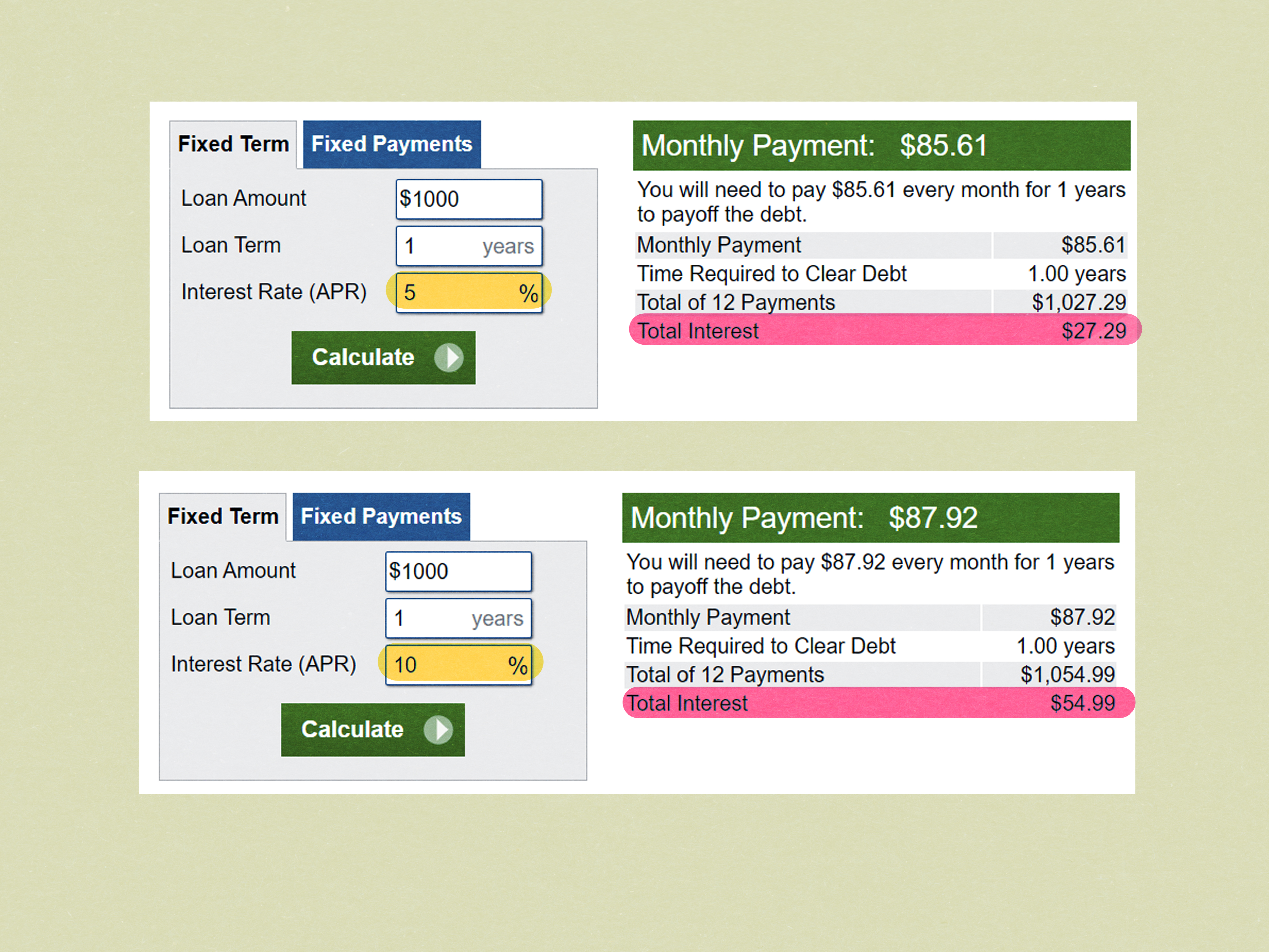
An online installment loan calculator is usually the fastest way to estimate a payment. Enter the loan amount, interest rate, and repayment term, and the calculator can show your monthly payment, total interest, and amortization schedule within seconds.
That convenience is useful, but calculators should be treated as a planning tool rather than the final word. The loan agreement and disclosure documents control the actual payment obligation.
What to Compare With the Lender’s Quote
When a lender provides an offer, compare these numbers with your own calculation:
- Amount financed
- Interest rate
- APR
- Monthly payment
- Number of payments
- Finance charge
- Total of payments
- Origination fees or mandatory charges
- Prepayment terms
A loan can have a reasonable-looking interest rate but a higher APR because required fees increase the cost of borrowing. For example, if a lender approves a $20,000 loan but deducts a $400 origination fee before sending the money, you may receive only $19,600 in cash while repaying based on the full amount financed. That difference matters.
Watch for Payments That Are Not Included in the Formula
For mortgages, the standard payment formula generally calculates only principal and interest. Your actual monthly housing payment may also include property taxes, homeowners insurance, mortgage insurance, homeowners association dues, or other costs.
For auto loans, add sales tax, title fees, dealer add-ons, warranties, and negative equity from a previous vehicle if those amounts are rolled into financing. A $450 payment can become much larger once the loan includes every optional feature, protection package, and chrome-plated mystery charge in the dealership paperwork.
Important Differences Between Simple Interest and Precomputed Interest
Not all installment loans calculate interest in the same way. Many loans use simple interest, meaning interest accrues on the remaining principal balance. With those loans, paying principal down faster can reduce future interest.
Some loans use precomputed interest. In that structure, the lender calculates the interest cost upfront and divides the total into scheduled payments. Extra payments may not reduce your total interest in the same way they would with a simple-interest loan.
Before making extra payments, ask the lender three questions:
- Does the loan use simple interest or precomputed interest?
- Will extra money be applied directly to principal?
- Is there a prepayment penalty or payoff fee?
Those questions may save you more than any fancy calculator formula.
Common Installment Loan Payment Mistakes to Avoid
Using APR as Though It Were Always the Interest Rate
APR and the stated interest rate can be similar, but they are not always identical. APR may account for certain finance charges, while the periodic interest calculation may use the contract rate. Use the stated interest rate when applying a standard amortization formula unless the lender explains otherwise.
Forgetting to Convert the Rate Correctly
For monthly payments, divide the annual rate by 12. A 12% annual rate does not mean 12% interest every month. That would turn a loan into a financial jump scare.
Choosing the Longest Term Automatically
A longer repayment period lowers the monthly payment but can increase total interest substantially. Always compare both monthly affordability and lifetime borrowing cost.
Ignoring Fees and Add-Ons
Loan fees, optional insurance products, warranties, and financed taxes can raise the amount financed. Calculate the payment based on the actual financed balance, not just the original purchase price.
Assuming Every Extra Payment Saves Interest
Extra payments can be valuable, but only if they are applied to principal under the loan’s terms. Verify the lender’s process before assuming your extra money is speeding up the payoff.
Practical Borrower Experiences: What the Math Feels Like in Real Life
Calculating an installment loan payment on paper is one thing. Living with that payment every month is something else entirely. Borrowers often discover that the most useful number is not the payment a lender says they can qualify for. It is the payment that still feels manageable after groceries, insurance, utilities, repairs, and one unexpected emergency have barged into the budget without knocking.
A common experience is getting excited about a low monthly payment and only later noticing the longer loan term. A five-year auto loan may look friendlier than a three-year loan because the payment is lower, but the borrower may pay far more in interest. The lower payment can be helpful when cash flow is genuinely tight, but it should be a deliberate tradeoff rather than an accidental one.
Another lesson comes from comparing the amount borrowed with the amount received. Borrowers sometimes approve a loan for a round number, such as $10,000, then find that an origination fee reduces the actual funds deposited into their account. The monthly payment is based on the loan structure, not necessarily the cash that lands in the bank. That is why reviewing the amount financed, APR, and total of payments before signing is so important.
Many people also underestimate how much timing matters with simple-interest loans. When interest accrues based on the remaining balance, paying even a little extra toward principal can have a meaningful effect over time. But the payment must be labeled or processed correctly. An extra $100 that is treated as an early future payment may not reduce principal immediately. An extra $100 specifically applied to principal can work much harder.
Borrowers who build a basic spreadsheet often say the biggest benefit is not the formula itself. It is the confidence that comes from testing scenarios. They can see what happens if the rate rises by one percentage point, if they make a larger down payment, or if they shorten the term by one year. That turns borrowing from a vague emotional decision into a series of clear choices.
There is also value in testing the payment against a worst-case month. Imagine a car repair, a medical bill, or reduced work hours. Could the payment still be made without relying on a credit card? If the answer is no, the loan may be too large even if the lender approves it. Approval is not a gold star for affordability. It is simply a lender’s decision that the risk works for them.
The most practical experience-based rule is simple: compare at least three versions of the same loan before committing. Test a lower loan amount, a shorter term, and a longer term. Look at the payment, total interest, and how each option fits your actual budget. The best installment loan payment is rarely the smallest number on the screen. It is the one you can pay consistently while still leaving room for real life to do what real life does best: surprise you.
Conclusion
Knowing how to calculate an installment loan payment helps you borrow with your eyes open. You can use the amortization formula for a precise estimate, build an amortization schedule to track principal and interest, use spreadsheet functions for fast comparisons, or check an online calculator against the lender’s disclosure.
Whichever method you choose, do not stop at the monthly payment. Compare the APR, total interest, total of payments, fees, repayment term, and prepayment rules. A loan should fit your full financial life, not just look attractive in a sales conversation.

