
Beauty Unlocked
Lenin Palace: I Visited One Of The Most Beautiful Metro Systems In The World
Aug
Some cities hide utility pipes beneath their streets. Moscow hides chandeliers, marble colonnades, bronze revolutionaries, glowing stained glass, and enough ideological artwork to keep a history professor happily distracted for a semester.
My first descent into the Moscow Metro did not feel like entering public transportation. It felt like arriving late to a state banquetone held several stories underground, where the guests wore winter coats and stared at their phones while standing beneath mosaics worthy of a national museum.
The photographic project known as Lenin Palace captures this contradiction beautifully. The metro is both an ordinary commuting system and a monumental stage built to communicate power, progress, sacrifice, and Soviet identity. It is practical infrastructure wearing formal evening clothes.
What Is the Lenin Palace?
The phrase “Lenin Palace” is an evocative description of the Moscow Metro’s grandest Soviet-era stations. For decades, visitors have compared these spaces to underground palaces because they feature vaulted ceilings, ornate lighting, polished stone, sculpture, mosaics, decorative metalwork, and architectural themes that change dramatically from one stop to the next.
Unlike a conventional transit system designed to move passengers with minimal ceremony, Moscow’s early stations were intended to make a statement. The working population was not merely being carried beneath the capital. It was being invited into a carefully constructed vision of national progress.
That vision included idealized workers, farmers, soldiers, students, athletes, scientists, writers, and political leaders. Everyday passengers became the audience for a vast visual story in which the Soviet state was always building, harvesting, defending, studying, flying, or heroically looking toward the future.
The result is complicated. The beauty is real, but so is the propaganda. The extraordinary craftsmanship cannot be separated from the political system that commissioned it. Visiting the Moscow Metro means admiring the artistry while keeping both eyes openpreferably before an escalator handrail carries you into the person ahead.
How Moscow Built Palaces Beneath the Streets
The first line opened in 1935
Construction began in the early 1930s, during a period of rapid Soviet industrialization. The first passenger service opened on May 15, 1935, with 13 stations connected by approximately 7 miles of track. It was presented as far more than a transportation project. It was evidence that the Soviet Union could master modern engineering and create public architecture on an imperial scale.
The earliest stations did not all have the extravagant appearance associated with the later Circle Line. However, the guiding philosophy was already visible: transportation should be monumental, educational, and emotionally persuasive.
Marble, granite, bronze, glass, ceramic tile, stainless steel, and elaborate lighting were used to distinguish the metro from the dim, purely functional underground railways found elsewhere. Highly regarded architects, sculptors, painters, engineers, and craftspeople were recruited. Each station became an individual composition instead of a standardized concrete box with a map nailed to the wall.
A transportation network with a political script
The metro’s splendor served a clear ideological purpose. Its stations presented an optimistic version of Soviet society: healthy bodies, abundant harvests, heroic soldiers, productive factories, scientific achievement, and unity among the Soviet republics.
These underground rooms were often described as palaces for the people. The phrase sounds generous, and on one level it was. Fine materials and ambitious art were placed in spaces used by ordinary citizens rather than hidden in private mansions.
On another level, the stations were enormous instruments of persuasion. The state controlled the story, selected the heroes, revised uncomfortable images, and removed figures who fell from political favor. Art was made public, but public memory remained editable.
That tension is one reason the Moscow Metro remains so fascinating. It is not just beautiful architecture. It is history carved into stoneand occasionally rewritten in the same stone.
The metro during World War II
During World War II, stations also served as air-raid shelters. Deep platforms and tunnels protected civilians during German bombing raids, turning decorative halls into emergency living spaces. Construction continued during the war, demonstrating how essential the system had become to both Moscow’s transportation and its civic identity.
Mayakovskaya station acquired particular historical significance. It was used as a shelter, and Joseph Stalin addressed a wartime gathering there in November 1941. The scene is difficult to imagine today: political officials, civilians sheltering from bombs, a formal speech, and an Art Deco ceiling filled with visions of an ideal Soviet sky.
My First Descent Into the Moscow Metro
The entrance looked ordinary enough. There was the familiar urban choreography of ticket barriers, hurried commuters, directional signs, and people who clearly knew where they were going. I attempted to imitate them, an internationally recognized travel technique known as “walking confidently while being completely lost.”
Then came the escalator.
It seemed to descend forever. The platform vanished somewhere below, and the people standing ahead of me became smaller as the tunnel continued downward. The mechanical hum grew louder while street noise disappeared. By the time I reached the bottom, Moscow aboveground felt like another city.
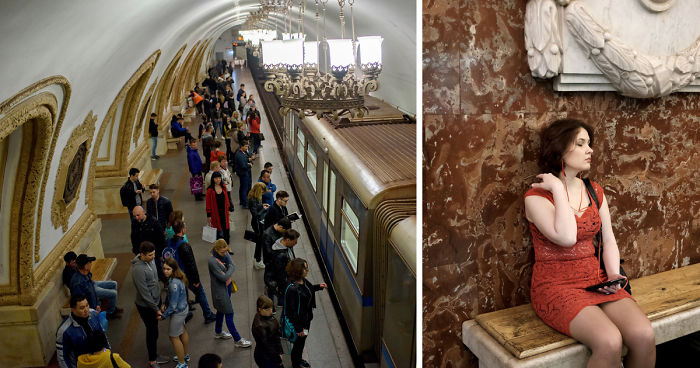
The first hall stopped me in my tracks. Columns repeated into the distance. Light reflected from polished stone. Decorative arches framed the platform, creating a rhythm more familiar in a cathedral than in a subway station.
Meanwhile, local passengers behaved as commuters everywhere do. They checked messages, adjusted scarves, hurried toward doors, and looked mildly annoyed at anyone obstructing traffic. Nothing makes you feel more like a tourist than discovering that somebody else’s architectural wonder is simply where they change trains before work.
The Most Beautiful Moscow Metro Stations I Saw
Komsomolskaya: Baroque drama beneath a railway hub
Komsomolskaya is the station most likely to make a first-time visitor whisper, “This cannot possibly be public transportation.” Its yellow ceiling, white marble columns, monumental mosaics, gilded details, and enormous chandeliers create the atmosphere of a ceremonial ballroom.
The grand Circle Line station was designed to impress passengers arriving near several major railway terminals. Its architecture celebrates episodes from Russian military history, presenting the country as a nation repeatedly tested and triumphantly defended.
The station’s barrel-vaulted hall is supported by 68 marble-faced columns. Yet numbers do not explain its effect. What matters is the theatrical scale. The ceiling appears to float above the crowd, while the chandeliers form a brilliant path through the center of the platform.
I tried to study the mosaics, but trains kept arriving with the subtlety of industrial thunder. Komsomolskaya does not allow quiet contemplation for long. It is a palace with a transportation schedule.
Mayakovskaya: Soviet Art Deco looking toward the sky
Mayakovskaya feels lighter and more futuristic. Architect Alexey Dushkin used slender columns, stainless steel, smooth curves, and recessed ceiling domes to create one of the finest examples of Soviet Art Deco.
Inside those domes are mosaics designed by artist Alexander Deyneka. They depict an idealized day in the Soviet Union: aircraft, sports, work, leisure, technology, and bright open skies. Because the images sit high above the platform, visitors must stand almost directly beneath them to see the details.
The station opened in 1938, and a full-scale section of its design received international recognition at the 1939 New York World’s Fair. Its modern structure and optimistic imagery must have seemed like a transmission from the future.
Today, the contrast remains powerful. The trains rush through a deep underground hall while perfect blue skies appear overhead. It is architectural optimism in a place where sunlight cannot reach.
Novoslobodskaya: A glowing underground chapel
Novoslobodskaya is famous for 32 illuminated stained-glass panels set into the station’s pylons. Flowers, stars, geometric patterns, and figures representing different professions glow from within elaborate metal frames.
The effect is warmer and more intimate than Komsomolskaya’s imperial grandeur. Rather than overwhelming passengers with scale, Novoslobodskaya surrounds them with color. The platform feels part chapel, part jewelry box, and part theater lobby.
At the end of the hall is a mosaic commonly translated as Peace Throughout the World. Its placement turns the platform into a processional space: passengers move past individual stained-glass scenes toward a monumental image of peace and collective purpose.
I found myself walking slowly to inspect each panel. Commuters flowed around me like water around a decorative but inconvenient rock.
Ploshchad Revolyutsii: Bronze citizens and a polished dog
Ploshchad Revolyutsii is one of the most memorable stations because its arches are lined with bronze sculptures. Soldiers, farmers, athletes, students, aviators, writers, workers, and parents represent an idealized progression of Soviet society.
There are 76 figures in the station today. Their dark bronze surfaces make the polished areas immediately visible. The most famous belongs to a border guard’s dog. Generations of passengers have rubbed its nose for good luck, leaving it bright and golden compared with the rest of the sculpture.
Watching people touch the dog was one of my favorite moments. A rigid work of state-sponsored Socialist Realism had developed an informal, almost playful ritual. Official ideology had been transformed by ordinary commuters into a superstition about exams, travel, romance, and daily fortune.
I touched the nose too. Refusing free luck while traveling would have been irresponsible.
Kievskaya: Beauty, history, and uncomfortable symbolism
Kievskaya features rich ornamentation and mosaics devoted to Ukrainian history and the Soviet-era narrative of friendship between Russia and Ukraine. Scenes include agricultural labor, public celebrations, cultural figures, military events, and selected moments from the countries’ shared past.
The craftsmanship is impressive, but the imagery now carries a painful contemporary weight. Art that once presented unity as permanent is viewed in a radically different political reality.
This is where the metro becomes more than an attractive background for photographs. Kievskaya demonstrates how monuments change even when their physical materials remain untouched. The mosaics may be the same, but the viewer brings new knowledge to them.
I admired the color and workmanship while feeling uneasy about the certainty of the message. History rarely behaves as neatly as a state-sponsored mural suggests.
Elektrozavodskaya: An electric ceiling for an industrial age
Elektrozavodskaya was named for a nearby electrical equipment factory, and its design embraces the theme with enthusiasm. Rows of circular lamps cover the ceiling, creating a brilliant pattern that looks like a science-fiction film designed in the 1940s.
The lighting is not merely decorative. It transforms the entire platform into a celebration of electricity, industrial labor, and technological progress. Reliefs along the walls depict workers and wartime production, linking the glowing ceiling to the human effort represented below.
Standing there, I felt as though I had entered a machine built to manufacture optimism. It was stylish, slightly intimidating, and bright enough to make every other subway ceiling seem underdressed.
Teatralnaya and Arbatskaya: Elegance between performances
Teatralnaya, located near the Bolshoi Theatre, incorporates porcelain figures associated with music and dance from across the former Soviet republics. The connection between location and decoration makes the station feel like an extension of Moscow’s theater district.
Arbatskaya offers a different kind of spectacle. Its long platform, chandeliers, ornamental ceiling, and deep bomb-shelter design give it the proportions of a subterranean promenade. At busy times, however, the elegant architectural lines disappear behind crowds moving with the urgency of people who have absolutely no interest in your wide-angle photograph.
Why the Moscow Metro Feels So Different
Every station has a visual identity
Many subway systems rely on standardized platforms distinguished mainly by signs and colored tiles. Moscow’s historic stations behave more like separate rooms in a vast museum. One may resemble a palace, another an industrial temple, and another a memorial hall.
This individual identity turns a journey into a sequence of visual discoveries. Passengers are not simply traveling between neighborhoods. They are moving between architectural narratives.
The materials create permanence
Marble, granite, bronze, stained glass, ceramic, and metal suggest durability. They communicate that the metro was meant to be more than a temporary solution to traffic. It was built as a civic monument that happened to have trains passing through it.
The art works at the scale of a crowd
The mosaics and sculptures are large enough to remain visible in busy stations. Chandeliers organize enormous halls. Repeated columns guide movement. Decorative arches frame entrances and exits. The architecture does not fight against transportation; it choreographs it.
The contrast makes the beauty stronger
A chandelier in a palace is expected. A chandelier above thousands of commuters feels extraordinary. The Moscow Metro’s beauty is intensified by its ordinary function.
You can admire a mosaic, miss your train, catch the next one shortly afterward, and continue to lunch. High art and mild inconvenience coexist perfectly.
How to Explore a Beautiful Metro System Respectfully
A self-guided architecture tour works best outside the busiest commuting periods. Early mornings, late mornings, and quieter weekend periods generally provide more room to observe details without becoming an obstacle.
- Plan a short station list. Six carefully chosen stations are more rewarding than racing through fifteen and remembering none of them.
- Look upward. Some of the finest mosaics and lighting details are directly above the central hall.
- Step aside before taking photographs. Platforms are active transportation spaces, not private studios.
- Study the end walls. Major mosaics, portraits, inscriptions, and political symbols are often placed at the ends of platforms.
- Notice the passengers. The relationship between monumental architecture and ordinary life is part of the experience.
- Read the history critically. Appreciate the craftsmanship without accepting every ideological message at face value.
Rules concerning photography, security, access, and travel can change. Visitors should check current official guidance before entering stations with professional equipment or planning an organized photo session.
Beauty Does Not Erase the Past
It is tempting to describe the Moscow Metro only as an underground museum. That phrase is accurate, but incomplete. Museums usually identify their narratives as interpretations. The metro’s original artwork often presented political claims as unquestionable truth.
The stations celebrate industrial progress while saying little about the coercion and suffering associated with Stalin’s rule. They depict unity while hiding conflict. They glorify military sacrifice without showing its full human cost.
Recognizing those omissions does not require pretending the architecture is ugly. On the contrary, confronting the contradiction makes the visit more meaningful. Beautiful objects can serve troubling systems. Skilled artists can create lasting masterpieces within restrictive political environments. Public spaces can outlive the ideas they were built to promote.
The Moscow Metro is powerful because all of these things remain visible at once. It is functional and symbolic, magnificent and unsettling, historic and intensely alive.
Conclusion: The Palace Still Has Trains to Catch
By the time I returned to street level, I understood why the Moscow Metro is regularly described as one of the most beautiful metro systems in the world. Its greatest stations do more than decorate a commute. They create an entire underground city of memory, performance, ambition, and contradiction.
Komsomolskaya overwhelmed me with ceremonial grandeur. Mayakovskaya made the underground feel open to the sky. Novoslobodskaya glowed like a chapel. Ploshchad Revolyutsii transformed political sculpture into a living commuter ritual. Kievskaya showed how dramatically the meaning of art can change when history moves around it.
The phrase Lenin Palace captures the theatrical quality of the experience, but the metro is not a frozen monument. Trains arrive, doors open, shoes strike marble floors, and announcements echo beneath chandeliers. People hurry through scenes that visitors travel thousands of miles to admire.
That may be the system’s most remarkable achievement. It makes monumental architecture part of ordinary life. Moscow built an underground palace, then filled it with commuters who still have meetings to attend.
Additional Experience: Spending a Day Inside the Lenin Palace
I began my extended metro tour with a simple plan: visit a few famous stations, take some photographs, and return aboveground before lunch. This was adorable optimism.
Within an hour, I had become the kind of traveler who studies a single column for five minutes and then realizes the train on the opposite platform was the one I needed. The metro map looked manageable until several stations with similar names began appearing on different lines. I developed a navigation system involving colors, station numbers, educated guesses, and occasionally following a grandmother who seemed to possess flawless directional instincts.
At Komsomolskaya, I stood beneath the chandeliers and watched the room constantly rearrange itself. Each arriving train released a new crowd. Travelers with luggage crossed paths with office workers, students, tourists, and station employees. For a few seconds the platform became dense and chaotic; then the crowd dissolved into corridors, leaving the grand hall visible again.
The architecture seemed designed for this movement. Columns divided the human traffic without making the room feel cramped. The long central axis pulled the eye forward. Even the chandeliers appeared to mark an invisible route through the station.
Mayakovskaya produced a quieter reaction. I walked beneath the ceiling domes, tilting my head back to see the mosaics. Most passengers never looked up. They knew the skies were there. The artwork had become part of the station’s background, as familiar as the sound of train doors.
I wondered how quickly extraordinary surroundings become ordinary. Would I still admire those mosaics after passing them twice a day for five years? Perhaps I would stop noticing individual images but still feel their effectthe brightness, openness, and subtle illusion that the ceiling was higher than it really was.
At Ploshchad Revolyutsii, the polished dog’s nose offered an answer. Commuters may not pause for formal art appreciation, but they continue to interact with the station. Some touched the bronze nose without breaking stride. Others reached out deliberately and smiled. A child was lifted high enough to participate.
The sculptures had escaped the strict meaning assigned to them. A state monument had acquired local folklore, personal habits, and humor. That small ritual made the station feel human.
Later, I stopped at Novoslobodskaya and waited for the platform to become briefly quiet. The stained glass glowed against the darker stone, and for several seconds the station felt almost sacred. Then a train arrived, the doors opened, and the spell was interrupted by a man speaking loudly into his phone. Public transportation always gets the final word.
By late afternoon, I was tired, hungry, and no longer certain which side of the city I was under. Yet I kept adding stations to the route. Every transfer promised another architectural surprise: a different marble color, a military mosaic, a patterned floor, a decorative grille, or a ceiling that appeared far too elaborate for people carrying grocery bags.
When I finally emerged, daylight felt unusually plain. Buildings stood where buildings were expected to stand. The sky was above me instead of hidden inside a mosaic. Cars moved through streets without chandeliers.
The experience changed how I thought about infrastructure. A transit system can be efficient without being anonymous. Public architecture can make routine journeys memorable. It can also reveal who held power, which stories they wanted repeated, and how later generations reinterpret those stories.
I had entered the metro expecting beautiful stations. I left thinking about art, propaganda, memory, engineering, and the strange intimacy of sharing a palace with several million people who simply need to get home.
SEO Information

