
Body Care
Some Actors Will Forever Be Defined By A Character They Played, So I Photoshopped 14 Movie Posters To Illustrate What I See
Aug
Actors may spend decades building diverse résumés, but audiences are wonderfully stubborn. Give someone a cape, a wand, an indestructible shield, or a suspiciously dramatic helmet, and that character can follow the performer into every future movie.
That familiar mental mix-up inspired a playful series of photoshopped movie posters built around a simple idea: show the movie everyone else sees, then reveal the famous character my brain insists on seeing instead. The original project replaced performers in 14 posters with the roles most strongly associated with them, turning serious dramas, action thrillers, and science-fiction adventures into accidental franchise crossovers.
The results are funny because they expose a real feature of movie culture. Once an actor and a character become inseparable, the audience does not politely erase that association when a new film begins. We carry it into the theater like an oversized bucket of popcorn.
Why Iconic Movie Roles Become Impossible to Forget
A memorable performance creates more than a successful movie. It creates a visual shortcut. A pair of round glasses suggests Harry Potter. Red-and-gold armor means Iron Man. Long silver hair on Henry Cavill immediately makes many viewers wonder whether Superman has misplaced both his cape and his hairbrush.
Movie posters strengthen these associations because they must communicate a story almost instantly. The central face, costume, typography, lighting, and color palette establish a hierarchy that tells viewers what to notice first. Photoshop makes it possible to preserve that hierarchy while changing one crucial element, allowing a familiar poster to tell an entirely different joke.
This phenomenon extends far beyond the actors in the poster series. Mark Hamill remains closely linked to Luke Skywalker, while Keanu Reeves has become inseparable from the elegantly exhausted assassin John Wick. Sigourney Weaver’s Ellen Ripley still represents science-fiction heroism, and Anthony Hopkins can make an ordinary dinner invitation sound mildly concerning because audiences remember Hannibal Lecter.
Being strongly identified with one character is not necessarily a creative prison. It can be proof that an actor, costume designer, director, and writing team created something culturally permanent. The challenge is that permanent characters rarely respect personal boundaries. They follow actors into romantic dramas, independent films, period pieces, and apparently every photoshopped movie poster on the internet.
14 Photoshopped Movie Posters That Reveal the Character Behind the Actor
1. Daniel Radcliffe Still Looks Like Harry Potter
Daniel Radcliffe has played poets, corpses, villains, eccentric explorers, and men facing increasingly strange situations. Yet place his face on almost any movie poster and millions of viewers will still look for a lightning-shaped scar.
The Harry Potter films introduced Radcliffe to the world when he was a child, and he remained at the center of the series throughout its decade-long theatrical run. That level of exposure created an unusually strong bond between performer and character. A poster mashup therefore needs only a wand, Hogwarts-style clothing, or those unmistakable glasses to transform an unrelated Radcliffe movie into another suspiciously dangerous school year.
2. The Joker and Mysterio Wander Into a Romance
Heath Ledger and Jake Gyllenhaal gave deeply human performances in Brokeback Mountain, but superhero culture has since attached different masks to their faces. Ledger became permanently associated with the Joker after The Dark Knight, while Gyllenhaal entered the Marvel universe as Mysterio.
Replacing the original romantic-drama imagery with a purple-suited criminal mastermind and a fishbowl-helmeted illusionist creates glorious tonal confusion. The emotional landscape remains majestic, but now it appears that Gotham City and the multiverse have organized a very complicated weekend retreat.
3. Iron Man and Yon-Rogg Investigate a Mystery
Robert Downey Jr. and Jude Law made a lively detective team in the Sherlock Holmes films. Later superhero associations, however, make the pair look like Tony Stark and Yon-Rogg have temporarily left intergalactic business behind to solve crimes in Victorian London.
Downey’s connection to Iron Man is especially difficult to switch off. His casting as Tony Stark helped define the 2008 film and established the personality at the center of Marvel’s expanding cinematic universe. Add armor to a Sherlock Holmes poster and the detective’s method changes from careful deduction to “build a flying machine and ask questions while hovering.”
4. Chadwick Boseman Brings Wakanda Everywhere
Chadwick Boseman portrayed several important historical figures, including Jackie Robinson, James Brown, and Thurgood Marshall. Even so, his performance as King T’Challa became a cultural landmark whose influence reached far beyond superhero entertainment.
Placing Black Panther imagery over another Boseman movie poster does not merely produce a recognizable costume swap. It recalls the dignity, restraint, leadership, and humanity he brought to the role. Marvel described Black Panther as a global cultural phenomenon, while filmmakers and colleagues repeatedly emphasized the depth Boseman gave T’Challa. In this case, the visual association feels less like typecasting and more like a lasting tribute.
5. Kylo Ren and Black Widow Attempt Marriage Counseling
Marriage Story stars Adam Driver and Scarlett Johansson as a couple navigating divorce, parenthood, resentment, and the logistical nightmare of living on opposite coasts. The performances are painfully grounded. Unfortunately, franchise-trained brains may see Kylo Ren arguing with Black Widow.
The mashup works because both alternate identities carry enormous emotional baggage. Kylo Ren is powerful, volatile, and haunted by family history. Black Widow is disciplined, guarded, and accustomed to saving the world before breakfast. Their fictional divorce would require lawyers, mediators, several government agencies, and at least one person capable of surviving a lightsaber.
6. Superman Takes a Contract in The Witcher
Henry Cavill’s Geralt of Rivia has silver hair, monster-hunting experience, and a voice apparently stored somewhere beneath a mountain. Yet many viewers first registered Cavill as Superman in Man of Steel.
Replacing Geralt with the caped Kryptonian turns the fantasy series into a much shorter adventure. Monsters that once required potions, preparation, swordsmanship, and careful investigation now face a man who can fly through a building. The contrast also demonstrates how costume silhouettes guide recognition: Geralt’s swords establish one identity, while Superman’s cape and chest emblem instantly overwrite it.
7. Thanos Replaces Cable in Deadpool 2
Josh Brolin played both the time-traveling soldier Cable and the universe-editing villain Thanos. That makes Deadpool 2 ideal material for a movie poster mashup. Swap Cable’s mechanical arm for the Infinity Gauntlet and the film suddenly has a much larger budget problem.
Brolin’s performance capture preserved subtle facial expressions beneath Thanos’ enormous digital form, helping the character feel like more than an animated obstacle. As a result, audiences can recognize Thanos even when he is dropped into another Brolin role. Deadpool, naturally, would probably notice the casting overlap and spend the entire movie discussing it.
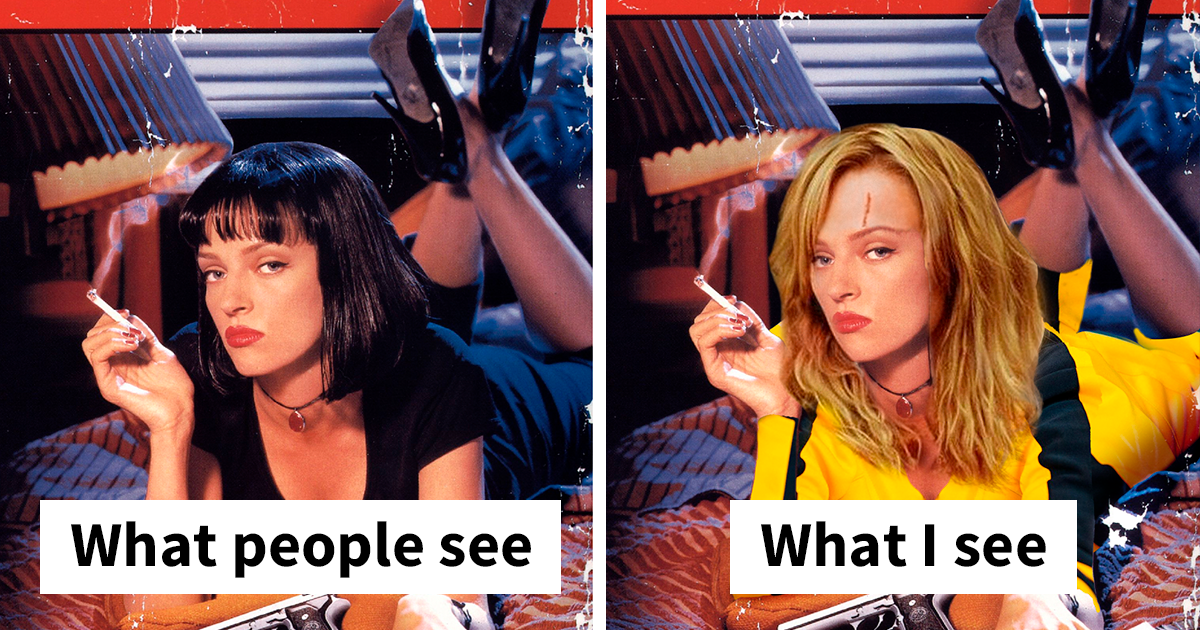
8. Beatrix Kiddo Interrupts Pulp Fiction
Uma Thurman’s Mia Wallace remains one of the defining images of Pulp Fiction. Her dark bob, white shirt, and cool expression have appeared on dorm-room walls for decades. Then Thurman played Beatrix Kiddo in Kill Bill, giving audiences another unforgettable Tarantino character.
Placing the sword-carrying Bride into the Pulp Fiction poster turns relaxed criminal cool into immediate danger. Mia Wallace looks like she might judge your restaurant choice. Beatrix Kiddo looks like she already knows where you live. The mashup succeeds because both characters are iconic, creating a rare battle between two equally powerful screen identities.
9. Captain America Boards Snowpiercer
Chris Evans played Curtis in Bong Joon-ho’s Snowpiercer, a grim science-fiction thriller about the last survivors of humanity living aboard a train divided by class. He also carried Captain America’s shield across years of Marvel adventures.
Replacing Curtis with Steve Rogers adds an interesting layer to the poster because both characters rebel against unjust systems. The difference is mostly equipment. Curtis has improvised weapons, desperation, and a very bad train ticket. Captain America has enhanced strength, tactical experience, and a shield that would make moving between train cars considerably easier.
10. Thor Accepts an Extraction Mission
In Extraction, Chris Hemsworth plays Tyler Rake, a mercenary assigned to rescue a kidnapped boy. The character is bruised, exhausted, and painfully mortal. Add Thor’s armor and hammer, however, and the rescue mission begins to feel slightly unfair.
The visual joke depends on Hemsworth’s physical presence, which fits both roles despite their different worlds. Tyler Rake fights through danger using firearms, tactical training, and determination. Thor could arrive through a column of rainbow light, summon lightning, complete the mission, and return home before the villains finish explaining their plan.
11. Loki and Captain Marvel Hunt King Kong
Kong: Skull Island features Tom Hiddleston and Brie Larson exploring an island where nearly everything is enormous and hungry. Marvel fans may instead see Loki and Captain Marvel participating in the expedition.
This substitution changes the balance of power dramatically. Loki would attempt to negotiate with Kong, betray the expedition, disguise himself as someone else, and claim that every failure was part of his strategy. Captain Marvel could probably end the entire conflict by flying directly through whatever monster was causing trouble. Kong might be the only participant wondering why everyone suddenly has cosmic powers.
12. Swordfish Becomes a Superhero Team-Up
The cast of Swordfish creates a perfect collision of later character associations. Hugh Jackman becomes Wolverine, Halle Berry becomes Storm, Don Cheadle becomes War Machine, and John Travolta turns into Vincent Vega from Pulp Fiction.
The result resembles a superhero crossover organized by someone who became distracted halfway through the casting process. Three comic-book characters arrive prepared for battle, while Vincent Vega appears ready to debate hamburgers and locate the nearest diner. It is chaotic, oddly appealing, and proof that a single poster can contain several layers of cinematic memory at once.
13. Doctor Strange and Gamora Enter Star Trek
Benedict Cumberbatch and Zoe Saldaña both appeared in the modern Star Trek films, although superhero audiences may mentally replace them with Doctor Strange and Gamora. One manipulates time and mystical dimensions; the other is a highly trained warrior raised by Thanos.
Placing those identities into a Starfleet poster makes the Enterprise seem dramatically overqualified. Doctor Strange could open a portal to the destination instead of waiting for warp speed, while Gamora would improve security by glaring at anyone who touched the controls without permission. The poster still reads as science fiction, but the franchise has quietly changed addresses.
14. Batman Replaces Daredevil
Ben Affleck’s superhero history supplies the final poster joke. He played Matt Murdock in the 2003 film Daredevil before later becoming Bruce Wayne in Batman v Superman: Dawn of Justice.
Replacing Daredevil with Batman is visually natural because both characters operate at night, wear intimidating costumes, rely on training rather than traditional superpowers, and carry enough unresolved trauma to keep several fictional therapists employed full time. The edited poster feels less like a crossover and more like Gotham and Hell’s Kitchen accidentally sharing the same brooding vigilante.
What Creating Movie Poster Mashups Teaches You
The Best Idea Usually Begins With Instant Recognition
A project like this becomes interesting long before Photoshop opens. The first task is identifying an actor–character association strong enough to be understood without an explanation. A successful combination should trigger recognition in a second or two. If viewers must read three paragraphs to understand why the replacement is funny, the visual joke has already requested medical attention.
The most effective pairings generally involve a famous costume, hairstyle, prop, posture, or color scheme. Harry Potter has his glasses and wand. Captain America has the shield. Thor has his armor and hammer. Superman has one of the most recognizable silhouettes in popular culture. These elements allow the character to remain readable even after being inserted into a completely different visual environment.
Matching Lighting Is Harder Than Choosing the Joke
The entertaining concept may take five minutes to imagine, but creating a believable composite requires patience. The replacement face or costume must match the original poster’s direction of light, contrast, perspective, texture, and depth of field. A sharply lit superhero pasted into a soft, atmospheric drama can look less like intentional art and more like someone fell through the wrong layer panel.
Working with separate layers makes corrections easier. Masks help preserve hair, clothing, smoke, and environmental details. Color adjustments allow the inserted character to inherit the mood of the original design. A polished mashup should retain enough of the source poster to be immediately recognizable while making the transformation impossible to miss.
Small Details Sell the Entire Illusion
The most satisfying stage is adding details that viewers may not consciously notice. A faint reflection on armor, matching film grain, a shadow beneath a cape, or a subtle color cast can make the new subject feel physically present. Typography may also need adjustment when the replacement changes the implied genre. A quiet drama featuring Kylo Ren, for example, suddenly looks as though its divorce proceedings may involve a fleet of Star Destroyers.
Poster mashups also teach restraint. It is tempting to add every recognizable symbol connected to a character, but too many references weaken the composition. One shield is funny. A shield, helmet, motorcycle, glowing portal, spaceship, and exploding city suggest the designer has lost control of the guest list.
Audience Reactions Become Part of the Artwork
One of the most enjoyable aspects of sharing this kind of series is discovering that people do not agree about an actor’s defining role. Some viewers see Uma Thurman as Mia Wallace; others immediately see the Bride. Benedict Cumberbatch may register as Doctor Strange, Sherlock Holmes, or a Star Trek villain depending on the viewer’s age and favorite franchise.
Those disagreements reveal that typecasting is partly personal. The role that defines an actor is often the first performance that made a strong impression on us. Someone who grew up with Harry Potter may never fully separate Daniel Radcliffe from Hogwarts, while a younger viewer could discover him through an entirely different film and wonder why everyone keeps offering him imaginary wands.
The Project Becomes a Celebration Rather Than a Criticism
At first, the idea of an actor being forever defined by one character can sound limiting. After working through multiple poster concepts, however, the association begins to feel more complimentary. Creating an identity that survives changes in genre, costume, age, and setting is incredibly difficult.
These actors are not remembered because their careers lack variety. They are remembered because one performance connected with audiences so strongly that it became part of popular visual language. The photoshopped posters exaggerate that connection for comedy, but the joke depends on admiration. We recognize the character because the performer made that character feel permanent.
Conclusion: The Character Never Completely Leaves
Great actors can disappear into dozens of roles, but audiences keep souvenirs. We remember a wand, a cape, a helmet, a shield, or a particular expression. When that actor appears in another movie, the old character sometimes walks onscreen beside them.
These 14 photoshopped movie posters turn that mental habit into visual comedy. Superman becomes a monster hunter. Captain America leads a train rebellion. Kylo Ren attempts to survive a divorce. Thor takes a mercenary assignment that should probably last six minutes.
The mashups are funny, but they also demonstrate the power of iconic movie roles. An unforgettable character can outlive marketing campaigns, franchise endings, costume changes, and even the actor’s attempts to move in a completely different creative direction. Hollywood may cast the next role, but the audience brings the previous one along for the ride.
SEO Metadata
Note: This article discusses transformative fan-art concepts for commentary and entertainment. Original movie artwork, character designs, and trademarks remain the property of their respective rights holders.

