
Skincare
10 Weird Ways Saints Are Depicted In Art
Aug
Walk into a gallery of medieval or Renaissance art and you may encounter a surprisingly alarming crowd. One elegantly dressed woman carries two eyeballs on a plate. Another presents her severed breasts as calmly as if she were serving pastries. Nearby, a bishop holds his own head, a man displays his removed skin, and a dragon appears to be having serious digestive problems.
Welcome to the strange, symbolic, and occasionally stomach-testing world of saints in art.
These images were not created merely to shock viewers. Before wall labels, searchable museum databases, and phones capable of identifying paintings, artists needed a reliable way to tell saints apart. Halos were not much help because practically everyone in a sacred scene had one. The solution was a system of visual attributes: objects, animals, wounds, and instruments associated with a saint’s life, martyrdom, or miracles.
A gridiron identified Saint Lawrence. A wheel belonged to Saint Catherine. Eyes pointed to Saint Lucy. Once viewers learned the code, even a crowded altarpiece became readable. The results could be beautiful, frightening, oddly funny, or all three before lunch.
Many of the stories behind these symbols come from hagiographydevotional accounts that mix religious teaching, historical memory, folklore, and legend. They should not always be read as modern biographies. Artistically, however, they created some of the most unforgettable characters in Western and Eastern Christian art.
1. Saint Bartholomew Carries His Own Skin
The apostle with the world’s worst overcoat
Saint Bartholomew is traditionally identified as one of the apostles of Jesus. According to later accounts of his martyrdom, he was flayed alive before being killed. Artists therefore gave him a knife, a strip of skin, orwhen subtlety had left the studiohis entire removed hide.
In some paintings, Bartholomew holds the skin over one arm as though it were an unwanted winter coat. The most famous example appears in Michelangelo’s Last Judgment in the Sistine Chapel. Bartholomew sits near Christ holding a knife in one hand and a sagging sheet of human skin in the other. The distorted face on that skin is widely interpreted as a self-portrait of Michelangelo.
This interpretation transforms the attribute into something more personal. The empty skin may suggest the artist’s exhaustion, spiritual anxiety, or awareness of mortality. It also proves that Renaissance self-portraits did not always require flattering lighting.
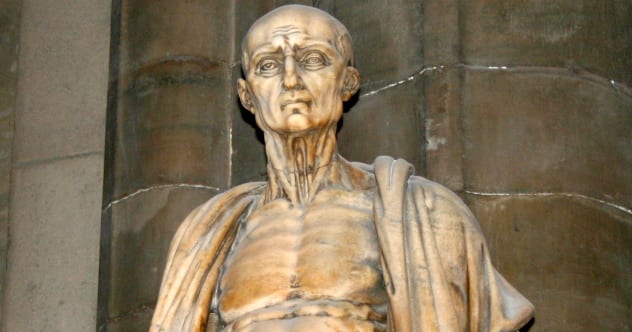
Another unforgettable example is Marco d’Agrate’s sculpture in Milan Cathedral. The saint stands without skin, his muscles exposed, while the removed hide hangs around him. It looks partly like a devotional statue and partly like an anatomy lesson that escaped from medical school.
2. Saint Denis Walks Around Holding His Head
A saint who refused to let decapitation end the journey
Saint Denis, regarded as an early bishop and martyr of Paris, is frequently shown carrying his severed head in his hands. Figures depicted this way are called cephalophores, meaning “head carriers.” Medieval art contains several of them, but Denis is the celebrity of the category.
According to legend, Denis was beheaded during a period of Roman persecution. Rather than collapsing in the expected manner, he picked up his head and walked for miles while continuing to preach. Artists commonly portray him dressed in bishop’s robes, moving forward with his head held at chest or waist level.
The image presents an interesting artistic problem: where should the halo go? Some painters place it around the severed head. Others position it above the empty neck. Occasionally both areas appear visually emphasized, as if the artist wisely decided not to referee the argument.
Although the scene looks macabre, its intended message is triumphant. Denis remains spiritually active after bodily destruction. His severed head is not merely evidence of suffering; it announces that his faith survived the executioner.
3. Saint Lucy Serves Her Eyes on a Dish
Vision, light, and extremely memorable tableware
Saint Lucy is usually depicted as a young woman holding one or two eyes. They may rest on a plate, sit in a cup, grow from a stem like peculiar flowers, or appear on a small rod. In Francisco de Zurbarán’s painting of Lucy, she is richly dressed and calmly presents two realistically painted eyeballs on a pewter dish.
Later legends connected Lucy’s martyrdom with the removal of her eyes. One version says she tore them out to discourage an unwanted admirer, after which God restored her sight. Other traditions associate the symbol with her name, which resembles the Latin word for light.
Whatever the legend’s development, the eyes made Lucy easy to recognize and helped establish her as a patron saint associated with sight and eye disorders.
The strangest feature is often Lucy’s completely normal gaze. She may be holding a spare pair of eyes while still looking directly at the viewer with the originalsor perhaps replacementsfirmly in place. The theological meaning is restoration and spiritual vision. The immediate visual impression is that Saint Lucy came prepared with backups.
4. Saint Agatha Holds Her Breasts on a Platter
A brutal martyrdom turned into an identity symbol
Saint Agatha, a virgin martyr associated with Sicily, appears in art with one of the most startling attributes ever placed on a serving dish: her severed breasts.
According to her traditional story, Agatha rejected the advances of a Roman official and refused to abandon her Christian faith. Her tortures included the removal of her breasts with pincers. Medieval and early modern artists portrayed either the violent event itself or the saint standing peacefully afterward with the removed body parts displayed on a plate.
The contrast can be unsettling. Agatha may wear luxurious clothing, delicate jewelry, and an expression of complete serenity while holding evidence of extreme violence. That contrast was intentional. Christian martyr art often emphasizes the saint’s composure rather than the torturer’s power. Her body was harmed, but her spiritual identity remained intact.
Over time, the rounded objects on her plate were occasionally misunderstood as loaves of bread or bells. This visual confusion contributed to local traditions connecting Agatha with bakers, bell makers, and protection from fire. Iconography can take surprising turns, especially when later viewers are unsure whether they are looking at anatomy or baked goods.
5. Saint Erasmus Comes With a Windlass and Intestines
The patron saint whose attribute requires a strong stomach
Saint Erasmus, also known as Saint Elmo, was traditionally honored as a bishop and martyr. In Western art, he is sometimes identified by a windlass or capstan around which intestines are wound.
Later accounts claimed that his abdomen was opened and his intestines pulled out with a rotating device. Artists transformed that gruesome story into an unmistakable attribute. Erasmus may stand calmly beside the machine, hold a small version of it, or appear during the torture itself.
The windlass also resembles equipment used aboard ships, fitting Erasmus’s long association with sailors. Saint Elmo’s firethe electrical glow that may appear around ship masts during stormswas interpreted by sailors as a sign of his protection.
As a result, one object can carry several layers of meaning. It is an instrument of martyrdom, a visual name tag, and a reminder of the saint’s maritime patronage. It is also an object that will make many museum visitors cross their arms protectively over their stomachs.
6. Saint Lawrence Carries a Giant Gridiron
When sacred art resembles a backyard cookout
Saint Lawrence was a deacon of Rome who, according to tradition, was executed by being roasted on a metal gridiron. His attribute is therefore a large rectangular grill.
Artists sometimes show the martyrdom directly, with Lawrence stretched over flames. In other works, the event is compressed into a simple symbol: the saint stands in formal robes while holding a gridiron like an oversized tennis racket. He may also rest his feet on it or place it beside his throne.
Without knowing the story, modern viewers could easily assume Lawrence is the patron saint of barbecues. The image becomes even stranger when the saint appears relaxed and dignified, showing no apparent concern about carrying the instrument used to kill him.
That calmness is central to the image. Martyrdom attributes were meant to function like trophies of spiritual victory. The gridiron no longer belongs to the executioner. Lawrence possesses it, reducing an instrument of terror to a recognizable accessory.
7. Saint Catherine Poses With a Broken Spiked Wheel
A torture machine that failed spectacularly
Saint Catherine of Alexandria is typically accompanied by a wheel fitted with blades or spikes. Sometimes the wheel is complete. More often, it is broken into pieces, which is the important part of the story.
According to medieval legend, Catherine was a learned Christian woman who challenged pagan scholars and refused the demands of Emperor Maxentius. The emperor ordered her to be killed using a complicated arrangement of spiked wheels. Divine intervention destroyed the device before it could complete the execution, so Catherine was ultimately beheaded instead.
In art, she may rest one hand gracefully on the broken machine, as Artemisia Gentileschi does in her self-portrait as Catherine. The spikes remain visible, but the saint appears composed and powerful. The failed torture device has become proof of protection.
The wheel was such an effective symbol that artists could include only a fragment of it. A well-dressed woman, a palm of martyrdom, and one broken spiked wheel were enough to tell informed viewers exactly who had entered the painting.
8. Saint Margaret Climbs Out of a Dragon
The holy escape scene that became medieval fantasy art
Saint Margaret of Antioch is commonly shown standing on a dragon, leading one by a chain, or emerging from its body. Her legend reads less like a courtroom record and more like an early fantasy adventure.
While Margaret was imprisoned for her faith, the devil reportedly appeared in the form of a dragon and swallowed her. The cross she carried irritated or split the creature’s insides, allowing her to emerge alive and unharmed. Medieval manuscript artists sometimes depicted the precise moment of escape, with Margaret rising from the dragon’s back as if exiting the world’s least comfortable sleeping bag.
The dragon symbolized evil, temptation, and the forces that tried unsuccessfully to consume her. Because she escaped from the creature, Margaret became associated with protection during pregnancy and childbirth. The connection relied on the visual idea of emerging safely from a confined body.
Not every church authority approved of the story’s more fantastic details, but artists loved them. A calm saint standing beside an embarrassed dragon is difficult to forget.
9. Saint Christopher Sometimes Has a Dog’s Head
A regional tradition that surprises Western viewers
In most Western art, Saint Christopher appears as a giant carrying the Christ Child across a dangerous river. In certain Eastern Christian and Russian images, however, Christopher has the head of a dog.
This unusual form is connected with medieval stories about the cynocephali, legendary races of dog-headed people believed to live in distant parts of the world. Some versions of Christopher’s legend described him as belonging to such a people before his conversion. Translation, storytelling, and regional tradition gradually produced images of a muscular saint with a distinctly canine face.
The dog-headed Christopher was never the universal Christian standard. It belongs to particular artistic and devotional contexts. Nevertheless, it demonstrates how flexible saint iconography could become as stories traveled across languages and cultures.
The image may look like a modern fantasy character, but its religious message concerns transformation. Christopher represents a person from the imagined edge of humanity who becomes a defender of the faith. The dog’s head emphasizes the distance he has traveledgeographically, culturally, and spiritually.
10. Saint John the Baptist Grows Wings
The messenger who looks like an angel
Saint John the Baptist is normally recognizable by his rough clothing, uncut hair, cross-shaped staff, and wilderness setting. In Byzantine, post-Byzantine, and some Russian art, he receives an additional feature: a large pair of wings.
Known in this form as the Angel of the Desert or Angel of the Wilderness, John is not being transformed into an angel in the biological sense. The wings express his role as a divine messenger and precursor who prepared the way for Christ. Biblical language describing a messenger sent ahead of the Messiah helped shape this visual interpretation.
The result is striking. John may look thin, wild, and intensely human while enormous wings rise from his shoulders. Some icons also show him holding a scroll, a chalice containing the Christ Child, or even his own severed headbecause apparently one unusual attribute was not enough.
For viewers familiar only with Western Renaissance paintings, the winged Baptist can be startling. Yet the image reveals how artists used physical impossibility to communicate spiritual function. The wings tell viewers what John does: he announces, prepares, and points beyond himself.
The Experience of Seeing These Strange Saint Images
The first reaction is usually confusion
Encountering these works in a museum can feel like walking into the middle of a conversation whose language you do not speak. A visitor sees a beautiful figure holding a plate and initially assumes it contains fruit. A closer look reveals eyeballs. The experience moves rapidly through several stages: curiosity, recognition, discomfort, and finally fascination.
This confusion is useful. It reminds us that art was not always designed for modern museum settings. Many of these images originally appeared in churches, chapels, private prayer books, processional objects, or altarpieces. Their first audiences often knew the saints’ feast days, legends, and attributes from sermons, festivals, theater, and oral storytelling. What seems bizarre to a visitor today may once have been instantly readable.
Looking slowly changes the image
The longer viewers study these works, the less they resemble simple horror scenes. Notice how often the saint remains calm. Lucy does not panic over the eyes on her dish. Catherine controls the broken wheel. Lawrence holds the gridiron rather than lying helplessly upon it. Denis walks forward even though his head is no longer attached.
This reversal is one of the most powerful features of martyr iconography. The torture instrument has lost its authority. By holding it, standing on it, or presenting it to the viewer, the saint turns evidence of defeat into evidence of endurance.
Details also reveal an artist’s individual approach. One painter minimizes the violence, replacing a martyrdom scene with a small symbolic object. Another adds realistic wounds and makes the viewer confront bodily suffering. A sculptor may use exposed anatomy to display technical skill. A manuscript illuminator might surround a frightening event with gold leaf, decorative flowers, and jewel-like color.
Humor and discomfort can coexist
Modern viewers often feel guilty for finding some images funny. Yet visual humor does not necessarily mean disrespect. A saint carrying a grill, a bishop holding his head, or a dragon looking mildly inconvenienced can produce genuine surprise. The gap between sacred intention and modern first impression creates an unavoidable comic effect.
That reaction can become the beginning of serious observation rather than its end. Why does the image seem funny? Which symbols have lost their original meaning? What did the artist expect the audience to recognize? Questions like these turn an odd picture into a lesson about historical memory.
Learning the symbols makes galleries more readable
Once visitors know a few attributes, museum galleries start behaving like enormous visual puzzles. A knife and loose skin suggest Bartholomew. A dish of eyes indicates Lucy. A dragon may identify Margaret, while a broken wheel points to Catherine. The gridiron announces Lawrence before the wall label confirms it.
This knowledge also makes crowded paintings easier to explore. Instead of seeing a generic collection of haloed figures, viewers begin identifying individual personalities and stories. Sacred art becomes less like a distant category and more like an ensemble cast in which every character has a memorable prop.
The best experience comes from balancing three perspectives. First, appreciate the artistic design: composition, color, material, gesture, and technique. Second, investigate the historical and devotional context. Third, allow the image to remain strange. Explaining a dog-headed saint does not make him visually ordinaryand honestly, that is part of the fun.
Conclusion
The weird ways saints are depicted in art are more than collections of gruesome accidents and supernatural adventures. They form a sophisticated visual language. Severed heads, eyes, skin, dragons, wheels, grills, wings, and even internal organs helped viewers identify holy figures while communicating ideas about courage, protection, transformation, and victory over death.
These symbols also show that religious art has never been as predictable as it may appear from a distance. Medieval and early modern artists could be dramatic, inventive, anatomically curious, psychologically intense, and occasionally very strange. Their saints do not simply stand around looking holy. They emerge from monsters, survive impossible machines, carry evidence of their martyrdoms, and sometimes arrive with the head of a dog.
The next time a museum painting seems confusing, look for the oddest object in it. That object may be the clue that unlocks the entire story.
Editorial note: Accounts of many early saints developed through centuries of hagiography and regional tradition. The article describes their artistic iconography and associated legends rather than presenting every narrative detail as independently verified history.

