
Beauty Tools & Accessories
30 Stunning Wildlife Silhouettes At Sunset
Aug
Sunset has a habit of making everything look more dramatic. A quiet pond becomes liquid gold, a crooked tree becomes modern art, and an ordinary bird suddenly appears ready to star in a nature documentary narrated by someone with an extremely calming voice.
Wildlife silhouettes at sunset are especially powerful because they remove distracting details and reduce an animal to its most recognizable elements: the curve of an elephant’s trunk, the towering neck of a giraffe, the antlers of an elk, or the wide wings of an eagle. Color, shape, movement, and atmosphere do the storytelling.
The following 30 scenes celebrate the visual possibilities of sunset wildlife photography. They are not merely pretty outlines against orange skies. Each silhouette can reveal behavior, habitat, relationships, and the scale of the natural world without showing a single feather, stripe, or whisker.
Why Wildlife Silhouettes at Sunset Look So Powerful
A silhouette is created when a backlit subject is significantly darker than its background. In practical terms, the photographer exposes for the illuminated sky rather than the animal. The brighter background retains its color while the subject falls into shadow, producing a clean, graphic outline. Nikon’s photography guidance emphasizes the importance of choosing a strong, recognizable subject and metering for the background. Audubon similarly notes that successful bird silhouettes depend on distinctive shapes and uncluttered positioning.
Timing also helps. Many wild animals become more active around dawn and dusk, when temperatures are cooler and feeding conditions may improve. National Park Service wildlife-viewing guidance regularly recommends these periods for observing animals, while National Geographic photographers describe dusk as an excellent time to see wildlife emerging after the heat of the afternoon.
Then there is the sky itself. Sunset can produce bands of yellow, orange, red, violet, and blue that change minute by minute. A detailed wildlife portrait documents appearance. A silhouette creates mystery. The viewer has to complete part of the picture, which is exactly why these images tend to linger in the imagination.
30 Stunning Wildlife Silhouettes at Sunset
-
1. An Elephant Herd Crossing the Horizon
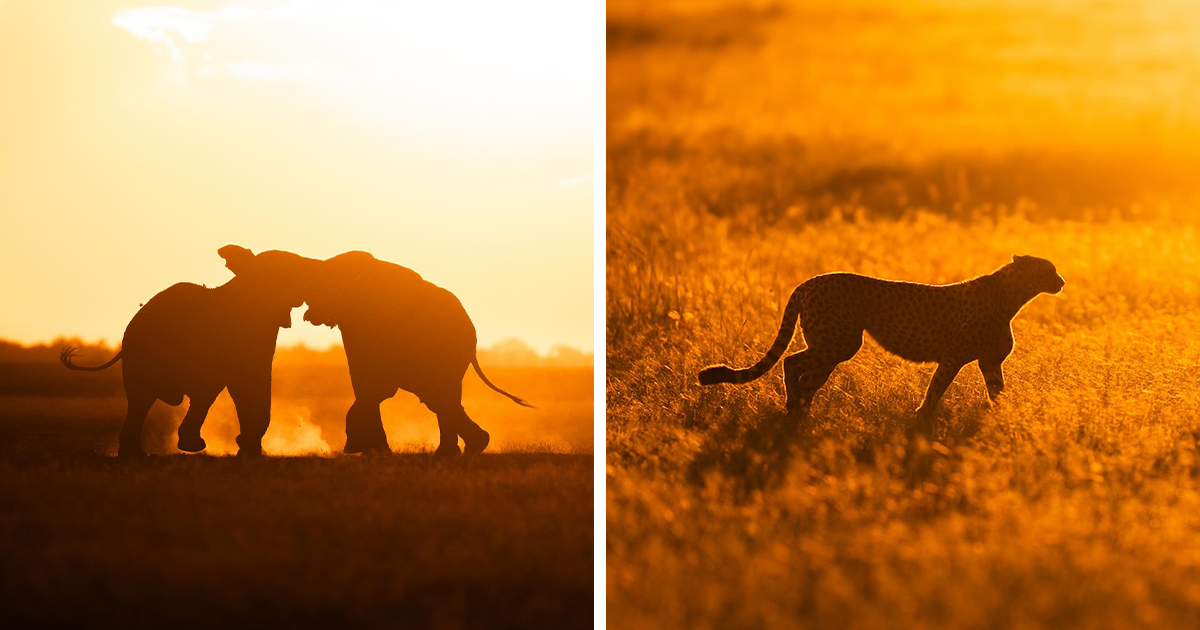
Few wildlife silhouettes are as instantly recognizable as a line of elephants. Their enormous bodies, swinging trunks, fan-shaped ears, and surprisingly delicate tails create a procession that feels prehistoric. A calf walking beneath the adults adds scale, tenderness, and the universal visual language of “please keep up, tiny legs.”
-
2. A Giraffe Beside an Acacia Tree
A giraffe and a flat-topped tree may be the ultimate African sunset pairing. The animal’s long neck rises into the brightest part of the sky while the branches echo its height. With enough negative space, the scene becomes less like a photograph and more like a living emblem of the savanna.
-
3. A Lion Standing on a Rocky Ridge
A lion does not need visible fur or facial detail to look commanding. Its muscular chest, heavy head, and long tail communicate authority through shape alone. Place that outline on a ridge beneath a copper-colored sky and the result looks heroiceven if the lion is actually deciding where to nap next.
-
4. A Cheetah Scanning the Grasslands
The slender profile of a cheetah creates a very different mood. Its small head, deep chest, arched back, and long balancing tail suggest speed even when the animal is motionless. Tall grasses around its legs can soften the lower edge of the silhouette and make the cat appear to float through the landscape.
-
5. Zebras Moving Through Sunset Dust
Silhouettes hide a zebra’s famous stripes, but they emphasize the upright mane, rounded body, and alert ears. A small herd kicking up dust can become a layered composition of overlapping shapes. The glowing particles catch the last light, producing an atmosphere that no studio smoke machine could improve.
-
6. Wildebeest Following an Ancient Route
A line of wildebeest crossing a distant ridge conveys migration, persistence, and scale. Their sloping backs, curved horns, and uneven walking rhythm make the procession visually distinctive. When hundreds of animals merge into a dark ribbon, the photograph becomes a story about movement rather than individual identity.
-
7. A Rhinoceros and Calf in Profile
The heavy body and prominent horn of a rhinoceros create one of nature’s boldest outlines. A calf beside its mother introduces emotional contrast: armor-plated power paired with careful protection. Keeping plenty of empty sky around the pair helps prevent their silhouettes from merging into one mysterious, many-legged blob.
-
8. Bison on a Prairie Ridge
A bison’s massive shoulders and lowered head make it look like a moving piece of the landscape. Photographed from a respectful distance, a group on a western ridge can appear almost geological. Their shaggy profiles stand beautifully against a broad sunset, especially when prairie grasses form a thin, glowing rim around their legs.
-
9. A Bugling Elk Beneath the Evening Sky
An elk lifting its head to bugle creates a silhouette filled with tension. During the breeding season, a mature bull’s antlers produce an intricate crown against the sky. The open mouth and extended neck imply sound, allowing a silent photograph to feel surprisingly loud.
-
10. A Moose Wading Through a Marsh
Moose look wonderfully strange even in full daylight, and sunset makes their proportions more dramatic. The long legs, broad muzzle, and palmate antlers are unmistakable. A reflection in still water doubles the silhouette, while reeds and low mist give the frame a quiet, northern atmosphere.
-
11. Pronghorn Racing Across Open Country
The slim legs and compact bodies of pronghorn are well suited to action silhouettes. A small group running across an open plain can be frozen sharply or photographed with slight motion blur. Either approach communicates speed, particularly when the animals are separated cleanly against a bright strip of sky.
-
12. A Bear Fishing at the Water’s Edge
A bear’s rounded ears and powerful shoulders create a clear outline, especially when the animal stands sideways. A photograph of a bear near a river can combine a dark subject, sparkling water, and a warm reflection. The photographer, naturally, should remain far enough away that the bear remains completely uninterested in the camera operator.
-
13. Wolves Traveling Along a Skyline
A wolf pack silhouetted on a ridge immediately suggests cooperation and wilderness. Differences in posture reveal the group’s rhythm: one animal pauses, another trots ahead, and a third watches the surroundings. Even without visible expressions, spacing and body language can tell the story of a coordinated social unit.
-
14. A Red Fox Mid-Pounce
A fox leaping into the air produces a playful, energetic silhouette. Its pointed muzzle, triangular ears, and long tail remain recognizable throughout the movement. Capturing the exact instant when all four feet leave the ground turns a small predator into a sunset acrobat with impeccable timing.
-
15. Kangaroos Bounding Across the Outback
The upright body, enormous hind feet, and balancing tail of a kangaroo create a silhouette unlike any other mammal. Several kangaroos moving across a low ridge can form a rhythmic sequence. A red outback sky completes the scene without needing much encouragement from the saturation slider.
-
16. An Orangutan High in the Canopy
An orangutan suspended between branches creates a complex silhouette of long arms, curved fingers, leaves, and vines. Unlike a clean horizon scene, this composition can benefit from a little visual complexity. The challenge is preserving enough separation for the animal’s shape to remain readable within the forest structure.
-
17. Lemurs Balanced on Bare Branches
A lemur’s long tail can become the main compositional line in a sunset photograph. Whether it curves downward, loops around a branch, or points into the sky, the tail leads the viewer through the frame. A small family positioned at different heights adds personality without requiring visible facial expressions.
-
18. Flamingos Reflected in Shallow Water
Flamingos provide elegance through geometry. Their curved necks, long legs, and downward-facing bills form graceful shapes against a glowing lagoon. Reflections can create near-symmetrical patterns, while a bird lifting its wings introduces a sudden burst of visual drama into an otherwise peaceful scene.
-
19. Sandhill Cranes Returning to Roost
Sandhill cranes offer several silhouette opportunities in one scene: long-legged birds standing in water, pairs calling to one another, and flocks descending with outstretched wings. Their extended necks distinguish them from many other large birds. Low-angle light may also illuminate mist or dust around the flock.
-
20. Pelicans Flying in Formation
Pelicans often travel in lines that rise and fall above the water. Their broad wings and large bills remain identifiable even at a distance. A group crossing the face of the setting sun can create a minimalist frame in which timing matters more than equipmentand luck quietly takes some of the credit.
-
21. A Heron Waiting at the Shoreline
A heron standing motionless in shallow water is practically designed for silhouette photography. Its long neck can be straight, folded into an S-shape, or extended toward prey. Surrounding the bird with open water and reflected color produces a clean image that feels calm, patient, and slightly suspicious.
-
22. An Eagle Launching From a Branch
The moment an eagle leaves its perch combines recognizable shape with explosive movement. Talons release, wings spread, and the body tilts forward into flight. Photographing the bird against the brighter sky preserves the outline of individual flight feathers, adding texture without revealing traditional plumage detail.
-
23. An Owl on a Weathered Tree
An owl’s rounded head and upright posture make it a natural sunset subject. Small ear tufts, when present, sharpen the outline. A bare branch contributes character, particularly when it bends or twists through the frame. The resulting image feels like the opening shot of a story in which the forest knows more than it is saying.
-
24. Bats Pouring From a Roost
A stream of bats emerging at dusk can transform the sky into a pattern of scattered wings. Individual silhouettes may be tiny, but the combined movement creates scale and energy. Because bats can change direction rapidly, a fast shutter speed and wider framing are often more practical than trying to track one airborne acrobat.
-
25. Dolphins Arcing Above a Golden Sea
A dolphin briefly breaking the surface can become a perfect curved silhouette. The difficulty is anticipating where it will appear and reacting before it vanishes. Multiple dolphins add rhythm, especially when one is airborne while others create dark fins and ripples farther across the water.
-
26. A Whale Tail Against the Horizon
A whale’s raised flukes create a monumental silhouette despite appearing for only a few seconds. Water streaming from the edges can catch the sunset and form glowing threads. A low horizon and generous sky emphasize the scale of the ocean while keeping the composition uncluttered.
-
27. A Sea Turtle at the Edge of the Surf
The domed shell and broad flippers of a sea turtle create a moving silhouette where land and water meet. Such photographs must be made without blocking the animal, using artificial light, or interfering with its route. Ethical distance is not merely polite; it is part of making an honest wildlife image.
-
28. An Alligator Gliding Through Sunset Water
Only the eyes, head, and ridged back of an alligator may rise above the surface, producing a low, stealthy silhouette. Calm water can reflect the sky while the animal cuts a dark line through it. The minimal outline creates suspense without requiring the photographer to behave like an appetizer.
-
29. Mountain Goats on a High Ridge
Mountain goats or ibex positioned on a steep ridge can appear suspended between earth and sky. Curved horns, sure-footed stances, and jagged rock produce a composition built from strong angles. A telephoto lens can visually enlarge the setting sun without requiring anyone to climb into the animal’s personal space.
-
30. Penguins Gathering Under a Polar Sunset
Penguins make charming silhouettes because their upright posture remains unmistakable at almost any distance. A colony gathered along ice or shoreline can combine humor, community, and a vast sense of place. One isolated bird facing the horizon may look philosophical, although it could simply be waiting for everyone else to hurry up.
How to Photograph Wildlife Silhouettes at Sunset
Expose for the Sky
Point the camera’s meter toward the bright sky near the subject, avoiding the sun itself, and set the exposure based on that background. The animal should become dark naturally. If the camera tries to brighten the subject, use negative exposure compensation or switch to manual exposure. Watch the histogram and highlight warnings so the brightest colors are not clipped. Canon’s wildlife photography guidance recommends checking highlight warnings and reducing exposure in small increments when bright areas are lost.
Look for a Recognizable Outline
Silhouettes succeed or fail on shape. A bird facing the camera may become an unidentifiable lump, while the same bird in profile clearly reveals its bill, neck, and tail. Wait for legs, wings, horns, trunks, or tails to separate from the body. When several animals overlap, patience may be more useful than another expensive lens.
Keep the Background Simple
Position the subject against open sky, bright water, or an uncluttered area of sunset color. Trees and grass can add context, but too many dark elements may swallow the animal’s outline. Moving a few steps sideways can dramatically improve separation without moving closer to the wildlife.
Use a Shutter Speed That Matches the Action
Standing animals may require only a moderate shutter speed, especially with image stabilization. Flying birds, running mammals, and jumping dolphins need faster settings. Manual mode with automatic ISO can be helpful because it allows the photographer to control motion and depth of field while the camera responds to rapidly fading light.
Focus on the Edge
Autofocus may struggle when the subject is almost completely dark. Aim at the high-contrast border where the animal meets the sky. If the camera continues hunting, switch to manual focus and magnify the live-view image. A small aperture can provide additional depth of field, but only when enough light remains for a suitable shutter speed.
Protect the Animal Before Protecting the Shot
Use a telephoto lens, observation blind, designated pullout, or established viewing area. Never chase, surround, bait, call, or pressure wildlife into position. The U.S. Fish and Wildlife Service advises photographers to avoid disrupting feeding, resting, nesting, or parenting behavior, while the National Park Service recommends backing away and using binoculars or zoom lenses.
A Field Experience: What a Sunset Wildlife Session Really Feels Like
The following experience is a realistic composite based on common conditions encountered during ethical sunset wildlife photography.
The session begins well before the sky becomes interesting. Arriving early provides time to study the landscape, check where the sun will fall, identify safe viewing areas, and notice the routes animals are already using. That last point matters. It is far better to position yourself near a naturally active area than to arrive late and start wandering around like a confused delivery driver.
At first, the light is still harsh. The water appears silver, the grasses look flat, and every animal seems determined to stand behind a bush. A few test photographs help establish exposure and confirm that the camera is focusing properly. Batteries are checked, memory cards are cleared, and the lens hood is tightened after nearly rolling into the mud for reasons it refuses to explain.
As the sun drops, the entire mood changes. Birds begin moving toward evening roosts. Deer step cautiously from the forest edge. Insects rise above the grass, providing both food for swallows and a buffet for mosquitoes. Wildlife activity often increases around dusk, but that does not guarantee an immediate masterpiece. Most of the time is spent observing, waiting, and resisting the temptation to force the situation.
The first promising subject may be a heron standing in shallow water. From the original position, reeds cut through its body and ruin the outline. Instead of approaching the bird, the photographer moves slowly along the designated viewing area. Ten yards to the side, the background becomes open water. The heron’s neck, bill, and legs finally separate against a band of amber reflection.
The camera is set to expose for the sky. The first frame is too bright, leaving the bird gray rather than black. A small exposure reduction deepens the silhouette and protects the orange highlights. The heron turns its head. For half a second, its bill aligns perfectly with the brightest section of water. Several frames are made, and then the moment disappears.
There is no opportunity to celebrate because a flock of cranes approaches from the distance. The shutter speed is raised, which pushes the ISO higher as the light fades. The photographs become slightly grainier, but sharp wings matter more than technically spotless darkness. One frame captures three cranes with clear separation: one gliding, one beginning a downstroke, and one extending its legs toward the marsh.
After the sun crosses the horizon, many people pack up. That can be a mistake. The brightest oranges fade, but the sky often develops quieter layers of pink, violet, and deep blue. These colors may produce subtler, more sophisticated silhouettes than the blazing sun itself. A lone deer steps onto a ridge during this afterglow, pauses briefly, and looks across the valley.
No one calls to the deer. No one moves closer. The animal’s comfort determines the distance and duration of the encounter. The shutter clicks a few times, then stops. A minute later, the deer returns to the trees on its own terms.
The walk back is darker, cooler, and less glamorous than the finished photographs suggest. Gear feels heavier. Shoes have acquired mud of uncertain origin. Most images are ordinary, several are badly timed, and one appears to feature a bird with seven wings because two subjects overlapped. Yet a handful of frames preserve the evening exactly as it felt: quiet, temporary, and much larger than the person holding the camera.
That is the real appeal of photographing wildlife silhouettes at sunset. The experience is not about controlling nature. It is about preparing carefully enough to recognize a moment that was going to happen without youand being respectful enough to let it continue after the shutter closes.
Conclusion
The best wildlife silhouettes at sunset combine simple shapes with rich stories. An elephant herd can represent family, a wolf pack can suggest cooperation, and a solitary heron can turn stillness into drama. Because details disappear, posture and spacing become more important. Every curve, gap, wingbeat, and raised head contributes to the meaning of the frame.
Successful sunset wildlife photography requires technical control, but it also rewards fieldcraft, patience, and restraint. Expose for the sky, protect the highlights, wait for recognizable profiles, and use distance rather than disturbance. Nature already provides the animals, choreography, lighting, and background. The photographer’s job is mainly to avoid getting in the way.

