
Body Care
How to Play Codenames: Rules & Setup
Jul
Codenames is the rare party game that can make your quietest friend sound like a suspicious intelligence officer and your loudest friend suddenly whisper, “I’m 87% sure ‘kangaroo’ means ‘Australia.’” Designed by Vlaada Chvátil and published by Czech Games Edition, Codenames is a clever team-based word association game where two groups race to identify their secret agents on a shared grid of words.
The beauty of Codenames is that the rules are simple, but the decisions are deliciously tricky. One player on each team becomes the spymaster, the only person who knows which words belong to their team. Everyone else becomes an operative, trying to decode clues without accidentally helping the other team, wasting a turn on an innocent bystander, ordramatic music, pleasechoosing the assassin and losing instantly.
This guide explains exactly how to play Codenames, how to set up the game, what clues are allowed, how turns work, and how to avoid the most common beginner mistakes. By the end, you will be ready to run a game confidently, give smarter clues, and maybe stop your team from confidently touching the one card that everyone definitely should have avoided.
What Is Codenames?
Codenames is a social deduction and word association board game for teams. Players split into two sides: red and blue. Each team is trying to find all of its hidden agents before the other team does. The agents are represented by word cards laid out in a five-by-five grid. Everyone can see the words, but only the two spymasters know which words belong to which team.
On each turn, the spymaster gives a clue made of exactly one word and one number. For example, a spymaster might say, “Ocean: 3.” That means the clue “Ocean” relates to three words on the board. The operative team then discusses and guesses which cards the clue points to. Maybe they choose “whale,” “beach,” and “ship.” Brilliant! Or maybe they choose “moon” because tides exist and suddenly everyone is arguing like a courtroom drama in flip-flops.
Codenames Components
A standard Codenames box includes everything needed for repeated games with different word combinations. The exact edition may vary slightly, but the classic game typically includes:
- 200 double-sided word cards, creating 400 possible codenames
- 40 key cards that show secret team assignments
- 8 red agent tiles
- 8 blue agent tiles
- 1 double agent tile, used by the starting team
- 7 innocent bystander tiles
- 1 assassin tile
- 1 key card stand
- 1 timer, usually optional unless your group enjoys dramatic pressure
- Rulebook or instruction sheet
The word cards are the heart of the game. Because you use only 25 cards per round, Codenames has a lot of replay value. The same word can feel harmless in one game and terrifying in another depending on the key card. “Piano” might be your agent today, the assassin tomorrow, and the reason your cousin refuses to trust you ever again next weekend.
How Many Players Do You Need?
The classic Codenames rules work best with four or more players. You need two teams, and each team needs at least one spymaster and one operative. That means the minimum standard setup is two players per team.
The game can support larger groups very well. In fact, Codenames is often better with six, eight, or even more players because group discussion becomes part of the fun. More operatives means more theories, more wild connections, and more moments where someone says, “Hear me out,” which is usually when trouble begins.
Recommended Player Count
For beginners, six players is a sweet spot: three per team, with one spymaster and two operatives on each side. This keeps the game lively without turning every guess into a committee meeting with snacks.
How to Set Up Codenames
Setting up Codenames is fast, which is one reason it works so well at parties, family gatherings, game nights, and “we have 25 minutes before dinner is ready” situations.
Step 1: Split Into Two Teams
Divide players into two teams: red and blue. Try to make the teams roughly equal in size and skill. If one team has all the crossword fans and the other team has people who think “synonym” is a kind of cinnamon roll, rebalance before starting.
Step 2: Choose One Spymaster Per Team
Each team chooses one spymaster. The spymasters sit on the same side of the table. Their teammates, called operatives, sit across from them. This seating matters because the spymasters need to see the secret key card while keeping it hidden from the operatives.
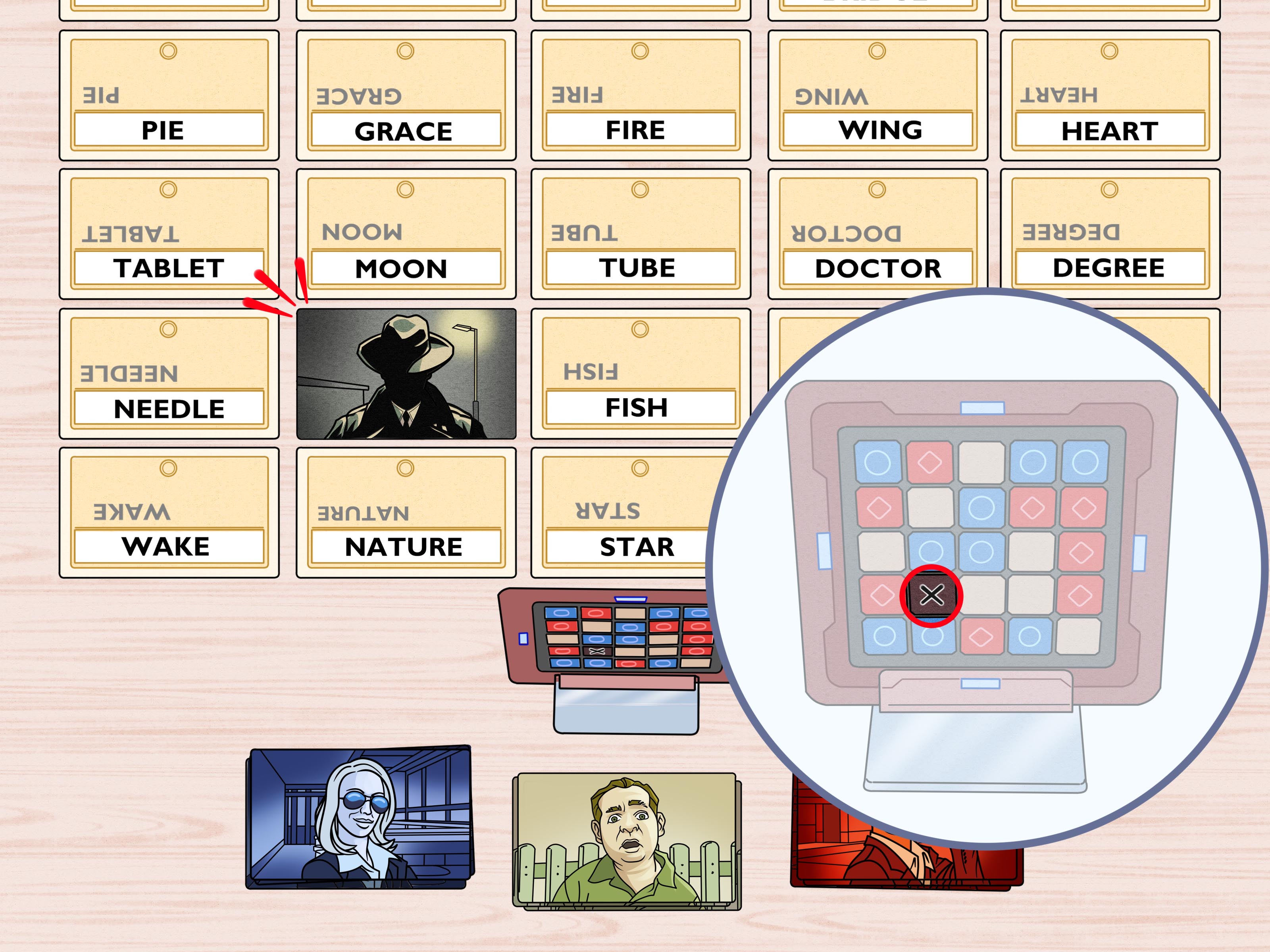
Step 3: Lay Out 25 Word Cards
Shuffle the word cards and place 25 random cards face up in a 5×5 grid. These are the codenames on the board. Everyone should be able to read them clearly. If your table is long, rotate some cards so both teams can read them without doing yoga.
Step 4: Draw a Key Card
The spymasters draw one key card and place it in the stand between them. Only the spymasters may look at it. The key card shows the hidden identity of each word in the grid. Some words are red agents, some are blue agents, some are innocent bystanders, and one is the assassin.
Step 5: Identify the Starting Team
The key card shows which team goes first. The starting team has one extra agent to find, meaning it must identify nine agents instead of eight. That is why the starting team receives the double agent tile, flipped to its team color.
Step 6: Place Agent, Bystander, and Assassin Tiles Nearby
Put the red tiles near the red spymaster, the blue tiles near the blue spymaster, and keep the bystander and assassin tiles within easy reach. The tiles are used to cover cards as guesses are made.
The Objective of Codenames
The goal is simple: be the first team to identify all of your agents. If you are red, you want all red words covered with red agent tiles. If you are blue, you want all blue words covered with blue agent tiles.
However, you must avoid three dangers:
- Innocent bystanders: Guessing one ends your turn.
- Enemy agents: Guessing one helps the other team and ends your turn.
- The assassin: Guessing this card makes your team lose immediately.
That assassin card is what gives Codenames its delightful tension. A spymaster may see a brilliant clue that connects three friendly words, only to notice that it also points directly at the assassin. This is when the spymaster begins quietly sweating through their cardigan.
How Turns Work in Codenames
Teams take turns, beginning with the team shown on the key card. A turn has two main parts: the spymaster gives a clue, and the operatives make guesses.
Part 1: The Spymaster Gives a Clue
The spymaster gives one clue consisting of one word and one number. The word should connect to one or more words on the board that belong to the spymaster’s team. The number tells the operatives how many words relate to the clue.
For example, if the red team has the words “doctor,” “hospital,” and “needle,” the red spymaster might say:
Medical: 3
This means the clue “Medical” is intended to connect to three red words. The operatives then discuss which words they think fit.
Part 2: Operatives Discuss and Guess
After hearing the clue, the operatives may talk openly with each other. They can debate, disagree, panic, overthink, underthink, and accuse each other of “not understanding the vibe.” When they are ready, one operative makes an official guess by touching a word card.
The spymaster then checks the key card and covers the guessed word with the correct tile:
- If it is their own team’s agent, they may guess again.
- If it is an innocent bystander, their turn ends.
- If it is the other team’s agent, the other team gets that agent covered, and the guessing team’s turn ends.
- If it is the assassin, the guessing team loses immediately.
How Many Guesses Can a Team Make?
A team must make at least one guess after receiving a clue. If the guess is correct, the team may continue guessing. In general, a team may make up to one more guess than the number given by the spymaster.
For example, if the clue is “Animal: 2,” the team may guess up to three cards, as long as its guesses keep being correct. This “plus one” rule is useful because teams can go back and guess a word they missed from an earlier clue.
However, just because you can guess again does not mean you should. Codenames rewards courage, but it also rewards not poking the assassin with a stick.
When Does a Turn End?
A turn ends when one of the following happens:
- The team chooses to stop guessing after at least one guess.
- The team guesses an innocent bystander.
- The team guesses an opposing team’s agent.
- The team reaches the maximum number of allowed guesses.
- The team guesses the assassin and loses the game.
Ending voluntarily is often smart. If your team has already found the obvious words and the next guess feels like a coin toss, it is perfectly legal to say, “We are not touching that disaster today,” and pass the turn.
How to Win Codenames
A team wins when all of its agents have been found. Usually, this happens on that team’s own turn. However, a team can also win because the opposing team accidentally guessed its final agent. It feels strange, but yes, your rivals can hand you victory by mistake. Be gracious. Try not to cackle.
A team also wins immediately if the other team reveals the assassin. In that case, the game ends right away. There is no comeback round, no dramatic appeal, and no “but I meant the other card.” The assassin is the final answer.
Legal Clues in Codenames
Good clues are the soul of Codenames, but not every clue is allowed. The official spirit of the game is that clues should be based on meaning, association, or conceptnot spelling tricks, table gestures, or suspicious eyebrow choreography.
Your Clue Must Be One Word
The clue word should be a single word. “Space” is fine. “Outer space” is usually not, unless your group agrees on a house rule. Proper nouns, acronyms, and compound words can sometimes create gray areas, so many groups agree before the game how strict they want to be.
Your Clue Cannot Be a Visible Codename
You cannot use a word that is currently showing on the board as your clue. You also should not use a direct form of a visible word. If “run” is on the table, “running” is not a good clue. Once that word is covered, restrictions may change depending on the exact wording and your group’s interpretation.
No Gestures, Hints, or Reactions
The spymaster should not point, stare, sigh meaningfully, tap the table, or make a face that says, “Please do not choose that card unless you enjoy losing.” After giving the clue, the spymaster should stay neutral. This is harder than it sounds. Codenames turns ordinary facial muscles into dangerous communication devices.
Example Round of Codenames
Imagine the red team has these agents on the board: “apple,” “leaf,” and “tree.” The red spymaster says:
Orchard: 3
The red operatives discuss. They choose “apple” first. Correct. The spymaster covers it with a red tile. They choose “tree” second. Correct again. Now they debate between “leaf” and “farm.” The clue was “Orchard,” so “leaf” seems reasonable, but “farm” is also nearby in meaning. If “leaf” is red and “farm” is a bystander, the right choice keeps the turn alive while the wrong choice ends it.
This is the classic Codenames tension: every clue creates a small web of meaning, and the team must decide which threads are safe to pull.
Common Beginner Mistakes
Giving Clues That Are Too Ambitious
New spymasters often try to connect four words with a genius-level clue and accidentally create a clue that also connects to the assassin. A two-word clue that is safe is often better than a four-word clue that requires your teammates to read your childhood diary.
Ignoring the Assassin
Before giving any clue, check whether the assassin could also match it. If your clue is “Royal: 3” and the assassin is “crown,” please reconsider. Your clue may be technically clever, but it is also wearing a neon sign that says “instant defeat.”
Operatives Overthinking Everything
Operatives should think carefully, but not turn every clue into a philosophical dissertation. Sometimes “Cold: 2” means “snow” and “ice.” It does not always mean “loneliness,” “tax season,” and “that one look your cat gives you.”
Spymasters Reacting to Guesses
Spymasters must remain calm. No nodding, groaning, smiling, or suddenly becoming fascinated by the ceiling. If the team guesses a correct word you did not intend, act like it was your plan all along. Congratulations, you are now a professional spy and part-time theater student.
Strategy Tips for Spymasters
A strong spymaster balances creativity with safety. Start by scanning your team’s words and looking for natural groups. Then check nearby enemy words, bystanders, and especially the assassin. The best clue is not always the biggest clue; it is the clue your team can actually interpret.
Good spymaster clues often use categories, themes, locations, functions, or shared associations. For example, “kitchen” might connect “knife,” “sink,” and “plate.” “Myth” might connect “dragon,” “giant,” and “Olympus.” But every board is different, so always judge clues based on the full grid.
When behind, bigger clues may be necessary. When ahead, safer clues may be smarter. If your team needs only two words and the other team is far behind, there is no need to launch a five-card moonshot unless you enjoy chaos as a lifestyle.
Strategy Tips for Operatives
Operatives should listen closely to both the clue word and the number. The number matters. If the clue is “School: 2,” do not immediately grab every education-related word on the table. Your spymaster is telling you there are two intended targets, with the possibility of one extra guess if you are confident about a previous clue.
It also helps to remember missed clues. If your team skipped a possible word last turn, the plus-one guess may let you return to it later. Keeping a mental note of earlier clues can make the difference between a clean win and a tragic assassin incident.
Optional Rules and House Rules
Codenames includes flexible elements that groups can adjust. The timer is optional, but useful if players take too long. Some groups use it only when someone is clearly stuck. Others flip it immediately because they enjoy watching friends make decisions under sand-powered pressure.
Groups may also decide how strict to be about proper nouns, abbreviations, compound words, and homonyms. The official rulebook encourages players not to be too strict, but the key is consistency. Agree early, especially if you have competitive players who treat party games like courtroom litigation.
Can You Play Codenames With Two or Three Players?
The classic version is built for two teams, but there are variants for smaller groups. With two players, many people prefer Codenames: Duet, a cooperative version designed specifically for two. With three players, one player may act as spymaster while the others guess, or you can adapt team roles depending on your group’s preference.
That said, classic Codenames shines brightest with two lively teams. The table talk, competing theories, and dramatic wrong guesses are part of the fun.
Why Codenames Is Still a Great Party Game
Codenames remains popular because it is easy to teach, quick to set up, and different every time. It works for casual players and serious board gamers. It does not require acting skills, trivia knowledge, or a giant table full of miniatures. All it asks is that you connect words in clever ways and occasionally trust someone who is absolutely wrong with impressive confidence.
The game also reveals how people think. One person sees “bank” and thinks of money. Another thinks of rivers. Another thinks of betrayal because they once played Monopoly with their family. Codenames turns those differences into comedy, strategy, and memorable moments.
Conclusion
Learning how to play Codenames is easy: split into two teams, choose spymasters, lay out 25 word cards, draw a secret key, and race to identify your agents through one-word clues. The challenge comes from giving clues that are broad enough to be useful but safe enough to avoid enemy agents, bystanders, and the dreaded assassin.
If you are teaching new players, focus on the basics first: one word, one number, at least one guess, wrong guesses end the turn, and the assassin ends the game. Once everyone understands that, Codenames becomes fast, funny, and surprisingly strategic. Whether your team wins through brilliant deduction or loses because someone insisted “penguin” was clearly connected to “business,” you will probably want to shuffle the cards and play again.
Personal Experience and Practical Table Advice
The best Codenames games usually happen when players relax into the silliness of the premise. Yes, it is technically a spy-themed word game, but at the table it feels more like a friendly test of how well people’s brains can share the same strange hallway. One spymaster may give a clue that seems obvious to them, only to watch their team march confidently in the opposite direction. That is not a failure; that is the game doing exactly what it was built to do.
One useful experience-based tip is to make the first clue simple, especially when playing with beginners. A clue like “Animal: 2” for “dog” and “horse” may not feel dazzling, but it teaches the rhythm of the game. Players learn how to discuss, touch a card, watch the spymaster reveal the result, and decide whether to keep guessing. After one or two safe turns, everyone becomes more comfortable with riskier connections.
Another practical tip is to remind spymasters that silence is part of the role. New spymasters often want to explain themselves after a clue goes sideways. They might say, “No, no, I meant the other kind of bank,” or “Why would you pick that?” That ruins the fairness of the game. The better approach is to stay neutral and let the team live with its decision. It sounds strict, but it makes the funny moments even better because everyone knows the result came from the clue and the discussion, not accidental coaching.
For operatives, the most helpful habit is to separate “possible” from “probable.” Many words can be connected if you stretch hard enough. In Codenames, stretching too hard is how teams end up choosing the assassin while feeling intellectually proud of themselves. When debating a clue, ask: “Which words would our spymaster expect us to see first?” That question usually leads to better guesses than building an elaborate theory that requires three metaphors and a weather report.
It is also worth paying attention to team personality. Some teams are bold and love big guesses. Others prefer safe, careful play. Neither style is automatically better. A bold team can make amazing comebacks, but it can also lose in five minutes. A cautious team may avoid disasters, but it might fall behind if it never uses the plus-one guess. The best groups learn when to push and when to stop.
In real game nights, Codenames works especially well as an opener. It gets people talking quickly, does not require heavy rules explanation, and gives everyone a reason to participate. Even players who do not usually enjoy board games often enjoy Codenames because the action is conversational. You are not memorizing a rulebook; you are arguing whether “Hollywood” points to “star,” “screen,” or “alien.” Somehow, everyone has an opinion.
Finally, do not worry too much about perfect clues. Some of the most memorable Codenames moments come from imperfect clues, surprising guesses, and spymasters trying heroically not to react. The goal is to create a fun puzzle for your team, not to prove you are a linguistic mastermind operating on a higher plane of party-game consciousness. Give the clue, trust your team, keep a straight face, and enjoy the chaos.
Note: This article is synthesized from official Codenames rules, publisher materials, and reputable board game learning guides. Source links are intentionally not included in the article body for clean web publishing.

