
Body Care
Archaeologists Explored a ‘Blood Cave’and Found Chopped-Up Maya Skulls
Jun
Note: This article is based on current archaeological reporting, university research summaries, and established Maya archaeology context. Because the Cueva de Sangre research is still developing, some interpretations may be refined after future peer-reviewed publication.
A Cave With a Name That Does Not Whisper
Some archaeological sites arrive with gentle names: “Temple of the Sun,” “House of the Deer,” “Plaza of the Moon.” Then there is Cueva de Sangre, which translates from Spanish as “Blood Cave.” Subtle? Not exactly. The name sounds like it was rejected from a horror movie for being too on the nose. Yet the site beneath the Maya world of Dos Pilas in Petén, Guatemala, is not fiction. It is a real underground cave system where archaeologists encountered a deeply unsettling collection of fragmented human bones, including skull pieces showing evidence of cutting, trauma, and deliberate placement.
The discovery has renewed attention on Maya human sacrifice, cave ritual, and the difficult question of what ancient communities believed they were doing when they carried body parts into the dark. The short answer is: archaeologists do not think this was random violence or ordinary burial. The evidence points toward ritual action, possibly linked to rain, agriculture, and the Maya rain god Chaac. The longer answer requires a descent into the cave itself, where water, darkness, bones, and belief all meet like the world’s most intense history seminar.
Cueva de Sangre is part of a larger network of caves associated with Dos Pilas. Surveys in the early 1990s documented numerous underground spaces in the region, and later studies have shown that ancient Maya use of these caves stretched across centuries. Some areas were dry, others seasonally flooded, and some passages could only be entered during certain months. That detail matters. In Maya cosmology, caves were not simply holes in the ground. They were sacred openings, portals, watery thresholds, and places where humans could communicate with powers that controlled rain, fertility, and life itself.
Where Is the Maya “Blood Cave”?
Cueva de Sangre lies in the Petén region of northern Guatemala, beneath or near the ancient Maya site of Dos Pilas. Dos Pilas was an important Classic Maya center in the Petexbatún region, a landscape of rainforest, rivers, wetlands, limestone, and political drama. If ancient Maya history had a streaming series, Dos Pilas would definitely get a season full of royal rivalry, dynastic conflict, military tension, and sudden collapse.
The cave itself is not a simple room with a spooky entrance. Research summaries describe Cueva de Sangre as a complex cave system, extending for kilometers, with riverine environments, seasonally inundated passages, and dry chambers. In practical terms, this means archaeologists are not strolling in with a latte and a clipboard. They are working in a difficult, wet, dark, unstable environment where the cave floor, water levels, and preservation conditions all affect what can be seen and studied.
The cave is especially significant because it is usually flooded for much of the year. It appears to have been most accessible during the dry season, roughly from March to May. That seasonal opening may connect the cave to rituals performed just before the arrival of the rains. For agricultural communities dependent on maize and seasonal rainfall, rain was not a pleasant weather update. It was survival. No rain meant no crops. No crops meant hunger, unrest, and cosmic anxiety with mud on its sandals.
What Archaeologists Found Inside Cueva de Sangre
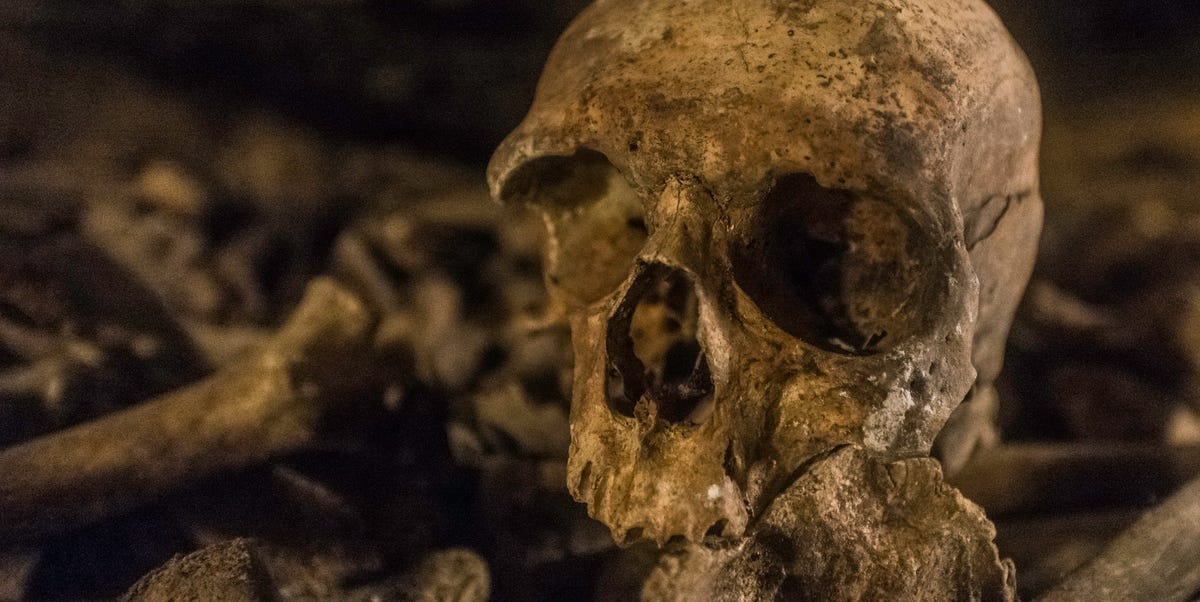
The most striking discovery was the large quantity of fragmented human remains scattered across the cave floor. Archaeologists have reported hundreds of bone fragments, including cranial remains, adult and juvenile bones, and pieces that appear to have been modified by human action. Some bones show injuries that occurred around the time of death, known as perimortem trauma. Others show cut marks or modifications consistent with defleshing, dismemberment, or the removal of body parts.
One especially attention-grabbing detail is the presence of skull caps arranged in a way that does not match ordinary burial. In one area, a series of skull caps was found stacked or placed together. That kind of arrangement is important because archaeologists pay close attention not only to what is found, but where and how it is found. A skull fragment lying in a collapsed tomb tells one story. Several cranial pieces placed together in a cave alongside ritual materials tell a very different story.
The cave also contained materials associated with ritual activity, including red ocher and obsidian blades. Red ocher has long symbolic associations in many ancient cultures, often connected with blood, life, death, transformation, or sacred marking. Obsidian blades, sharp enough to make modern kitchen knives look like butter spreaders, were used in Mesoamerica for cutting, bloodletting, and other ritual practices. Their presence does not automatically prove sacrifice, but when combined with human remains, cut marks, and unusual bone placement, the pattern becomes hard to ignore.
Why “Chopped-Up Skulls” Matter Archaeologically
The phrase “chopped-up Maya skulls” sounds sensational, but the scientific importance is more precise. Archaeologists are not simply saying, “Well, that looks nasty.” They are asking: Were these bodies buried? Were they disturbed later by water? Were they victims of violence? Were body parts selected for ritual use? Did people enter the cave carrying remains, or were individuals killed there?
Those questions matter because human bones can move after death. Water can scatter remains. Animals can disturb deposits. Cave floors can shift. Later visitors can accidentally or deliberately rearrange objects. This is where bioarchaeology becomes less glamorous than treasure hunting but far more useful. Researchers examine bone surfaces, fracture patterns, cut marks, burning, weathering, mineral staining, and anatomical placement. They compare what they see with known patterns of burial, decomposition, ritual deposition, and trauma.
In Cueva de Sangre, researchers have emphasized that the pattern looks less like intact bodies and more like selected body parts. Cranial remains appear especially prominent. This suggests that the head, face, skull, or identity of the individual may have carried special meaning. In many ancient societies, skulls were powerful symbols. They could represent ancestors, enemies, offerings, trophies, or transformed beings. The Maya world was no exception; body parts could hold ritual value beyond the whole body.
Human Sacrifice and the Ancient Maya: Context Without Cartoon Villains
It is easy to reduce ancient sacrifice to “scary people did scary things.” That is also lazy. The ancient Maya were mathematicians, astronomers, architects, farmers, artists, scribes, traders, rulers, and ritual specialists. Their cities contained temples, plazas, palaces, ballcourts, reservoirs, causeways, and carved monuments. They tracked time with extraordinary precision. They created painted ceramics and hieroglyphic texts. They also practiced forms of bloodletting and human sacrifice. Human societies are rarely polite enough to fit into one neat moral drawer.
For the Maya, blood was not merely gore. It was a sacred substance, a medium of communication with gods and ancestors. Royal bloodletting rituals, captive sacrifice, and offerings were part of political and religious life. These acts were often connected with renewal, legitimacy, warfare, fertility, and cosmic balance. In this worldview, death could be understood as an offering that helped sustain the relationship between people, gods, and the natural world.
That does not make the evidence from Cueva de Sangre comfortable. It should not be comfortable. But understanding the ritual logic helps modern readers avoid two bad habits: turning the Maya into horror-movie villains, or pretending the violence was not violence. Archaeology works best when it can hold both truths at once. The remains are evidence of real human suffering, and they are also evidence of a highly structured belief system.
The Rain God Chaac and the Agricultural Stakes
One of the leading interpretations of the Blood Cave remains connects them to Chaac, the Maya deity associated with rain, storms, lightning, and agricultural fertility. Chaac was not a minor background character in Maya religion. In a farming society dependent on seasonal rainfall, a rain god had the job security of a plumber during a basement flood.
Maize agriculture shaped Maya life. Planting, rainfall, harvest, storage, and drought were not simply economic concerns; they were spiritual and political concerns as well. If rains failed, crops failed. If crops failed, rulers could lose authority. Communities could face hunger, migration, or conflict. Rituals for rain were therefore serious business.
Caves played a special role in this system because they were associated with water and the underworld. A cave that floods seasonally would have felt even more powerful. It was dark, dangerous, and connected to hidden water. When Cueva de Sangre became accessible during the dry season, it may have offered a narrow ritual window just before the rains were expected. The timing is suggestive: people entering a watery cave during the dry months to make offerings for rain and harvest is the kind of pattern archaeologists do not simply shrug off.
Why the Dry Season Matters
The dry-season accessibility of Cueva de Sangre is one of the most fascinating clues. If the cave could be entered mainly from March to May, then ritual activity there may have been tied to the agricultural calendar. In parts of the Maya world today, communities still participate in rain-related ceremonies around early May, including visits to caves or sacred places. Archaeologists are careful with direct comparisons between ancient and modern practices, because cultures change. Still, living traditions can help scholars ask better questions about ancient evidence.
Imagine the scene without turning it into a movie trailer: a community facing the end of the dry season, waiting for rain, entering a dark cave that disappears into the earth, carrying offerings, perhaps bones or body parts, along with red pigment and obsidian tools. The cave is not just a backdrop. It is part of the ritual. The descent, darkness, water, mud, echo, and danger all create meaning. Anyone who has ever lost their phone under a couch knows that darkness changes behavior. Now multiply that by sacred geography, ancient cosmology, and a flooded cave system.
Dos Pilas: A Political World Above the Cave
Above the cave lay the world of Dos Pilas, a Maya center with a dramatic political history. Dos Pilas was part of the Classic Maya landscape of competing dynasties, shifting alliances, warfare, and regional power struggles. Research on the Petexbatún region has shown that elite competition and conflict played major roles in the history and eventual instability of the area.
This matters because rituals in caves were not separate from politics. In Maya society, rulers often presented themselves as mediators between humans and gods. Control over sacred landscapes could strengthen political authority. A ruler or ritual specialist who could organize ceremonies for rain, fertility, and divine favor held more than spiritual prestige. They held social power.
The Blood Cave remains may therefore reflect more than private devotion. They may reveal how communities used subterranean spaces to negotiate fear, fertility, political legitimacy, and survival. A cave offering was not the ancient equivalent of tossing a coin into a fountain. It was a high-stakes ritual act in a world where gods, crops, rulers, and ancestors were deeply intertwined.
What the Bones Can Still Tell Us
Research on Cueva de Sangre is ongoing, and that is important. Some headlines make discoveries sound final, as if archaeologists dusted off one skull and immediately solved the ancient world before lunch. In reality, good archaeology moves slowly. It tests hypotheses, compares evidence, revises interpretations, and occasionally says, “We are not sure yet,” which is a very scientific sentence and also a deeply underrated life skill.
Future analysis may include ancient DNA and stable isotope testing. DNA could help determine biological relationships among individuals. Were the victims local or from different communities? Were some related to one another? Stable isotopes in bones and teeth can sometimes reveal information about diet, childhood origin, and mobility. If the individuals grew up in different geological regions, their teeth may preserve chemical signatures of those places. Bones are quiet, but under the right instruments, they can become surprisingly chatty.
Further study may also clarify whether the remains belong to a single ritual episode or repeated events over time. Were bodies brought in whole and later modified? Were body parts carried into the cave after death? Were some individuals killed inside the cave? Archaeologists do not yet have every answer, and responsible reporting should not pretend otherwise.
Why This Discovery Captivates Modern Readers
The Blood Cave story fascinates people because it combines several powerful themes: hidden places, ancient religion, human remains, mysterious rituals, and new scientific methods. It also forces us to confront the fact that archaeology is not always golden masks and pretty pottery. Sometimes it is mud, bone fragments, trauma marks, and questions no one can answer quickly.
There is also something psychologically gripping about caves. Caves are natural archives, but they are also emotional spaces. They feel secretive. They distort sound. They hide water. They preserve things that sunlight destroys. Entering a cave can feel like entering another world, and for the ancient Maya, that may have been exactly the point.
In the case of Cueva de Sangre, the cave’s physical qualities amplify its ritual meaning. It is dark. It is wet. It is seasonal. It contains evidence of human sacrifice. It was associated with a region where caves were recognized as powerful sacred spaces. The result is a discovery that is both scientifically important and, yes, deeply eerie.
Lessons From the Blood Cave
1. Archaeology Is About Patterns, Not Just Objects
A single skull fragment with a cut mark is important, but it becomes more meaningful when placed within a larger pattern: hundreds of bones, cranial dominance, ritual materials, unusual placement, cave context, and seasonal access. Archaeology is the art of making evidence talk without forcing it to sing karaoke.
2. Caves Were Sacred Landscapes
For the ancient Maya, caves were not merely shelters or storage spaces. They were entrances to sacred realms, sources of water, places of emergence, and channels to deities and ancestors. The Blood Cave fits into this broader tradition of subterranean ritual activity across Mesoamerica.
3. Ritual Violence Was Structured
The evidence does not suggest random destruction. The careful selection and arrangement of remains point toward formal ritual practice. That makes the discovery more complex, not less disturbing. It reminds us that violence can be organized, symbolic, and socially meaningful within a culture’s worldview.
4. Science Will Keep Revising the Story
As more analyses are completed, researchers may refine the timeline, identify individuals, test mobility patterns, and better understand how the remains entered the cave. The current interpretation is strong, but not frozen in stone. Or limestone. This is a cave story, after all.
Experiences Related to the Blood Cave: What This Discovery Feels Like to Study, Visit, and Imagine
While most readers will never crawl into Cueva de Sangre with a helmet lamp, mud on their knees, and the sudden realization that every drip of water sounds like a footstep, the discovery offers a powerful experience through imagination and education. Archaeology often begins with facts, but it becomes memorable when we try to understand what those facts would have felt like to real people.
Picture an archaeologist entering the cave during the dry season. The jungle air outside is hot and alive with insects. Inside, the temperature shifts. The light narrows. The passage descends. The world becomes wet stone, echo, darkness, and careful breathing. Every step matters because the floor may hold fragile evidence. A small bone fragment could be a clue. A smear of pigment could change an interpretation. A blade of obsidian could connect the scene to ritual action. This is not treasure hunting. It is slow listening.
For a student learning about Maya archaeology, the Blood Cave is a reminder that ancient history is not flat. It is not just dates on a timeline or kings with hard-to-pronounce names. It is sensory. It involves landscapes, fear, hope, hunger, weather, and belief. A rain ritual in a cave makes more sense when one remembers that crops do not grow from good intentions. People needed rain. They prayed for rain. They may have offered the most valuable and terrifying gifts they could imagine.
For travelers who visit Maya sites in Guatemala, Mexico, Belize, or Honduras, the story adds depth to what they see above ground. Temples and plazas are impressive, but the ancient Maya world also extended downward. Beneath pyramids and settlements were caves, chasms, cenotes, and underground waters. These places were not side notes; they were part of the sacred map. Visiting a Maya ruin after learning about Cueva de Sangre changes the experience. You begin to look not only at the buildings, but at the land itself: the hills, openings, pools, and shadows.
For writers, educators, and museum visitors, the Blood Cave offers a challenge: how do we tell a story that is fascinating without turning human remains into entertainment? The best answer is respect. These bones belonged to people. Some were adults. Some were juveniles. Their names are unknown, but their remains still carry evidence of what happened to them. A good article can be vivid without being cheap. It can admit the horror while also explaining the belief system, environment, and scientific method behind the discovery.
There is also a personal lesson in the patience of archaeology. Modern life loves instant answers. We want the headline, the summary, the “five things you need to know,” and preferably a snack. But Cueva de Sangre resists speed. The cave has waited for centuries. The bones require careful analysis. The interpretation depends on multiple kinds of evidence. In that sense, the Blood Cave teaches a quieter skill: humility before the past.
Standing metaphorically at the cave entrance, we are reminded that ancient people were not simple, and neither were their rituals. They lived in worlds shaped by weather, politics, agriculture, gods, fear, and hope. The chopped-up Maya skulls of Cueva de Sangre are shocking, but they are not meaningless. They are fragments of a larger human story, one still being assembled piece by piece in the dark.
Conclusion: A Dark Cave, a Bigger Story
The discovery at Cueva de Sangre is one of those archaeological stories that grabs attention immediately and then becomes more interesting the longer we look. Yes, archaeologists found fragmented human remains and skull pieces with evidence of cutting and trauma. Yes, the cave’s name sounds like it was created by someone with a flair for gothic branding. But beneath the shock is a serious and important window into ancient Maya ritual life.
The evidence from the Blood Cave points toward a ritual deposit, possibly connected to sacrifice, rainmaking, agricultural fertility, and the sacred power of caves. The presence of cranial remains, cut marks, red ocher, obsidian blades, unusual placement, and seasonal cave access all support the interpretation that this was not a normal burial site. It was a place where the living entered darkness to speak to forces they believed controlled life itself.
As future studies continue, Cueva de Sangre may reveal more about who these people were, where they came from, how they died, and why their remains were placed in the cave. For now, the Blood Cave stands as a haunting reminder that archaeology is not only about discovering the past. It is about learning how human beings made meaning in moments of fear, need, and devotion. Sometimes that meaning is beautiful. Sometimes it is brutal. Sometimes, as in Cueva de Sangre, it is both.

