
Makeup
How to Dribble a Basketball for Beginners (With Videos)
Jun
Learning how to dribble a basketball can feel a little like trying to pat your head, rub your stomach, and solve algebra while someone yells, “Don’t look at the ball!” But here is the good news: dribbling is not magic. It is a skill built from simple habits repeated the right way.
For beginners, basketball dribbling starts with balance, fingertip control, a low stance, and the confidence to keep your eyes up. You do not need fancy shoes, a private gym, or a highlight-reel crossover that makes your neighbor drop his coffee. You need one basketball, a small space, and a plan.
This beginner-friendly guide explains how to dribble a basketball step by step, what mistakes to avoid, which drills to practice, and how to use videos to improve faster. Whether you are a new player, a parent helping a child, or an adult finally joining pickup games without wanting the ball to betray you, this guide will help you build real ball-handling confidence.
What Is Dribbling in Basketball?
Dribbling is the legal way to move with the basketball. Instead of carrying the ball like a football, you bounce it with one hand while walking, jogging, changing direction, or attacking the basket. A good dribble helps you protect the ball, create space, move past defenders, and set up passes or shots.
In simple terms, dribbling is your basketball steering wheel. Without it, you are basically holding a round orange problem.
Basic Dribbling Rules Beginners Should Know
Before practicing cool moves, learn the rules that keep your dribble legal:
- Use one hand at a time. You cannot dribble with both hands at the same time.
- Do not stop and start again. Once you pick up the ball after dribbling, you must pass or shoot before dribbling again.
- Avoid carrying the ball. Do not let your hand slide under the ball and pause it while continuing to dribble.
- Keep control while moving. If the ball gets too far away, defenders will treat it like a free snack.
These rules may sound strict, but they actually make the game fair and rhythmic. Once you understand them, your dribbling becomes smoother and smarter.
Beginner Dribbling Fundamentals
Every great ball handler starts with the same basics. NBA guards, college players, high school athletes, and beginners all work on these fundamentals. The difference is not the secret move. The difference is repetition.
1. Start in an Athletic Stance
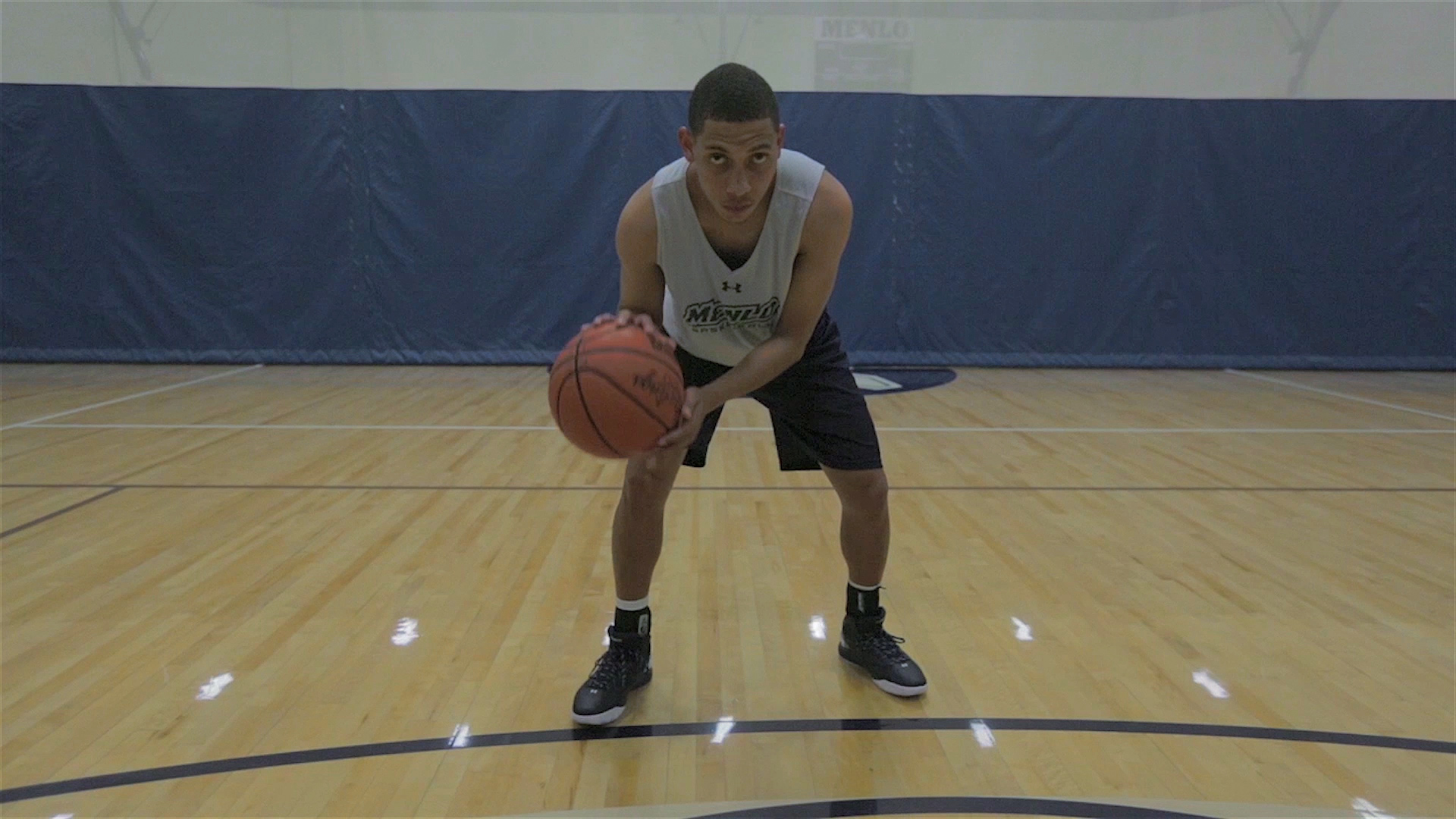
Stand with your feet about shoulder-width apart. Bend your knees slightly, keep your chest up, and lean forward just enough to feel ready to move. Your body should feel balanced, not stiff. Imagine you are about to guard someone, sprint, or dodge a flying sandwich. That is the stance.
A low athletic stance gives you better balance and makes it harder for defenders to knock you off your path. Beginners often stand too tall, which makes the ball bounce higher and easier to steal.
2. Use Your Fingertips, Not Your Palm
Good dribbling comes from the fingertips and finger pads, not the center of the palm. Your palm may touch the ball sometimes, but it should not slap the ball like you are angry at it for missing rent.
Spread your fingers comfortably and push the ball down with control. The fingertips help you feel the ball, guide its direction, and react faster. This is one of the biggest differences between a beginner dribble and a controlled basketball dribble.
3. Keep the Ball Low
For most beginner drills, the ball should bounce around knee height or lower. A low dribble is quicker, safer, and harder for defenders to steal. If the ball is bouncing near your chest, it has packed its bags and is ready to leave you.
Practice low pound dribbles with your right hand, then your left hand. Start slowly, then increase speed while staying in control.
4. Keep Your Eyes Up
This is the beginner skill that feels impossible at first. New players naturally stare at the ball because they want to make sure it is still there. Spoiler: it is still there. The goal is to build enough touch that your hand can control the ball while your eyes scan the court.
Look at the rim, a wall, a teammate, or an object across the driveway. The more you practice without looking down, the more game-ready your dribbling becomes.
5. Dribble Hard Enough
Soft dribbles are easy to lose. A firm dribble gets the ball back to your hand faster, improving control and reaction time. Do not smash the ball wildly, but do not tap it like you are afraid of hurting its feelings.
Think of each dribble as a quick push into the floor. Controlled power is the goal.
How to Dribble a Basketball Step by Step
Use this simple progression if you are learning from zero or teaching a new player.
Step 1: Practice Stationary Right-Hand Dribbles
Stand in an athletic stance. Dribble the ball with your right hand at knee height. Keep your left arm slightly out to protect the ball. Do this for 30 seconds.
Focus: fingertips, low bounce, eyes forward.
Step 2: Practice Stationary Left-Hand Dribbles
Now switch to your left hand. This may feel like brushing your teeth with your opposite hand while riding a tiny bicycle. That is normal. Your weak hand needs attention early, not later.
Focus: steady rhythm and equal effort on both hands.
Step 3: Add Pound Dribbles
Pound dribbles are strong, controlled bounces. Dribble hard and low with one hand for 20 to 30 seconds. Then switch hands.
Focus: power without losing control.
Step 4: Practice Crossovers
A crossover is when you dribble the ball from one hand to the other in front of your body. Start slowly. Keep the ball below your knees, push it across your body, and catch it with the opposite hand.
Focus: low transfer, quick hands, balanced feet.
Step 5: Walk While Dribbling
Once stationary dribbling feels comfortable, walk forward while dribbling with your right hand. Then return using your left hand. Keep your head up and move at a pace you can control.
Focus: rhythm while moving.
Step 6: Change Speed and Direction
Basketball is not played in straight lines forever. Add stops, starts, turns, and speed changes. Dribble slowly for three steps, then faster for three steps. Add a crossover and change direction.
Focus: control during movement, not just speed.
Best Basketball Dribbling Drills for Beginners
These beginner basketball dribbling drills can be done at home, in a driveway, at a park, or in a gym. Start with 10 to 15 minutes a day. Consistency beats marathon workouts once every three weeks.
1. Pound Drill
Dribble hard and low with your right hand for 30 seconds. Switch to your left hand for 30 seconds. Keep your knees bent and your eyes up.
Beginner tip: If the ball keeps escaping, slow down. Control comes before speed.
2. Low-Middle-High Dribble
Dribble low for 20 seconds, then at knee height for 20 seconds, then slightly higher for 20 seconds. Repeat with both hands.
This drill teaches touch and ball height control. In games, different situations require different dribble heights.
3. Stationary Crossover Drill
Dribble the ball from right hand to left hand in front of your body. Keep it low and quick. Do three rounds of 30 seconds.
Common mistake: Standing straight up. Stay low so your crossover is sharp instead of slow and dramatic.
4. Cone Zig-Zag Dribble
Set up cones, shoes, water bottles, or anything that will not complain if bumped. Dribble around each marker in a zig-zag pattern. Change hands when changing direction.
This drill helps beginners learn movement, angles, and control.
5. Figure-8 Ball Wrap
Stand with your feet apart and move the ball in a figure-8 pattern around your legs without dribbling. This builds hand speed, coordination, and comfort with the ball.
After you improve, try figure-8 dribbles by bouncing the ball through your legs in the same pattern.
6. Wall or Object Eyes-Up Drill
Choose a spot on a wall, fence, or backboard. Dribble while staring at that spot. For an extra challenge, have a friend hold up fingers and call out the number while you dribble.
This trains court vision, which is one of the most important beginner basketball skills.
7. Stop-and-Go Dribble
Dribble forward for five steps, stop in balance, then go again. Add a crossover after each stop. This helps you learn control, footwork, and body balance.
Basketball rewards players who can change speed. You do not always need to be the fastest player. Sometimes you just need to make the defender guess wrong.
Video Practice Guide for Beginners
Videos can help beginners because they show body position, hand placement, rhythm, and timing. When watching basketball dribbling videos, do not just admire the player. Study the details.
Video 1: Basic Dribbling Form
Suggested video topic: Beginner basketball dribbling fundamentals: athletic stance, fingertips, eyes up, and low dribble.
What to watch for: Notice how the player bends the knees, keeps the ball near the side of the body, and avoids slapping the ball with the palm.
Video 2: Stationary Dribbling Drills
Suggested video topic: Stationary ball-handling drills for beginners, including pound dribbles, crossovers, and low-middle-high dribbles.
What to watch for: Look for ball height, hand speed, and whether the player keeps the head up.
Video 3: Moving Dribbles and Change of Direction
Suggested video topic: Beginner moving dribble drills using cones, zig-zags, and stop-and-go movements.
What to watch for: Pay attention to footwork. The best dribblers move their body and the ball together.
Video 4: Common Dribbling Mistakes
Suggested video topic: Beginner basketball mistakes such as looking down, dribbling too high, carrying the ball, and using only the strong hand.
What to watch for: Pause the video and compare the mistake with the correction.
Common Beginner Dribbling Mistakes
Looking Down Too Much
Every beginner does this. The fix is not to force perfection immediately. Start by looking down for a few dribbles, then look up for a few. Over time, increase the amount of time your eyes stay forward.
Dribbling Too High
High dribbles give defenders more time to steal the ball. Practice low pound dribbles and crossovers below knee height.
Using Only the Dominant Hand
If you only dribble with your strong hand, defenders will quickly figure it out. Your weak hand does not need to become perfect overnight, but it must become useful.
Standing Too Tall
A tall stance makes you slower and less balanced. Bend your knees and stay ready to move.
Trying Advanced Moves Too Soon
Behind-the-back dribbles and between-the-legs combos are fun, but they are not the first step. Build control first. Flashy moves without fundamentals are just turnovers wearing sunglasses.
A Simple 20-Minute Beginner Dribbling Workout
Use this workout three to five times per week. Rest when needed and focus on quality.
- 2 minutes: Ball wraps around waist, legs, and head
- 3 minutes: Right-hand and left-hand stationary dribbles
- 3 minutes: Pound dribbles, both hands
- 3 minutes: Low-middle-high dribbles
- 3 minutes: Stationary crossovers
- 3 minutes: Walking dribbles forward and backward
- 3 minutes: Cone zig-zag or stop-and-go dribbles
If you lose the ball, do not panic. Losing the ball during practice is useful feedback. It tells you where control breaks down. The key is to reset, repeat, and keep your form sharp.
How Long Does It Take to Learn Basketball Dribbling?
Most beginners can learn a basic controlled dribble in a few practice sessions. Feeling confident while moving, changing hands, and keeping your eyes up may take several weeks of consistent practice.
The timeline depends on age, coordination, practice time, and comfort with the ball. A beginner who practices 15 minutes a day will usually improve faster than someone who practices one long session and then lets the basketball retire in the garage.
How to Practice Dribbling at Home
You do not need a full court. A driveway, garage, basement, patio, or quiet outdoor space can work. If noise is an issue, practice ball wraps, fingertip taps, and control drills without bouncing.
For at-home dribbling, use safe spacing. Move breakable objects away unless you want to explain why a crossover destroyed a lamp. Wear shoes with decent grip, keep your knees bent, and use a surface where the ball bounces evenly.
Beginner Experience: What Learning to Dribble Really Feels Like
When beginners first learn how to dribble a basketball, the experience is rarely smooth. The ball bounces off a foot. It rolls under a chair. It hits the edge of the driveway and escapes like it has somewhere more important to be. This is not failure. This is the normal first chapter of learning basketball.
One of the most common beginner experiences is frustration with the weak hand. A right-handed player may feel comfortable dribbling with the right hand but completely uncoordinated with the left. The left hand may feel slow, clumsy, and suspiciously disconnected from the brain. The best approach is patience. Spend extra time on the weak hand every practice. Even five focused minutes can make a difference over a few weeks.
Another real experience is the fear of looking up. Beginners often feel that if they stop watching the ball, the ball will instantly vanish. At first, it might. But after enough fingertip-control drills, the hand begins to recognize the rhythm. The player starts to feel the ball instead of chasing it with their eyes. This is a big breakthrough. Once your eyes come up, basketball becomes less about surviving the dribble and more about seeing the game.
Many beginners also learn that dribbling is physical. Staying low works the legs. Pound dribbles work the fingers, wrists, and forearms. Moving dribbles challenge balance and coordination. After 15 minutes, a new player may feel more tired than expected. That is normal. Ball handling is not just a hand skill; it is a full-body skill.
Progress usually arrives in small, satisfying moments. The first time you complete 30 seconds of left-hand dribbling without losing the ball feels like winning a tiny championship. The first clean crossover feels even better. The first time you dribble while looking at a teammate instead of the floor, you realize the game is opening up.
For younger players, turning drills into games helps a lot. Instead of saying, “Do 100 dribbles,” try challenges like, “Can you dribble for 20 seconds without looking down?” or “Can you zig-zag around five shoes without touching them?” Fun keeps beginners engaged, and engaged players practice more.
For adult beginners, the biggest challenge may be embarrassment. Nobody enjoys feeling awkward in front of others. But every good player has had beginner moments. The player with smooth handles today once chased the ball across the court too. Practice quietly, build confidence, and remember that improvement is earned bounce by bounce.
The best experience a beginner can have is realizing that dribbling is learnable. You do not need natural talent to become competent. You need repetition, attention to detail, and a willingness to make mistakes without quitting. The ball will get away from you sometimes. Laugh, grab it, and keep going. Basketball rewards players who keep showing up.
Final Tips for Better Basketball Dribbling
- Practice both hands every session.
- Keep your knees bent and your body balanced.
- Use your fingertips and finger pads for control.
- Keep the ball low when defenders are nearby.
- Look up as much as possible.
- Start slow, then increase speed.
- Use videos to study form, not just flashy moves.
Conclusion
Learning how to dribble a basketball for beginners is all about building simple habits: stay low, use your fingertips, keep your eyes up, practice both hands, and repeat the basics until they feel natural. You do not need to master every move right away. Start with stationary dribbles, pound dribbles, crossovers, and slow movement drills. Then add speed, direction changes, and game-like pressure.
Videos can speed up the learning process because they show rhythm, stance, and hand position in real time. But watching is only half the job. The real improvement happens when you grab a ball and practice consistently.
Dribbling may feel awkward in the beginning, but every bounce teaches your hands, eyes, feet, and brain to work together. Keep practicing, stay patient, and do not let a runaway basketball hurt your feelings. It is not personal. It is just training.
SEO Tags
Note: This article is for beginner basketball education and general skill development. Players should practice safely, use proper footwear, and follow guidance from a coach, parent, or instructor when available.

